
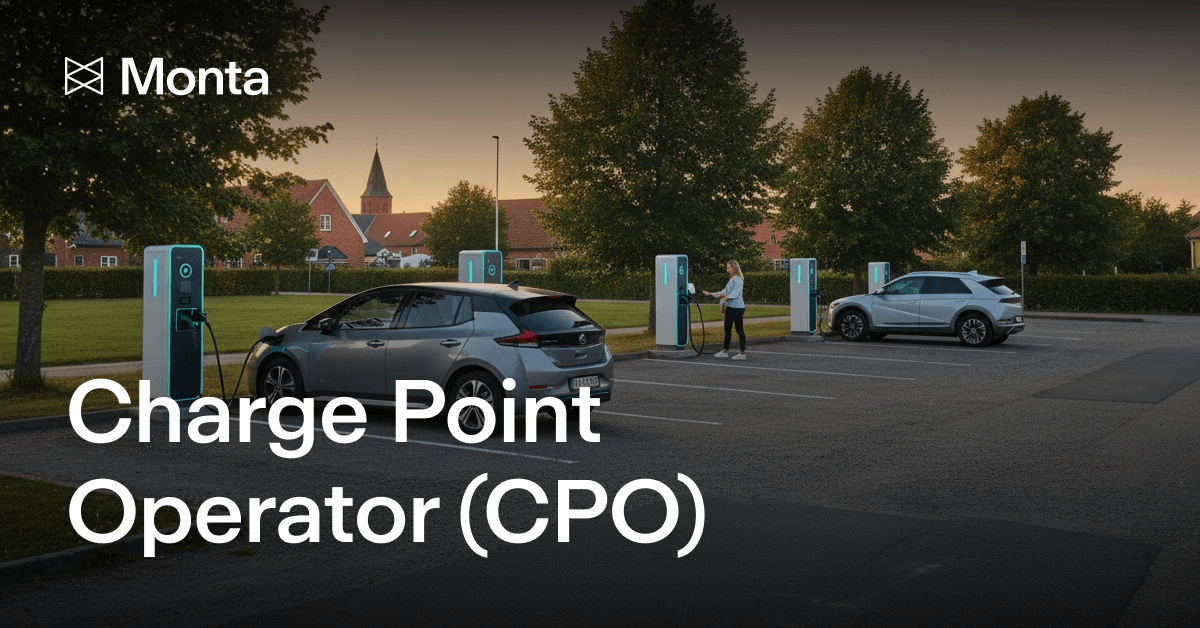
What Is a Charge Point Operator (CPO)?
A CPO is “the entity responsible for managing the operation of electric vehicle charging stations.” These operators oversee installation, maintenance, and monitoring to ensure chargers remain safe, available, and reliable. CPOs may not own the equipment but are responsible for daily performance, uptime, and operational efficiency.
CPOs function as the operational core of EV infrastructure, ensuring chargers communicate with backend systems through the Open Charge Point Protocol (OCPP). They cooperate with eMobility Service Providers (eMSPs), software vendors, and roaming platforms within the EV ecosystem.
What Is the Role of CPOs in the EV Charging Ecosystem?
CPOs manage electric vehicle charging stations across networks of varying sizes and brands. Their role involves monitoring charger performance, scheduling maintenance, and optimizing energy distribution. They coordinate with energy suppliers, grid operators, eMSPs, and software platforms.
Key responsibilities include:
- Maintaining uptime, safety, and accessibility through preventive maintenance
- Running firmware updates and tracking faults in real time
- Following technical compliance and safety standards
What Are the Key Functions and Responsibilities of a CPO?
CPOs’ responsibilities fall into five main areas:
1. Infrastructure Setup and Deployment
CPOs plan, install, and configure chargers to ensure reliable and scalable network foundations. Site selection requires evaluation of grid capacity, accessibility, and backend system compatibility.
2. Network Operation and Remote Management
CPOs manage networks through OCPP-based systems that connect all chargers to central management platforms. This enables full visibility into network status, charger availability, and performance while allowing remote fault detection, load balancing, and firmware updates.
3. Maintenance and Technical Performance
CPOs maintain performance through ongoing inspections, firmware updates, and hardware diagnostics. Routine maintenance prevents issues from disrupting service, while troubleshooting procedures guide technicians in resolving problems quickly.
4. Data Management and Reporting
CPOs collect operational data from charging sessions, including energy usage, charging duration, and revenue. This data identifies high-demand areas, supports financial reporting, and enables pricing adjustments. Charge point management software (CPMS) transforms raw data into actionable insights.
5. Interoperability and Standards Compliance
CPOs ensure network interoperability using open standards like OCPP and OCPI. These protocols allow chargers from multiple brands to communicate seamlessly with different software platforms and eMSPs, removing vendor lock-in and simplifying network management.
What Is Charge Point Operator Management Software?
Charge point operator management software is the digital backbone that enables operators to monitor, control, and manage EV chargers across entire networks. Built on OCPP, this software consolidates operational tasks into one system with a unified dashboard providing real-time charger visibility.
How CPOs Use a Charge Point Management System (CPMS)
CPOs use CPMS to control, monitor, and optimize charging networks. The system connects chargers, users, and backend systems through OCPP communication. Operators onboard new chargers, configure pricing, manage user access, and perform firmware updates remotely.
Cloud-based CPMS software provides flexibility and scalability, allowing full control without on-site intervention while supporting centralized analytics for better decision-making.
What Is the Difference Between CPOs and eMSPs?
CPOs and eMobility Service Providers (eMSPs) have distinct roles: CPOs manage and operate the physical charging infrastructure while eMSPs focus on the digital and user-facing side of EV charging.
CPOs handle installation, maintenance, and uptime through OCPP standards. eMSPs provide driver access via apps, RFID cards, authentication, pricing, and payments. They collaborate through OCPP and Open Charge Point Interface (OCPI) standards for data exchange, roaming, and billing.
What Is the Difference Between CPOs and Charge Point Owners?
Charge point owners invest in and provide physical assets — chargers and locations — while CPOs handle technical operation, maintenance, and connectivity. Owners may be municipalities, private companies, retailers, or developers, but ownership does not mean direct operational involvement.
CPOs ensure chargers run reliably through OCPP-based software, monitoring networks and performing diagnostics. Collaboration often occurs through leasing, revenue-sharing, or service contracts, with open standards enabling transparent data exchange.
Why Are CPOs Essential for EV Infrastructure?
CPOs are essential for several reasons:
- Building and Managing Networks: CPOs design, install, and maintain infrastructure enabling safe, efficient EV charging at scale.
- Infrastructure Development and Scalability: They assess site potential and plan expansion using standardized hardware and open protocols.
- Operational Reliability and User Trust: Proactive maintenance and real-time monitoring ensure uptime and service reliability.
- Smart Charging and Energy Integration: CPOs manage load balancing, dynamic pricing, and grid interaction to optimize energy use.
- Standardization and Open Access: Using OCPP and OCPI enables interoperability across networks and roaming capabilities.
- Support Through Digital Platforms: Solutions like Monta connect CPOs, eMSPs, and installers in unified environments.
What Is the Role of OCPP in CPO Operations?
The Open Charge Point Protocol (OCPP) standardizes communication between chargers and backend systems. OCPP defines how session status, pricing, and diagnostics data exchanges occur between hardware and software.
OCPP enables CPOs to monitor, control, and maintain chargers from multiple manufacturers within one platform. This flexible, standards-based approach eliminates vendor lock-in and allows seamless integration of new chargers as networks grow.
What Are the Challenges Charge Point Operators Face?
Key challenges include:
- Managing Diverse Charger Fleets: Operating multi-brand chargers requires OCPP compliance for interoperability.
- Ensuring Uptime and Service Quality: Maintaining consistent availability across sites affects user satisfaction.
- Handling Complex Operational Data: Processing large data volumes for billing, reporting, and analytics across platforms.
- Compliance and Protocol Evolution: OCPP and OCPI standards evolve regularly, requiring system updates.
What Is the Future of Charge Point Operations?
The future involves data, automation, and renewable energy integration. As EV adoption grows, CPOs will depend on analytics and interoperable systems for larger networks. Focus will shift toward smart, connected infrastructures communicating with grids and energy markets.
Interoperability through OCPP and OCPI will remain central, with platform-neutral solutions supporting scalability and flexibility. Vehicle-to-grid (V2G) and bidirectional charging technologies will enable energy flow between vehicles and grids, supporting renewable integration. Subscription-based and white-label models will expand service delivery options.
What Are the Key Features of CPO Management Software?
Key features include:
- Real-Time Monitoring and Diagnostics: Continuous charger status tracking with automatic fault alerts.
- Dynamic Pricing and Energy Optimization: Flexible tariff adjustment based on demand and smart load balancing.
- Remote Access and Firmware Management: Secure remote control for updates and authorization without site visits.
- Analytics and Reporting: Automated tracking of sessions, energy use, and uptime with actionable insights.
- Integration and Interoperability: OCPP and OCPI support for multi-brand management and roaming partnerships.
How Does Monta Support Charge Point Operators?
Monta supports CPOs through:
- OCPP-Based Connectivity: Connecting OCPP-compatible chargers for single-interface network management with real-time monitoring and remote firmware updates.
- Management Partnership: Functioning as a long-term partner providing scalable, transparent tools adapting to network growth.
- Operational Optimization Tools: Flexible tariff settings, access management, and usage analytics for data-driven decisions.
- Ecosystem Collaboration: Facilitating cooperation between CPOs, eMSPs, and installers through standardized integration.
Monta operates as an OCPP-compliant system serving the entire EV ecosystem with integrated software for drivers, companies, cities, and electricity grids.