
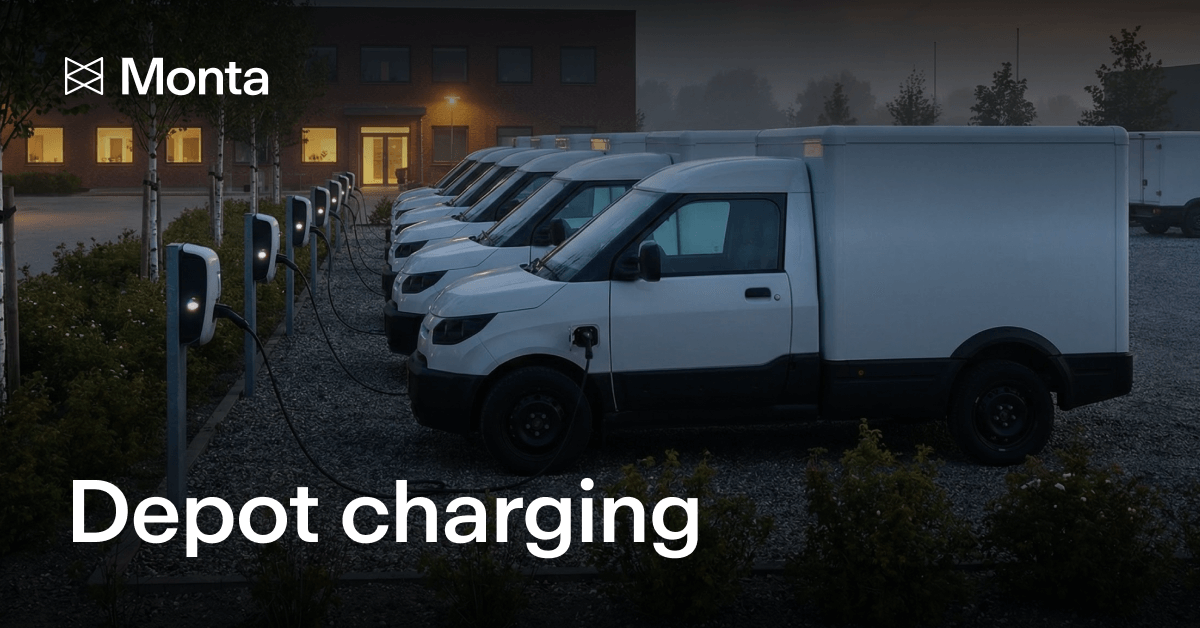
Depot charging is a centralized electric vehicle charging solution built for fleet-owned vehicles that return to a common operating facility as part of daily operations. Depot charging enables controlled, scheduled energy replenishment during non-operational hours, supporting predictable vehicle availability, lower energy costs, and simplified infrastructure management when integrated with EV charging solutions such as Monta EV charging platform. Fleet depot charging continues to play an expanding role in commercial electrification strategies as businesses transition buses, trucks, delivery vans, and service fleets to electric power, since centralized charging aligns infrastructure investment with operational planning, duty cycles, and long-term fleet growth.
What is depot charging?
Depot charging is the practice of charging electric vehicles at a fleet’s home base, depot, or primary operating facility during scheduled non-operational periods. Depot charging is commonly used for electric buses, trucks, and delivery vans, and for commercial fleets, because vehicles return to the same location regularly and can recharge during overnight or extended downtime, thereby supporting predictable daily operations.
How does depot charging work?
Depot charging works by routing electric vehicles back to a centralised depot where charging occurs during scheduled downtime, typically overnight or during extended non-operational periods. Vehicles connect to dedicated chargers upon arrival, and a power management system assigns charging priority, balances electrical load, and schedules charging sessions based on vehicle departure times, battery state, and available power capacity. Coordinated load management prevents demand spikes, optimises energy costs by shifting charging to off-peak periods, and ensures every vehicle reaches the required charge level before the next operational cycle.
How long does depot charging take?
Depot charging typically takes 6 to 12 hours, depending on charger type, vehicle battery capacity, and available electrical power. Level 2 AC chargers commonly used at depots provide cost-effective charging that fully replenishes medium-duty fleet batteries overnight, whereas higher-power DC chargers reduce charging time for larger batteries when higher throughput is required. Larger battery packs and limited site power increase total charging duration, while higher available amperage and optimised load management reduce overall charging time.
What are the types of depot charging systems?
The types of depot charging systems are listed below.
- AC depot charging: AC depot charging uses Level 2 chargers at a fleet depot to recharge vehicles during long downtime periods, such as overnight parking. The system supports predictable, low-cost charging for light-duty vehicles with full recharge times completed over several hours.
- DC fast charging for depots: DC fast charging for depots delivers high-power electricity directly to vehicle batteries, supporting faster turnaround for medium- and heavy-duty fleets. The system is suitable for operations with limited dwell time or multi-shift vehicle use that require rapid recharging.
- Mixed AC/DC depot charging setups: Mixed AC/DC depot charging combines lower-cost AC chargers with fewer high-power DC chargers at a single site. The approach balances capital cost and operational flexibility by matching charger type to vehicle duty cycle.
- Smart and managed depot charging: Smart and managed depot charging uses software to schedule charging, balance electrical load, and control peak demand across all chargers. The system ensures vehicles reach required charge levels while reducing energy costs and preventing electrical overloads.
1. AC depot charging
AC depot charging refers to the use of Level 2 alternating current chargers installed at a fleet’s depot for routine, scheduled charging during long vehicle downtime. AC depot charging works by delivering grid power to the vehicle’s onboard charger, which converts AC electricity to DC for battery storage. Equipment typically costs £800–£2,500 ($1,000–$3,200, €900–€2,900) per charger, with installation adding £1,500–£6,000 ($1,900–$7,600, €1,700–€7,000) depending on cabling distance, panel capacity, and site conditions. Charging speed generally ranges from 7 kW to 22 kW, which results in full charging times of approximately six to twelve hours for light-duty fleet vehicles.
2. DC fast charging for depots
DC fast charging for depots uses direct current chargers that bypass the vehicle’s onboard converter and supply power straight to the battery. DC depot charging works by delivering high-power electricity that supports faster turnaround for vehicles with limited dwell time or multi-shift operations. Hardware costs typically range from £10,000–£35,000 ($12,500–$45,000, €11,700–€41,000) per charger, while installation and electrical upgrades can add £10,000–£50,000+ ($12,500–$63,000, €11,700–€58,500) depending on grid capacity. Charging speed commonly ranges from 50 kW to 150 kW, allowing many medium- and heavy-duty vehicles to recharge within two to four hours.
3. Mixed AC/DC depot charging setups
Mixed AC/DC depot charging setups combine lower-cost AC chargers with a smaller number of DC fast chargers at the same facility to balance cost and operational flexibility. Mixed systems work by assigning AC chargers to vehicles parked for long periods and reserving DC chargers for vehicles requiring rapid turnaround. Total cost varies by fleet size and charger mix, though AC units typically cost £800–£2,500 ($1,000–$3,200, €900–€2,900) and DC units £10,000–£35,000 ($12,500–$45,000, €11,700–€41,000), excluding site work. Charging speed spans from 7 kW on AC chargers up to 150 kW on DC chargers, depending on vehicle assignment.
4. Smart and managed depot charging
Smart and managed depot charging refers to charging infrastructure controlled by software that schedules charging sessions, balances electrical load, and limits peak demand. Smart depot charging works by monitoring vehicle state of charge, departure times, and site power availability, then dynamically adjusting charging rates to meet operational requirements. Software and management platforms typically cost £50–£300 ($65–$380, €60–€350) per charger per year. Charging speed depends on the underlying AC or DC hardware, but managed control ensures every vehicle reaches its required charge level while minimising energy costs and avoiding electrical overloads.
What power levels are typical for depot charging?
The power levels typical for depot charging are listed below.
- AC Level 2 depot charging (7–22 kW): AC Level 2 power levels represent the most common depot charging option for light-duty fleets with long dwell times. Charging at 7–22 kW supports overnight replenishment for vans, cars, and service vehicles that return to a depot daily and remain parked for several hours.
- Low-power DC depot charging (25–50 kW): Low-power DC charging supports medium-duty fleets that require faster charging than AC but still operate within scheduled downtime. Power levels in the 25–50 kW range balance faster energy delivery with manageable grid impact and controlled infrastructure cost.
- Medium-power DC depot charging (60–100 kW): Medium-power DC charging serves vehicles with larger batteries or tighter turnaround windows. Power levels between 60–100 kW fit depot environments where vehicles complete charging within a few hours between shifts or route rotations.
- High-power DC depot charging (120–150+ kW): High-power DC charging supports heavy-duty vehicles such as buses and trucks with large battery packs and demanding duty cycles. Power levels above 120 kW require robust electrical infrastructure and coordinated load management to maintain grid stability.
Typical depot charging power levels by charging type, vehicle type, and use case are illustrated in the table below.
| Charging type | Typical power level | Common vehicle types | Typical use case |
|---|---|---|---|
| AC Level 2 | 7–11 kW | Passenger cars, delivery vans | Overnight charging during long depot dwell time |
| AC Level 2 (high) | 22 kW | Light commercial vehicles | Faster overnight charging where grid capacity allows |
| Low-power DC | 25–50 kW | Medium-duty trucks, service vehicles | Scheduled charging between shifts |
| Medium-power DC | 60–100 kW | Delivery trucks, buses | Faster depot turnaround with limited downtime |
| High-power DC | 120–150+ kW | Heavy-duty buses, trucks | Rapid charging aligned with intensive duty cycles |
Does depot charging require grid upgrades?
Yes. Depot charging can require grid upgrades when the combined electrical demand of fleet chargers exceeds existing service capacity at the facility. Grid upgrades often involve transformer upgrades, panel expansions, or new utility service connections to support simultaneous charging without overloading infrastructure. The need for upgrades depends on fleet size, charger power levels, charging concurrency, and existing electrical capacity, which is why load studies and phased deployment plans help control costs and align charging demand with available power.
How does depot charging differ by vehicle type?
Depot charging differs by vehicle type because battery size, daily mileage, dwell time, and power requirements vary across fleet categories. Light-duty vehicles typically use AC Level 2 charging during overnight downtime, which aligns with smaller batteries and predictable daily routes, while medium-duty vehicles often require higher-power AC or low-kW DC chargers to recharge larger batteries within limited off-service windows. Heavy-duty vehicles such as buses and trucks require high-capacity electrical infrastructure and DC charging to support large battery packs and intensive duty cycles, which makes infrastructure planning critical to ensure charging aligns with route schedules, return times, and operational uptime.
1. Depot charging for electric bus fleets
Depot charging for electric bus fleets refers to a centralised charging infrastructure designed to recharge transit buses during scheduled off-service hours. Transit agencies design bus depots around overnight charging windows, installing high-capacity chargers that align with fixed route schedules and predictable return times while supporting EV charging for electric buses across growing public transit networks. Depot layouts prioritise pull-through lanes, dedicated parking stalls, and robust electrical backbones to support simultaneous charging of multiple buses. Route planning directly influences charger selection, since longer routes and higher daily mileage require higher-power chargers to ensure buses reach full charge before morning dispatch.
2. Depot charging for electric trucks
Depot charging for electric trucks is designed to support heavy-duty vehicles with large battery packs and variable duty cycles. Fleet operators design truck depots to accommodate extended dwell times, trailer access, and higher electrical loads, which support EV charging for electric trucks across demanding commercial operations. DC chargers are often selected to match overnight or shift-based charging schedules. Power planning emphasises transformer capacity, load management systems, and phased infrastructure expansion to handle peak demand. Route planning determines whether lower-power overnight charging is sufficient or whether faster charging is required to support multiple shifts or long-haul operations.
3. Depot charging for delivery vans and commercial fleets
Depot charging for delivery vans and commercial fleets supports high vehicle counts with predictable daily usage patterns. Fleet depots are designed for overnight charging using AC Level 2 or low-power DC chargers that balance cost and charging time across many vehicles while supporting commercial EV charging at scale. Depot layouts emphasise dense charger placement, efficient parking flow, and centralised power management to maximize utilization. Route planning influences charger selection by matching battery size and daily mileage to charging duration, ensuring vans complete full routes without requiring mid-day charging interruptions.
Can depot charging support large fleets?
Yes. Depot charging supports large fleets by scaling through intelligent load management, staggered charging schedules, and phased infrastructure buildouts that align electrical capacity with fleet growth, often coordinated through EV fleet charging management software. Fleet operators plan for future expansion by conducting load studies, installing upgrade-ready electrical backbones, and deploying chargers in stages, which allows additional vehicles to be added without disrupting operations or requiring immediate full-capacity grid upgrades.
How much does depot charging cost?
Depot charging cost depends on three primary components (charging equipment, installation and electrical upgrades, and ongoing operating expenses). Hardware pricing varies by charger type, with AC Level 2 depot chargers typically costing £800–£2,500 ($1,000–$3,200, €900–€2,900) per unit, while low-power DC chargers range from £10,000–£35,000 ($12,500–$45,000, €11,700–€41,000). Installation costs depend on site conditions, trenching, cabling, and panel capacity, with typical installation costs ranging from £1,500 to £6,000 ($1,900–$7,600, €1,700–€7,000) per charger before major utility work.
Electrical upgrades often represent the highest variable cost in depot charging projects. Small depots with available capacity likely avoid major upgrades, while larger fleets often require transformer upgrades, new service connections, or switchgear expansion. Electrical upgrade costs range from £5,000–£50,000 ($6,300–$63,000, €5,800–€58,500) depending on fleet size, charger power, and existing infrastructure. Larger depots reduce per-vehicle cost by spreading fixed electrical upgrades across more chargers. Ongoing operating and maintenance costs remain relatively low compared with public charging. Annual maintenance typically ranges from £100–£400 ($125–$500, €115–€460) per charger, covering inspections, software monitoring, and minor repairs, while platforms such as an EV charging payment system support transaction handling, reporting, and cost tracking across charging sessions.
Electricity cost remains the primary ongoing expense. Depot charging benefits from off-peak energy pricing, with typical fleet electricity rates ranging from £0.12 to £0.25 per kWh ($0.15–$0.32, €0.14–€0.29). Demand charges apply in some utility territories when simultaneous charging increases peak load, which makes power management systems critical for cost control.
Depot charging delivers a lower per-mile energy cost than public charging by avoiding network markups and premium convenience pricing. Public charging often ranges from £0.55–£0.85 per kWh ($0.70–$1.10, €0.64–€1.01), while depot charging remains significantly lower due to controlled pricing and off-peak scheduling. Fleet operators achieve the strongest cost advantage when depot charging supports most daily energy needs, and public charging serves only as a supplemental option.
Is depot charging cheaper than public EV charging?
Yes. Depot charging is cheaper than public EV charging because fleet operators control electricity procurement, charge vehicles during off-peak utility hours, and avoid public network markups and demand-based pricing. Centralised depot infrastructure delivers lower per-kilowatt-hour costs and more predictable energy expenses than public charging stations, which typically include access fees, peak pricing, and higher rates for convenience and fast-charging availability.
What are the benefits of depot charging?
The benefits of depot charging are listed below.
- Lower charging costs: Depot charging reduces energy expenses by enabling charging during off-peak utility periods and by avoiding premium pricing associated with public fast-charging networks. Controlled energy procurement helps fleet operators achieve predictable operating costs.
- Operational control and predictability: Depot charging provides full control over charging schedules, power allocation, and vehicle readiness. Centralised management ensures each vehicle starts the day with sufficient range for planned routes.
- Improved fleet uptime: Depot charging aligns charging activity with non-operational hours, which prevents vehicles from being taken out of service for mid-route charging. Consistent overnight charging increases vehicle availability during working hours.
- Infrastructure reliability: Privately managed depot infrastructure eliminates dependence on public charger availability and performance. Reliable access reduces delays caused by congestion, outages, or incompatible charging equipment.
- Scalability for fleet growth: Depot charging infrastructure supports long-term fleet expansion through phased capacity upgrades. Planned electrical design allows additional vehicles to be integrated without operational disruption.
- Simplified maintenance and monitoring: Centralised chargers enable easier maintenance, performance monitoring, and energy management. Consolidated oversight supports faster issue resolution and consistent charger performance across the fleet.
- Optimised fleet efficiency: Depot charging improves fleet efficiency by synchronising energy replenishment with vehicle downtime. Predictable charging cycles increase route completion reliability and overall operational productivity.
How does depot charging differ from destination charging?
Depot charging differs from destination charging by serving distinct operational use cases based on location, charging intent, power delivery, and vehicle dwell time. Depot charging takes place at a fleet’s centralised base or dedicated hub and functions as a planned backbone strategy that fully recharges vehicles during long non-operational periods, which makes depot charging most appropriate for fleet vehicles that return to the same location daily and require predictable readiness for scheduled routes.
Destination charging occurs at locations a vehicle visits during normal activity (for example, warehouses, hotels, retail centres, or job sites) and functions as an opportunistic strategy that adds range while the vehicle is already parked, which makes destination charging most appropriate for extending range during multi-stop journeys or rest periods without disrupting operations.