
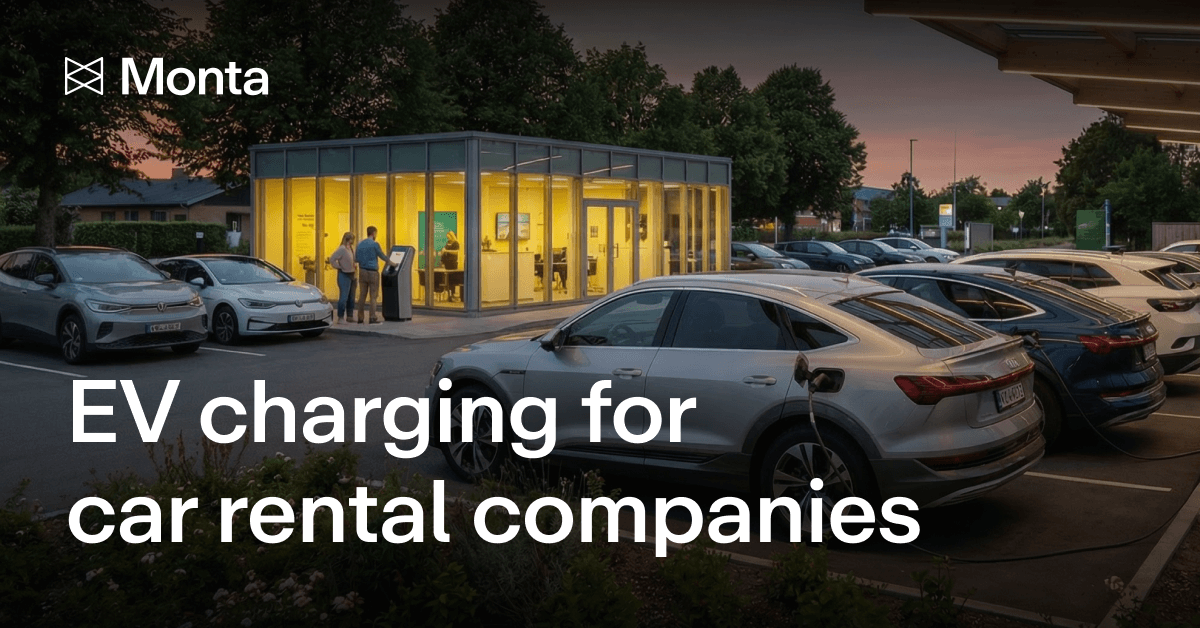
EV charging car rental refers to the structured use of depot and branch-based charging systems that keep electric vehicles ready between bookings while controlling energy cost and vehicle availability. Car rental companies view EV charging as an operational system that supports fleet rotation, overnight readiness, and predictable turnaround. Rental clients experience EV charging when renting a car as a slower, background activity that fits naturally into parking, hotel stays, shopping trips, or airport dwell time, rather than a rapid refuelling stop. Slower alternating-current charging during everyday activities reduces battery stress and lowers energy costs. It aligns with typical rental usage patterns, which explains why most fleets rely on AC charging rather than constant fast charging supported by CPMS’, like Monta for EV charging. Popular EV brands offered by rental fleets support the model through onboard AC charging rates around 11 kW across vehicles from Tesla, Hyundai, and Volkswagen, while retaining DC fast-charging capability between 130 kW and 250 kW for limited high-turnover needs. Car hire EV charging balances company-led operational control with a client experience that treats charging as a passive part of travel rather than an interruption.
What is EV charging for car rentals?
EV charging for car rentals refers to the controlled charging of electric vehicles owned by car rental companies through dedicated depot and branch infrastructure to keep vehicles operational between customer bookings. Car rental operators use EV charging as an internal fleet energy system that supports vehicle readiness, cost control, and predictable availability rather than as a customer-facing convenience service.
Car rental companies offer electric vehicles across multiple rental categories to match customer demand and trip profiles. Fleet offerings cover small and compact EVs for city travel, family-sized saloons and hatchbacks for general use, electric SUVs and 4×4-style vehicles for higher range and luggage capacity, electric minivans for group transport, and limited premium or convertible EV models in select markets where availability and charging infrastructure support higher utilisation.
EV charging serves several operational purposes within car rental fleet management. Charging infrastructure enables automated vehicle allocation by restoring battery levels without constant staff involvement. Depot-based charging supports overnight replenishment to prepare vehicles for morning demand. Selective fast charging supports rapid turnaround at airports and high-utilisation branches. Charging systems support transparent fee structures by allowing rental companies to apply standardised charges when vehicles return below defined battery thresholds.
Car rental EV charging relies on several core components working together as an operational system. Vehicle battery capacity determines charging time and energy demand. Charging hardware delivers power at levels matched to depot dwell time and fleet size. Grid connection and site electrical capacity define how many vehicles can charge simultaneously. Load management controls charging to stay within peak-hour limits. Off-peak energy sourcing reduces electricity cost exposure. Cost control mechanisms align charging schedules, tariffs, and utilisation to protect fleet profitability.
How does EV charging for car rentals work?
EV charging for car rentals works as a controlled depot-based energy process that restores vehicle battery levels between customer bookings through scheduled charging, load management, and fleet software coordination. Car rental operators route returned electric vehicles into designated charging bays where AC charge points replenish batteries during idle periods aligned with cleaning, inspection, and staging workflows. Fleet management systems prioritise charging orders based on next reservation time, required battery state, and available electrical capacity without requiring continuous staff intervention. Load management software limits simultaneous power draw to remain within the site grid capacity and peak-demand thresholds while maximising overnight energy use at lower electricity rates. Selective DC fast charging supports rapid turnaround at airports and high-utilisation branches where dwell time remains limited. The operational model positions EV charging as a core fleet logistics function that ensures vehicle availability, cost control, and predictable customer handover rather than a transactional refuelling activity.
How does EV charging in car rental operations differ from traditional fuelling?
EV charging in car rental operations differs from traditional fuelling through the method of energy delivery, turnaround timing, infrastructure dependence, workflow integration, and customer handover structure. EV charging delivers electricity through fixed on-site infrastructure that requires time-based replenishment, while refuelling relies on rapid liquid fuel transfer completed within minutes. Car rental operations integrate EV charging into depot workflows that coordinate cleaning, inspection, staging, and energy replenishment, whereas refuelling remains a discrete, external task disconnected from internal fleet processes. Infrastructure dependency increases under EV charging because electrical capacity, load management, and software coordination directly affect fleet availability. Customer handover models shift towards battery state thresholds and managed returns rather than full-tank expectations tied to refuelling.
The primary differences between EV charging for rental fleets and petrol or diesel refuelling are listed below.
- Energy delivery method: EV charging supplies electrical energy through fixed charge points connected to site power systems, while refuelling transfers liquid fuel through pumps supplied by fuel distributors serving the car rental fleet.
- Turnaround time structure: EV charging requires scheduled dwell time aligned with depot operations, while refuelling completes rapidly and independently of vehicle staging.
- Infrastructure dependency: EV charging depends on electrical capacity, grid coordination, and on-site equipment, while refuelling depends on nearby fuel stations and external logistics.
- Fleet workflow integration: EV charging embeds directly into depot workflows that manage vehicle rotation, while refuelling functions as a separate step outside core rental operations.
- Customer handover model: EV charging relies on defined battery return thresholds, while refuelling enforces full-tank return policies tied to fuel replacement charges.
The differences shift car rental companies from fuel consumers towards active energy managers. Operational teams assume responsibility for charging schedules, electrical capacity planning, and software-driven vehicle readiness rather than relying on external refuelling services. EV charging for car rental fleets positions charging infrastructure as a core operational system that influences availability, cost control, and daily fleet performance.
EV charging infrastructure for car rental companies consists of physical, electrical, and digital systems that support reliable charging across depots and branch locations. Infrastructure design prioritises fleet throughput, operational predictability, and scalability rather than public access or retail visibility. Systems operate as controlled assets embedded within rental operations rather than standalone charging sites.
The core components of EV charging infrastructure for car rental companies are listed below.
- Physical charging assets: Physical charging assets include fleet-dedicated AC charge points and selective DC fast charge points positioned within depot parking and staging zones.
- Electrical supply and site infrastructure: Electrical supply infrastructure includes transformers, switchgear, panels, and protection equipment sized for simultaneous fleet charging demand.
- Load management and control systems: Load management systems allocate power across charge points to prevent capacity breaches and control energy cost exposure.
- Fleet software integration: Fleet software integration links charge points with reservation systems, telematics, and utilisation platforms to prioritise vehicle readiness.
- Operational workflow alignment: Operational workflow alignment coordinates charging with cleaning, inspection, and vehicle rotation processes to maintain consistent availability.
The infrastructure model distinguishes EV charging for car rental fleets from public charging by embedding energy delivery directly into fleet logistics rather than treating charging as a customer-facing convenience.
What does EV charging infrastructure look like for car rental companies?
EV charging infrastructure for car rental companies consists of a coordinated combination of physical equipment, electrical systems, and digital controls that enable reliable charging of rental fleets across depots and branch locations. Car rental operators deploy charging hardware within controlled parking and staging areas, connect charge points to site electrical supply sized for simultaneous fleet demand, and manage energy delivery through software platforms that align charging with vehicle turnover and reservation schedules. Infrastructure design supports predictable vehicle availability, cost control, and grid compliance by integrating load management, peak-hour limits, and off-peak energy use into daily fleet operations. The infrastructure model treats EV charging as an internal operational system embedded within fleet logistics rather than a public-facing convenience service.
The core layers of EV charging infrastructure in car rental operations are listed below.
- Depot and branch charging layout: Depot and branch charging layout defines charge point placement based on parking density, vehicle flow, and turnaround sequencing. Car rental operators design layouts to support batch charging, staged vehicle release, and efficient staff movement rather than walk-up access.
- Electrical supply and load management: Electrical supply and load management coordinates transformer capacity, panel sizing, and charge point power allocation across the depot. Rental operations rely on managed charging systems to sequence vehicles, cap peak demand, and protect site electrical limits.
- Fleet software integration: Fleet software integration connects charge points with reservation systems, vehicle telematics, and utilisation tracking tools. Rental operators use integrated platforms to prioritise charging based on return time, next booking window, and required state of charge.
- Operational processes for vehicle rotation: Operational processes for vehicle rotation align charging with cleaning, inspection, and staging workflows. Depot teams schedule charging as part of standard turnaround procedures rather than treating charging as a separate activity.
Rental-focused charging infrastructure prioritises operational reliability, predictable availability, and cost control rather than open access and convenience. Car rental charging systems operate within controlled depots using scheduled charging, restricted access, and software-driven prioritisation, while public charging infrastructure serves ad hoc users through first-come access and transactional pricing. Rental charging design centres on fleet throughput and asset utilisation, whereas public charging design centres on customer dwell time and location visibility.
What is an EV charging station in a car rental company?
An EV charging station in a car rental company functions as a dedicated on-site system used to recharge rental fleet vehicles between customer rentals. Car rental operators deploy charging stations within controlled depots or branches to support predictable vehicle turnaround, fleet availability, and operational cost control. Charging stations operate as internal fleet infrastructure rather than public amenities, with design priorities focused on reliability, charging throughput, and integration with rental operations.
The fundamental elements that define an EV charging station for rental fleets are listed below.
- Fleet-dedicated charge points: Fleet-dedicated charge points serve rental vehicles only and operate under restricted access conditions. Charge point selection prioritises durability, standardised connectors, and compatibility with fleet charging schedules.
- Assigned parking and staging zones: Assigned parking and staging zones align vehicle parking with charging order and release timing. Depot layouts support batch charging and orderly vehicle rotation.
- Power delivery interfaces: Power delivery interfaces manage the electrical connection between charge points and the site infrastructure. Electrical design supports sustained multi-vehicle charging without exceeding site capacity limits.
- Fleet monitoring and access control: Fleet monitoring and access control systems restrict charge point use to authorised vehicles and staff. Monitoring platforms track charging status, energy use, and fault conditions.
- Integration with rental management systems: Integration with rental management systems links charging activity to reservations, vehicle availability, and fleet utilisation data. Software coordination supports prioritised charging based on booking demand.
How are EV charging depots designed for rental fleets?
EV charging systems for car rental fleets are designed through coordinated planning that aligns depot layout, fleet size, vehicle turnover rates, grid capacity limits, and daily operational workflows. Car rental operators approach charging design as an operational system rather than a standalone infrastructure project. It ensures that charging capacity, vehicle flow, and electrical limits support consistent fleet availability between rentals through depot charging. Design decisions account for simultaneous charging demand, overnight dwell time, and future fleet growth to maintain reliability and cost control across depot operations.
The key design considerations for EV charging in rental operations are listed below.
- Fleet size and vehicle mix: Fleet size and vehicle mix determine total charging demand based on battery capacity, daily mileage, and return patterns across different vehicle categories.
- Depot layout and vehicle flow: Depot layout and vehicle flow influence charge point placement, parking configuration, and staging efficiency for cleaning, inspection, and release.
- Turnover rates and dwell time: Turnover rates and dwell time define required charging power and scheduling logic to restore vehicles within available idle windows.
- Electrical capacity and grid constraints: Electrical capacity and grid constraints set limits on total simultaneous charging load and inform transformer sizing, panel design, and load management needs.
- Load management and charging control: Load management and charging control systems sequence vehicle charging to avoid peak demand breaches and manage energy cost exposure.
- Scalability and future expansion: Scalability and future expansion planning preserve flexibility for additional vehicles, higher battery capacities, and layout changes without major retrofits.
Design progresses through a staged process that begins with fleet assessment and demand modelling to quantify energy needs, charging windows, and peak load exposure. Engineering teams then translate demand assumptions into depot layouts, electrical designs, and managed charging configurations that align with operational workflows. Deployment follows with phased installation, system testing, and staff process integration to ensure charging supports daily rental operations from the first day of service.
What are the types of EV charging for car rentals?
-
Overnight depot AC charging
Overnight depot AC charging uses alternating current charge points rated between 7 kW and 22 kW to recharge rental vehicles during extended idle periods at depots. The overnight depot AC charging type represents the most common foundation for car rental electrification because predictable return times support overnight replenishment. Capital cost per charge point ranges from £1,500 to £5,000 ($1,900 to $6,300, €1,750 to €5,900), with installation and electrical works adding £2,000 to £10,000 ($2,500 to $12,500, €2,300 to €11,700) depending on depot capacity.
-
Managed fleet charging systems
Managed fleet charging uses software-controlled load balancing to sequence charging across multiple vehicles and limit peak demand. The managed fleet charging systems approach has become common in medium to large rental depots with more than ten electric vehicles. Software licensing and integration costs range from £5 to £15 per vehicle per month ($6 to $19, €6 to €18), while enabling hardware and controls add £500 to £1,500 per charge point ($630 to $1,900, €590 to €1,750).
-
DC fast charging for high-turnover locations
DC fast charging delivers direct current at power levels between 50 kW and 150 kW to support rapid vehicle turnaround at airports and high-demand urban branches. The DC fast charging for high-turnover locations type remains less common and appears primarily at flagship or constrained locations. Equipment costs range from £30,000 to £80,000 ($38,000 to $101,000, €35,000 to €94,000) per charge point, with grid upgrades and installation adding £20,000 to £100,000 ($25,000 to $126,000, €23,500 to €117,000).
-
Public-access supplementary charging
Public-access supplementary charging relies on third-party public charge points used during vehicle repositioning or customer rentals. The public-access supplementary charging type functions as a support mechanism rather than core infrastructure and remains widely available in urban markets. Usage costs range from £0.40 to £0.80 per kWh ($0.50 to $1.00, €0.46 to €0.94), with no upfront infrastructure investment required by the rental operator.
How much does EV charging for car rentals cost?
EV charging for car rentals typically costs £20,000 to £45,000 ($25,000 to $57,000, €23,000 to €53,000) per AC charging point once charging hardware, make-ready works, panels, switchgear, cabling, commissioning, and basic load management are included. EV charging for car rentals costs more than light-duty workplace charging because rental depots require higher electrical capacity, coordinated grid connections, and infrastructure designed for simultaneous vehicle charging. Car rental operators usually budget small depot projects with 10 to 15 vehicles commonly reaching £250,000 to £600,000 ($315,000 to $760,000, €290,000 to €705,000) in total capital cost, depending on existing electrical capacity and site layout.
Depot-scale electrical upgrades represent the largest cost variable in car rental electrification. Transformer upgrades, new service connections, and switchgear expansion add £50,000 to £300,000 ($63,000 to $380,000, €59,000 to €350,000) for medium and large depots as fleet size and charging density increase. Strategic deployment of DC fast charging at airports and high-turnover branches further raises capital requirements, with fully installed DC fast charge points generally costing £150,000 to £350,000 ($190,000 to $445,000, €176,000 to €410,000) per unit once grid upgrades and civil works are included.
Car rental operators manage long-term costs by prioritising flexible electrical design, distributed charge point placement, and scalable load management rather than dense fixed layouts. Cost-effective charging strategies rely on widespread AC charging for overnight replenishment, combined with selective DC fast charging where rapid vehicle turnaround directly improves fleet utilisation and revenue performance.
What charging power do car rental companies’ fleets need?
Car rental company fleets need a mix of AC charging power between 7 kW and 22 kW per vehicle, with limited use of DC fast charging above 50 kW reserved for high-turnover locations.
Compact and economy EVs require 7 kW to 11 kW AC charging to restore daily driving range during overnight depot dwell periods. Vehicles in such a category carry battery capacities between 40 kWh and 55 kWh, which return to operational charge levels within six to eight hours under managed charging schedules (for example, urban hatchbacks and small crossovers).
Mid-size rental EVs require 11 kW to 22 kW AC charging to support higher utilisation and shorter overnight windows. Vehicles in such a segment commonly use battery capacities between 60 kWh and 75 kWh, which recharge within five to seven hours when charge points operate at higher three-phase power (for example, standard saloons and mid-size SUVs).
Premium and long-range EVs require consistent access to 11 kW to 22 kW AC charging due to larger battery packs and customer expectations around range. Battery capacities between 75 kWh and 100 kWh demand higher sustained charging power to meet next-day availability targets without extending depot dwell time (for example, executive saloons and luxury SUVs).
Electric vans and multi-passenger vehicles require 11 kW to 22 kW AC charging due to high energy consumption and heavier vehicle weight. Battery capacities in such a category range from 70 kWh to 100 kWh, which necessitate longer charging windows supported by load-managed depot infrastructure (for example, people carriers and cargo vans).
High-turnover airport and urban locations require selective deployment of DC fast charging between 50 kW and 150 kW. Fast charging supports rapid turnaround for vehicles returning shortly before the next reservation window rather than serving as the primary fleet charging method.
Fleet electrification strategies therefore prioritise aggregated AC charging capacity matched to vehicle category, battery size, and dwell time, with fast charging deployed only where operational constraints justify higher power delivery.
How powerful does a car rental charging station need to be for a car rental depot?
A car rental charging station at a car rental depot needs to deliver AC charging power in the range of 7 kW to 11 kW per vehicle as the standard requirement. The power range supports full or near-full battery replenishment during overnight dwell periods while balancing infrastructure cost, electrical capacity, and fleet scale. Depot operations with higher daily utilisation or shorter turnaround windows require higher-capacity AC charge points up to 22 kW, deployed selectively rather than universally. DC fast charging capacity above 50 kW is not required for baseline depot operations and serves only targeted operational needs at high-turnover locations. Fleet charging design centres on aggregated AC capacity matched to vehicle count, dwell time, and load-managed scheduling rather than maximising per-charge point power.
Is DC fast charging necessary for car rentals?
No. DC fast charging is not necessary for most car rental operations, although DC fast charging provides value in specific high-turnover scenarios. Car rental fleets primarily rely on overnight depot charging using AC infrastructure, as predictable return times and idle periods allow for full battery replenishment without time pressure. Depot-based charging supports cost control, grid stability, and consistent vehicle readiness without the expense and electrical complexity associated with high-power equipment.
DC fast charging becomes relevant at airports, premium locations, and peak-demand branches where rapid vehicle turnaround directly affects revenue and availability. Fast charging supports short dwell times when vehicles return with a low state of charge shortly before the next reservation window. Fleet electrification strategies treat direct current fast charging as a targeted operational tool rather than a baseline requirement for car rental electrification.
What are the benefits of EV charging for car rental companies?
The benefits of EV charging for car rental companies are listed below.
- Lower operating energy costs: Lower operating energy costs result from electricity prices that remain more stable than petrol or diesel pricing. Fleet cost structures improve through scheduled charging and negotiated utility tariffs.
- Predictable cost control: Predictable cost control emerges from fixed electricity rates and standardised recharge fee policies. Financial planning improves through reduced exposure to fuel price volatility.
- Improved fleet availability management: Improved fleet availability management comes from planned charging aligned with reservation patterns and vehicle return cycles. Operations teams maintain higher vehicle readiness through controlled energy replenishment.
- Reduced vehicle maintenance burden: Reduced vehicle maintenance burden stems from electric drivetrains with fewer mechanical components. Service downtime decreases due to lower requirements for oil changes, exhaust systems, and transmission repairs.
- Regulatory and sustainability alignment: Regulatory and sustainability alignment supports compliance with emissions regulations and corporate environmental targets. Brand positioning strengthens among corporate travel managers and environmentally focused travellers.
- Operational data and visibility: Operational data and visibility increase through charging platforms that track energy consumption, charging status, and fleet utilisation. Management teams make decisions using consistent performance metrics.
Car rental operations benefit from overnight depot charging by restoring vehicle battery levels during low-demand periods when vehicles remain idle. Overnight AC charging supports consistent morning availability while reducing reliance on daytime fast charging. Load-managed depot charging lowers electricity costs and limits peak demand exposure at rental facilities. Centralised overnight charging simplifies staff workflows by aligning charging with cleaning, inspection, and vehicle staging processes.
Which companies manufacture EV chargers for car rental companies?
Companies that manufacture EV chargers for car rental companies are listed below.
- ABB: ABB manufactures AC and DC charging systems designed for depot, airport, and fleet environments where reliability, protection, and long asset lifecycles support high vehicle turnover, with solutions supplied by ABB.
- Siemens: Siemens delivers EV charging hardware integrated with power distribution, switchgear, and automation systems used at large rental depots and transport hubs, with equipment produced by Siemens.
- Schneider Electric: Schneider Electric provides EV charging solutions connected to energy management, monitoring, and load control platforms suitable for rental fleets with centralised charging operations, with systems developed by Schneider Electric.
- Eaton: Eaton supplies EV charging infrastructure and electrical components focused on grid protection, safety compliance, and depot-scale load management for fleet operators, with products manufactured by Eaton.
- ChargePoint: ChargePoint offers networked AC and DC chargers used by car rental companies for fleet depots and public-facing locations that require utilisation reporting and operational visibility, with platforms delivered by ChargePoint.
- EVBox: EVBox produces modular AC and DC charging systems designed for scalable fleet deployment and compatibility with managed charging software, with equipment supplied by EVBox.
- Tritium: Tritium specialises in DC fast chargers selected for airport and high-turnover rental locations where uptime, power density, and thermal performance support rapid vehicle turnaround, with technology developed by Tritium.
- Wallbox: Wallbox manufactures smart AC and DC charging solutions used in fleet depots that require compact hardware and software-enabled charging control, with products produced by Wallbox.
- Delta Electronics: Delta Electronics supplies EV charging systems integrated with power electronics and energy management solutions suited for large fleets and commercial charging sites, with equipment manufactured by Delta Electronics.
Car rental operations benefit from overnight depot charging through consistent vehicle readiness at the start of each rental day. Depot-based AC charging supports full or near-full battery replenishment during low-demand hours when vehicles remain idle. Load-managed overnight charging reduces peak electricity costs and prevents grid capacity stress at rental facilities. Centralised charging operations simplify staff workflows by consolidating vehicle turnaround, inspection, cleaning, and charging within a single operational window.
How do travellers benefit from EV car rental policy?
Travellers benefit from EV car rental policy through lower fuel costs, simpler return requirements, and predictable charging expectations. EV return policies reduce time pressure by allowing battery-level thresholds rather than full recharging, which supports efficient trip planning near airports and urban centres. EV rental policies provide cost transparency by replacing volatile fuel pricing with fixed or disclosed recharge fees. EV access policies support quieter driving, reduced emissions exposure, and access to charging infrastructure aligned with modern transport networks.
How do customers find rental locations with EVs?
Customers find rental locations with EVs through rental company booking platforms, travel aggregators, and location-specific inventory filters that display electric vehicle availability at selected branches. Major car rental operators publish EV availability directly on proprietary websites and mobile apps through vehicle class filters, location search tools, and fleet availability indicators tied to airport and urban branches. Online travel agencies and car hire comparison platforms list EV options by drivetrain or fuel type, allowing renters to identify locations that stock electric vehicles before confirming reservations. Airport signage, loyalty programme communications, and corporate travel portals further direct business travellers and frequent renters to branches that support electric vehicle rentals and nearby options to find an EV charge point during the rental period.
What is the common EV car rental return policy?
The common EV car rental return policy requires the electric vehicle to be returned with a minimum battery charge level, between 70% and 80%, rather than a full charge. Major car rental operators apply such a policy to align with practical charging availability and to avoid penalising renters for charging time constraints. Rental agreements state that a recharge fee applies when the vehicle returns below the specified threshold, with fees calculated as a flat recharge cost or a per-percentage shortfall charge based on local policy. The return structure mirrors fuel policies used for internal combustion vehicles while accounting for charging time, charge point access, and battery management considerations specific to electric vehicles.
What is the best EV car model to rent for efficient EV charging?
Tesla Model 3 Long Range RWD is the best EV car model to rent for efficient EV charging because it combines strong real-world efficiency with widespread fast-charging network access and substantial driving range. The Model 3 Long Range achieves high miles per kilowatt-hour efficiency similar to the top efficient EVs evaluated by industry testing and comparisons, making charging intervals less frequent and energy use more economical. It offers a long driving range per charge and compatibility with an extensive fast-charging infrastructure that reduces downtime during rental rotations compared with many other electric models.
Will car rental fleets become fully electric?
Yes. Car rental fleets will become predominantly electric over time, although full electrification will occur gradually rather than uniformly across all markets and vehicle classes. Car rental operators face increasing regulatory pressure, manufacturer electrification roadmaps, and fuel cost volatility that steadily favour electric vehicles for short-duration, high-utilisation use cases. Fleet electrification will progress fastest in urban centres and airport locations with supportive grid capacity, incentive structures, and predictable driving patterns, while remote regions and speciality vehicle segments transition later.
Future trends in EV charging will shape the pace and structure of the transition. Charging infrastructure will shift towards depot-centric models with high-capacity AC charging supported by load management software to balance overnight charging with grid constraints. Fast charging will expand selectively at airports and high-turnover branches where vehicle availability drives revenue performance. Utilities and site hosts increase investment in make-ready infrastructure, managed charging programmes, and capacity upgrades to support fleet-scale demand. Charging systems integrate deeper operational intelligence through software platforms that coordinate vehicle dispatch, charging priority, and energy costs, positioning EV charging as a core operational system rather than a peripheral facility asset.
Why haven’t more car rental companies fully adopted EV charging yet?
More car rental companies haven’t fully adopted EV charging yet for the reasons listed below.
- High upfront capital investment: High upfront capital investment covers charging hardware, electrical upgrades, civil works, and depot retrofitting required to support fleet-scale charging. Capital intensity increases financial risk for car rental operators with thin margins and high asset turnover.
- Limited grid capacity at key locations: Limited grid capacity constrains charge point deployment at airports and dense urban branches where electrical infrastructure lacks spare capacity. Grid limitations delay electrification timelines and restrict the achievable fleet size.
- Fleet utilisation uncertainty and peak-time conflicts: Fleet utilisation uncertainty complicates charging planning during peak rental periods with rapid vehicle turnover. Peak-time charging conflicts increase the risk of unavailable vehicles during high-demand windows.
- Operational complexity and turnaround constraints: Operational complexity arises from managing charging schedules alongside cleaning, inspection, and repositioning workflows. Turnaround constraints reduce flexibility compared with refuelling internal combustion vehicles.
- Staff training and workflow redesign: Staff training requirements increase operational overhead through new procedures, safety protocols, and charging management responsibilities. Workflow redesign introduces transitional inefficiencies during early deployment phases.
- Regulatory, permitting, and landlord constraints: Regulatory approval processes, permitting timelines, and landlord restrictions limit charge point installation at leased facilities. Control limitations reduce deployment speed and site-level optimisation.
The barriers shift fleet electrification decisions from purely environmental or fuel-cost considerations towards risk management and operational resilience. Car rental executives prioritise reliability, vehicle availability, and cost predictability when evaluating electric vehicle adoption, which favours phased pilots and selective deployment over rapid fleet-wide conversion. Structural constraints reinforce cautious investment strategies until infrastructure certainty, grid readiness, and operational maturity align with core rental business requirements supported by managed charging.