
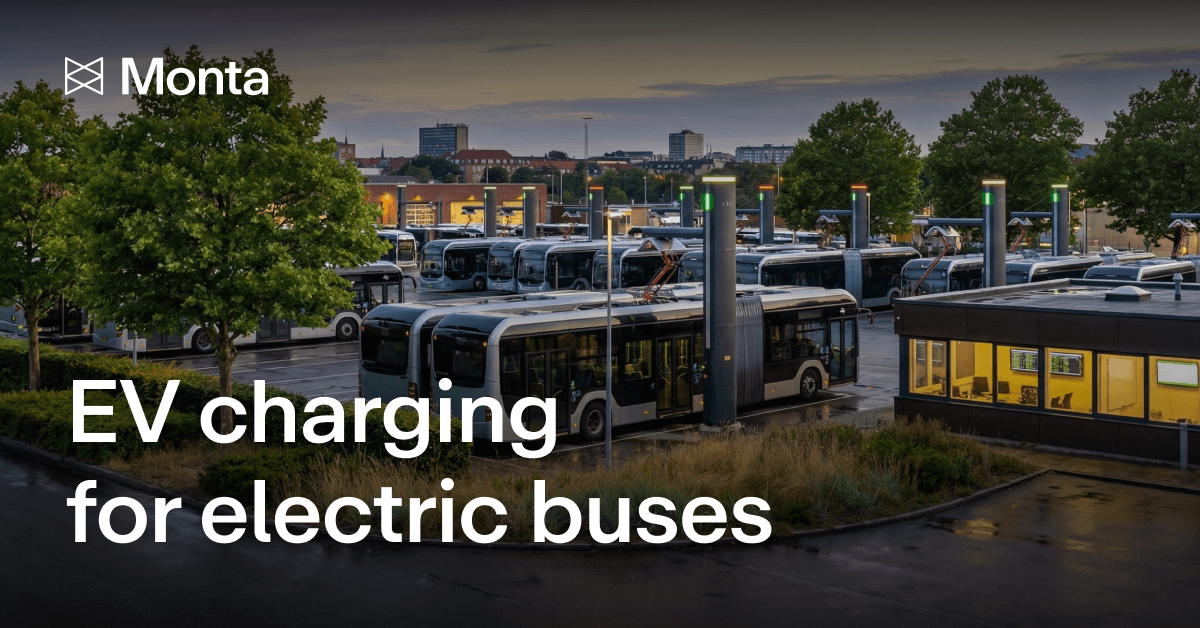
EV charging for electric buses refers to specialised charging infrastructure designed for transit agencies and fleet operators managing large, battery-electric buses under fixed routes and high daily mileage. Charging infrastructure supports zero-emission public transportation by delivering high-capacity power through an electric bus charging system that sustains frequent charging cycles and intensive energy demand. Depot-focused layouts enable electric bus depot charging to occur during scheduled off-service windows, which stabilises fleet availability and simplifies operational planning across transit networks. Software coordination and energy management provided through platforms such as Monta EV charging allow each electric bus charging station to operate reliably at scale while controlling energy costs and maintaining system uptime.
What is EV charging for electric buses?
EV charging for electric buses refers to high-capacity charging solutions engineered specifically for battery-electric transit buses with large battery systems and intensive daily duty cycles. Charging systems deliver substantially higher power than passenger vehicle chargers to support frequent use, rapid energy transfer, and consistent fleet availability under demanding transit schedules. Chargers support repeated daily charging events and sustained electrical loads to meet high-energy demand without compromising safety, reliability, or operational continuity.
How does EV charging for electric buses work?
EV charging for electric buses works through a coordinated process where buses return to a depot or designated on-route charging location, connect to high-capacity charging equipment, and replenish battery energy based on scheduled operating windows and route demands. Transit fleet management systems or depot operators initiate charging sessions automatically or manually, while power management systems regulate electrical load to prevent grid overload and control energy costs. Depot charging typically occurs overnight using AC or DC chargers sized for full battery replenishment, while daytime or on-route charging relies on high-power DC or pantograph systems to restore energy during short dwell periods. Charging control software monitors state of charge, charger availability, and departure schedules to ensure every bus reaches the required operating range before returning to service.
How long does it take to charge an electric bus?
Charging an electric bus takes between four and twelve hours using depot-based AC or lower-power DC chargers and between thirty minutes and three hours using high-power DC or pantograph systems, depending on battery capacity, charger output, and charging window. Transit agencies calculate charging duration by matching daily energy consumption to available dwell time, since larger battery packs and higher daily mileage require either longer overnight charging or higher-power daytime charging to meet route schedules.
Can electric buses charge overnight at depots?
Yes. Electric buses charge overnight at depots through depot charging, which uses fixed parking positions and dedicated chargers to deliver sustained power during non-operational hours and prepare buses for scheduled routes. Transit agencies rely on overnight depot charging to align energy delivery with service timetables, reduce daytime charging interruptions, and support consistent fleet availability across daily operating cycles.
What are the types of EV charging for electric buses?
Types of EV charging for electric buses are listed below.
- Level 2 charging for electric buses: Level 2 charging for electric buses delivers AC power at depots to recharge buses during long off-service periods, supporting predictable overnight charging aligned with fixed route schedules.
- DC fast charging for electric buses: DC fast charging for electric buses delivers high-power direct current, reducing charging time at depots and enabling higher daily mileage and multi-shift fleet operations.
- Pantograph opportunity charging for electric buses: Pantograph opportunity charging for electric buses delivers ultra-high-power charging via overhead connectors during short, scheduled route stops, maintaining continuous service without extended depot downtime.
1. Level 2 charging for electric buses
Level 2 charging for electric buses uses AC power delivered through onboard chargers to support long depot dwell periods. Transit agencies deploy Level 2 charging widely for overnight depot operations where route schedules allow slower recharge cycles. Capital cost for level 2 charging for electric buses typically ranges from £5,000–£20,000 ($6,300–$25,000, €5,800–€23,500) per charger, with total installed cost commonly reaching £12,000–£25,000 ($15,000–$31,500, €14,000–€29,500) per bus position, depending on depot electrical capacity.
2. DC fast charging for electric buses
DC fast charging for electric buses supplies direct current power to achieve rapid recharging for higher daily mileage or multi-shift operations. Transit fleets adopt DC fast charging frequently at depots that require shorter turnaround times between routes. Total project cost for DC fast charging for electric buses typically ranges from £50,000–£160,000 ($65,000–$200,000, €59,000–€188,000) per charger, driven by high-power equipment, switchgear, and grid connection requirements.
3. Pantograph opportunity charging for electric buses
Pantograph opportunity charging for electric buses uses overhead conductive systems to deliver very high power during short, scheduled route stops. High-frequency urban transit systems deploy pantograph opportunity charging selectively where overnight depot charging cannot meet energy demand. Installed cost for pantograph opportunity charging for electric buses commonly ranges from £95,000–£275,000+ ($120,000–$350,000, €112,000–€323,000) per charging site, reflecting specialised structures, civil works, and reinforced utility connections.
What charging power do electric buses require?
Electric buses require charging power that is significantly higher than passenger electric vehicles, typically ranging from 50 kW to 450 kW, depending on operating model and route demands. Depot-based overnight charging commonly uses 50–150 kW DC or 22–50 kW AC to replenish large battery packs during long off-service windows, while high-frequency routes and limited dwell times require 150–300 kW DC fast charging to maintain daily service levels. Opportunity and on-route charging systems, using pantograph technology, operate at 300–450 kW to deliver rapid energy top-ups during short terminal stops. Transit planners must size charging power based on total fleet size, daily energy consumption per bus, route length, and available dwell time to ensure reliable operations without overbuilding electrical infrastructure.
How powerful does a bus charging station need to be for transit fleets?
A bus charging station for transit fleets typically needs power levels ranging from 50 kW to 450 kW, depending on route length, dwell time, and operating schedule. Depot-based overnight charging commonly uses 50–150 kW DC or 22–50 kW AC to fully recharge buses during extended off-service hours, while high-frequency routes and limited layover windows require 150–300 kW DC fast charging to restore energy quickly between runs.
Is DC fast or opportunity charging necessary for electric buses?
Yes. DC fast or opportunity charging is often necessary for electric buses when route length, vehicle utilisation, or scheduling constraints prevent full overnight charging from meeting daily energy needs. High-frequency routes, long daily mileage, and multi-shift operations benefit from fast or on-route charging to maintain service without adding vehicles or extending dwell time. Chargers installed at terminals or layover points function similarly to destination charging in such cases, allowing buses to add energy during scheduled stops and remain in continuous operation rather than relying solely on depot charging.
How much does EV charging for electric buses cost?
EV charging for electric buses typically costs £40,000–£80,000 per bus ($50,000–$100,000, €47,000–€94,000) for depot charging infrastructure, though costs can vary significantly based on charging technology, fleet size, and site conditions. Infrastructure costs include chargers, electrical upgrades, and installation. The charging equipment itself ranges from £8,000–£24,000 ($10,000–$30,000, €9,400–€28,000) for standard plug-in depot chargers to £64,000–£120,000 ($80,000–$150,000, €75,000–€141,000) for high-power units for the starting point. Electrical infrastructure upgrades such as transformers, switchgear, and distribution panels, trenching and conduit work, civil site preparation, grid connection fees, and installation labour must be accounted for. The additional costs double or triple the equipment price, bringing total installed costs for a single depot charger to £40,000–£120,000 ($50,000–$150,000, €47,000–€141,000). Utility infrastructure requirements add £80,000–£800,000 ($100,000–$1,000,000, €94,000–€940,000) for transformers and substations for larger fleets.
Businesses must budget for higher upfront costs compared to light-duty EV charging. Electric buses require significantly more power and robust infrastructure than passenger vehicles. Bus charging infrastructure demands industrial-grade electrical systems and substantial power capacity while a light-duty EV charger likely costs a few thousand pounds installed. Businesses likely need to invest in an EV charging payment system if they plan to offer charging services to third parties or manage complex billing across multiple operators or routes. Transit agencies and businesses offset these substantial upfront investments through government grants and incentives specifically designed to support electric bus adoption.
How much does electric bus charging infrastructure cost?
Electric bus charging infrastructure costs vary significantly depending on the charging technology and installation requirements. Plug-in chargers for overnight charging (50–150 kW) typically cost £8,000–£24,000 per charger ($10,000–$30,000, €9,400–€28,000) for depot charging, which is the most common approach, while high-power depot chargers for faster charging (up to 350 kW) run £64,000–£120,000 per unit ($80,000–$150,000, €75,000–€141,000). However, the charger equipment itself represents only part of the total investment in electric bus charging infrastructure.
Installation costs include electrical infrastructure upgrades such as transformers, switchgear, and distribution panels, along with trenching and conduit work, civil site preparation, grid connection fees, utility upgrades, and installation labour. The additional costs easily double or triple the equipment price, meaning a depot charging installation might run £40,000–£120,000 per charger when fully installed ($50,000–$150,000, €47,000–€141,000). Utility infrastructure requirements are substantial for larger fleet operations, potentially requiring new or upgraded electrical service to the facility and transformers or substations costing £80,000–£800,000 ($100,000–$1,000,000, €94,000–€940,000) depending on capacity needs, plus ongoing demand charges and utility connection fees.
Electric bus charging infrastructure costs roughly £40,000–£80,000 per bus ($50,000–$100,000, €47,000–€94,000) for depot charging, though such costs vary widely based on existing electrical capacity and site conditions. Many transit agencies can offset these costs through government grants that cover significant portions of infrastructure expenses.
Can existing charging stations be upgraded for electric buses?
Yes. Existing charging stations can be upgraded to support electric buses, but upgrades usually require more than minor adjustments. A standard charging station for electric vehicle use often lacks the power capacity, connector type, and electrical protection needed for bus-scale charging, so upgrades typically involve higher-power chargers, reinforced cabling, transformer or switchgear enhancements, and revised load management. A depot or public site can be converted into an electric bus charging station when the electrical infrastructure is expanded to handle larger battery sizes, longer duty cycles, and simultaneous charging of multiple buses, which makes a technical assessment and utility coordination essential before reuse.
What are the benefits of EV charging for electric buses?
The benefits of EV charging for electric buses are listed below.
- Lower operating costs: Electric bus charging reduces fuel and maintenance expenses by replacing diesel use with electricity and eliminating engine-related servicing, lowering total operating costs per mile.
- Improved fleet reliability: Depot-based charging provides consistent overnight replenishment, improving vehicle availability and reducing unexpected service disruptions from fuelling or mechanical issues.
- Reduced emissions and air pollution: Electric bus charging supports zero tailpipe emissions, improving local air quality and helping transit agencies meet climate and clean air targets.
- Quieter urban operations: Electric buses operate at significantly lower noise levels, improving passenger comfort and reducing noise pollution along urban routes.
- Predictable energy planning: Charging schedules can be aligned with fixed routes and off-peak electricity pricing, allowing transit agencies to control energy costs and plan budgets more accurately.
- Simplified infrastructure management: Centralised depot charging consolidates fuelling infrastructure at a single location, streamlining operations and reducing the complexity of managing distributed fuel assets.
- Support for fixed-route scheduling: Electric bus charging integrates well with fixed-route transit models because vehicles return to base on predictable schedules that align with planned charging windows.
- Eligibility for public funding and incentives: Electric bus charging projects often qualify for grants, subsidies, and public funding programmes that reduce upfront infrastructure and vehicle acquisition costs.
- Improved driver and passenger experience: Smoother acceleration, reduced vibration, and quieter operation improve driving conditions for operators and ride quality for passengers.
- Long-term fleet modernisation: Investing in electric bus charging infrastructure supports long-term fleet renewal strategies and positions transit agencies for future electrification expansion.
What transit agencies and fleets benefit most from electric bus charging solutions?
Transit agencies and fleets that benefit most from electric bus charging solutions are listed below.
- Urban public transit authorities: Urban transit agencies operating fixed-route city buses benefit most because predictable schedules, centralised depots, and high daily utilisation align well with overnight and opportunity charging models.
- Municipal bus fleets: City- and county-operated bus fleets gain strong value from electric bus charging solutions due to controlled routes, public funding support, and clear emissions-reduction mandates tied to electric public transportation goals.
- Regional and suburban transit agencies: Regional transit providers benefit where buses return to depots daily and operate medium-length routes, allowing depot charging to replace diesel fuelling without disrupting service reliability.
- Bus rapid transit (BRT) operators: BRT fleets benefit significantly because high-frequency routes and dedicated corridors pair well with high-power opportunity charging at terminals or select stops.
- School bus fleets: School transportation fleets benefit from long overnight dwell times, predictable morning and afternoon routes, and centralised parking, which make depot-based charging highly efficient.
- Airport shuttle and transit operators: Airport transit fleets benefit due to fixed loops, controlled access, and the ability to install high-power chargers that support continuous operation without recharging delays.
- University and campus transit systems: Campus transit agencies benefit from shorter routes, frequent stops, and centralised depots, which reduce charging complexity and support rapid electrification.
- Private and contracted transit operators: Private operators running contracted public transit services benefit from electric bus charging when contracts emphasise emissions reduction, long-term operating cost control, and predictable fleet utilisation.
- Paratransit and demand-response fleets: Specialised transit services benefit when vehicles operate within defined service areas and return to base daily, enabling charging schedules that maintain availability without diesel dependence.
- Intermodal and transit hub operators: Agencies managing multimodal hubs benefit by integrating electric bus charging with broader charging infrastructure strategies that support buses, service vehicles, and future fleet expansion.
Which companies manufacture electric bus chargers?
Companies that manufacture electric bus chargers are listed below.
- ABB: ABB manufactures high-power depot and opportunity chargers designed for electric bus fleets, including pantograph and plug-in systems used by transit agencies worldwide. The company is widely recognised among electric bus charger manufacturers for scalable infrastructure that supports heavy-duty public transport operations.
- Siemens: Siemens produces electric bus charging systems focused on depot charging, opportunity charging, and grid-integrated transit infrastructure. Transit authorities rely on Siemens solutions for reliability, energy management, and alignment with large-scale electric public transportation programmes.
- Heliox: Heliox specialises exclusively in fast-charging solutions for electric buses and commercial fleets, with strong adoption across European and North American transit markets. The company focuses on modular DC charging systems optimised for depot environments and is a well-known name among electric bus charger manufacturers.
- Alstom: Alstom develops electric bus charging infrastructure, particularly opportunity charging systems integrated with urban transit networks. The company leverages rail and transit expertise to deliver charging solutions aligned with large-scale electric public transportation deployments.
- Ekoenergetyka: Ekoenergetyka manufactures high-power DC chargers for electric buses, trucks, and heavy-duty fleets. Transit operators use Ekoenergetyka systems for depot and on-route charging that supports intensive daily bus schedules.
- Kempower: Kempower provides distributed DC fast-charging systems used by electric bus fleets and commercial vehicles. The manufacturer focuses on flexible power sharing, which helps transit agencies scale charging capacity efficiently across depots.
- Tritium: Tritium designs compact DC fast chargers suitable for public transit, fleet depots, and corridor-based charging. The company is frequently referenced alongside electric car charging station manufacturers due to its focus on high-reliability, heavy-use charging hardware.
- ChargePoint: ChargePoint manufactures commercial charging hardware and software platforms used for electric buses, fleet vehicles, and mixed-use applications. Transit agencies and fleet operators deploy ChargePoint systems for depot charging supported by networked management tools.
- BTC Power: BTC Power develops DC fast chargers for electric buses and commercial fleets, with deployments across transit agencies and municipal operators. The manufacturer emphasises robust hardware designed for high-duty-cycle environments common in public transportation.
- Schneider Electric: Schneider Electric provides integrated electric bus charging solutions combined with energy management, switchgear, and grid infrastructure. The company’s charging systems support depot-based operations and are often deployed as part of broader electrification projects involving electric car charging station manufacturers.
How does electric public transportation benefit from depot charging?
Electric public transportation benefits from depot charging by enabling buses and transit vehicles to recharge at a centralised operating base during scheduled off-service hours, which supports predictable daily availability and reliable route execution. Depot charging allows transit agencies to align charging windows with fixed schedules, reduce energy costs through off-peak electricity use, and simplify maintenance and infrastructure management at a single location. Centralised charging improves fleet uptime, supports consistent service delivery, and reduces exposure to fuel price volatility, which strengthens long-term operating budgets for electric public transportation while lowering emissions and mechanical wear across the fleet.
How does EV charging for electric buses compare to diesel bus fuelling?
EV charging for electric buses differs from diesel bus fuelling by replacing rapid, on-demand refuelling with planned, electricity-based charging that aligns with depot schedules, route planning, and energy management. Diesel buses refuel in minutes at centralised fuel pumps and rely on continuous fuel availability, while electric buses charge over longer periods using AC or DC infrastructure during overnight downtime or scheduled layovers. Electric bus charging shifts operational focus towards energy planning, grid coordination, and charger availability, whereas diesel fuelling emphasises fuel logistics and price volatility. Electric bus charging delivers lower and more predictable energy costs, reduced mechanical wear, and zero tailpipe emissions over time, while diesel fuelling offers faster turnaround but higher fuel costs, greater maintenance complexity, and ongoing emissions exposure.