
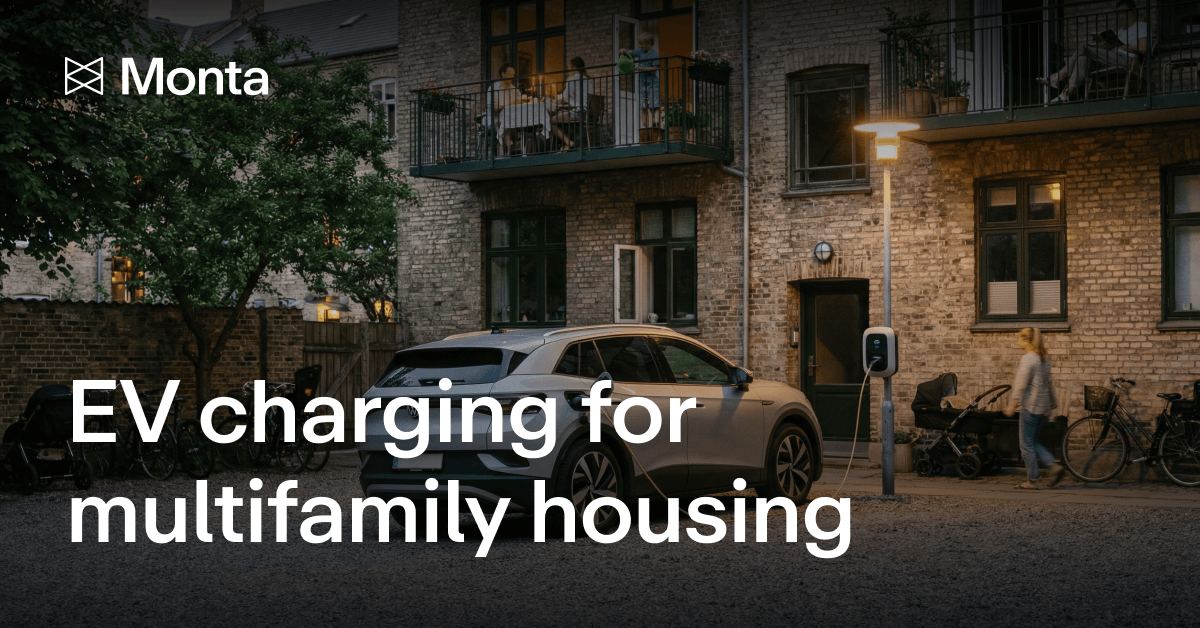
EV charging for multifamily housing functions as a residential-scale infrastructure solution designed for buildings with multiple dwelling units, including apartments, condominiums, mixed-use developments, and housing communities with shared parking facilities. EV charging for multifamily properties supports overnight and long-duration vehicle charging within common garages and surface lots while operating within shared electrical systems and governance frameworks. Property owners and housing associations view charging infrastructure as a long-term capital investment that protects asset relevance, supports regulatory compliance, and enables phased electrification, while residents depend on reliable access to home-based charging for daily mobility. Technology platforms such as the Monta EV charging management platform provide centralised tools for access control, billing allocation, monitoring, and load management, which allow stakeholders to coordinate usage, maintain system reliability, and scale deployment efficiently as electric vehicle adoption increases.
What is EV charging for multifamily housing?
EV charging for multifamily housing refers to the installation, management, and operation of electric vehicle charging infrastructure within multi-unit residential buildings such as apartment complexes, condominiums, housing cooperatives, and mixed-use residential communities. Property owners and housing associations integrate charging systems into shared garages and surface parking areas to support resident-focused, long-duration charging, typically overnight, while operating within common electrical panels, feeders, and transformer capacity.
Multifamily EV charging relies on structured deployment models that differ from single-family and public charging environments. Common approaches include dedicated or assigned charge points for individual households, shared charging stations in communal parking areas, load-managed, networked systems that distribute power across multiple users, and EV-ready building infrastructure that enables phased, scalable expansion. The solutions are engineered to support multiple households, ensure equitable access, provide transparent billing allocation, and accommodate building-level electrical constraints, rather than relying on high vehicle turnover or rapid refuelling.
How does EV charging for multifamily residential buildings work?
EV charging for multifamily residential buildings operates through a shared, managed residential charging model in which charging equipment is installed in common garages and parking areas and coordinated to serve multiple households over long dwell periods, overnight. Property operators connect charge points to shared panels and transformers and regulate power delivery through load management platforms that distribute available capacity across active charging sessions. Access systems assign user accounts, authenticate residents, and allocate energy costs through centralised billing tools. The operating model prioritises equitable access, extended dwell time, and building-level load management rather than rapid turnaround or short-term vehicle turnover.
Charging schedules align with residential routines, allowing vehicles to recharge gradually during evening and overnight hours while overall building demand remains stable. Management teams monitor system performance, respond to faults, and plan capacity expansion based on adoption trends and measured electrical loads.
EV charging in multifamily housing occurs passively while vehicles remain parked at home for many hours, whereas petrol fuelling involves a brief, attended transaction at a dedicated service station. Residents connect vehicles at the end of each day’s travel and retrieve them fully charged, without continuous supervision or staff involvement.
Multifamily EV charging integrates directly into residential operations and building management processes. Effective operation requires coordination among residents, property managers, electricians, and utility providers to balance electrical capacity, manage billing, and maintain equipment. The structure contrasts with traditional fuelling models that rely on centralised retail stations and on-site personnel rather than shared residential infrastructure.
What does EV charging infrastructure look like for multifamily housing?
EV charging design for rental and owner-occupied multifamily housing differs due to variations in ownership structure, decision-making authority, cost responsibility, and resident tenure. Rental properties operate under centralised ownership, which allows property operators to design and deploy multifamily EV charging infrastructure with standardised layouts, unified billing systems, and consistent access policies. Management teams prioritise flexibility, operational simplicity, and rapid deployment to support changing tenant populations and evolving market demand.
Owner-occupied multifamily housing is governed by homeowner associations or condominium boards, where collective approval governs infrastructure decisions. Charging design reflects individual ownership rights, shared governance processes, and long-term residency expectations. Boards focus on durable infrastructure, transparent cost-sharing frameworks, and long-term electrical capacity planning to support permanent residents and preserve property values.
The key design differences between rental and owner-occupied multifamily EV charging are listed below.
- Decision authority: Rental properties rely on property owners or management companies for approval, while owner-occupied properties require HOA or condominium association authorisation.
- Charging access models: Rental housing commonly uses shared charging systems, while owner-occupied developments often use assigned or individually funded charge points.
- Cost allocation structures: Rental operators often absorb initial costs or recover expenses through rent or usage fees, while owner-occupied communities distribute costs among unit owners or participating residents.
- Billing and metering methods: Rental properties typically use centralised billing platforms, while owner-occupied housing relies more heavily on individual metering and direct utility allocation.
- Scalability planning approaches: Rental developments prioritise adaptability for future tenants, while owner-occupied properties emphasise long-term capacity planning for permanent residents.
- Regulatory and governance compliance: Owner-occupied communities must align charging deployment with bylaws, CC&Rs, and right-to-charge regulations, while rental properties must comply with landlord-tenant and building code requirements.
What is an EV charging station in a multi-unit residential environment?
An EV charging station in a multi-unit residential environment is a resident-focused charging unit installed within shared parking areas of multifamily buildings to support long-duration, overnight vehicle charging for multiple households rather than short-term public use. Property owners and housing associations deploy these stations in common garages and surface lots to provide reliable home-based charging access within shared infrastructure. The charging stations are engineered to operate within common electrical panels, feeders, and transformers while accommodating simultaneous use by multiple residents. System design integrates access control, billing platforms, and property management tools to regulate usage, allocate costs, and maintain operational reliability across the building.
The fundamental elements that define an EV charging station in a multi-unit residential environment are listed below.
- Charging hardware: AC wall-mounted or pedestal-mounted charge points designed for continuous residential use.
- Electrical integration: Connections to shared panels, subpanels, circuits, and protective devices within the building.
- Load management and power sharing: Dynamic control systems that distribute available capacity across active charging sessions.
- Software and resident interface: Platforms that manage authentication, user profiles, billing allocation, and usage history.
- Site integration: Installation within assigned or shared parking spaces in garages or surface lots.
- Data and reporting systems: Monitoring tools that track energy consumption, equipment status, and fault conditions.
Do multifamily properties support electric vehicles for property management and services?
Yes. Multifamily properties support electric vehicles for property management and service operations, including routine maintenance, security, leasing, and logistics. Property operators deploy electric vehicles to reduce operating costs, meet sustainability targets, and improve mobility within large residential complexes. Management teams integrate these vehicles into on-site charging systems and operational schedules to maintain consistent service availability.
The types of electric vehicles commonly used in multifamily property management and services are listed below.
- Electric maintenance carts and utility vehicles: Compact vehicles support groundskeeping, equipment transport, and routine repairs within large developments.
- Electric vehicles for leasing, security, and property staff: Passenger EVs and small electric patrol vehicles enable staff mobility across multiple buildings and parking zones.
- Electric service vans for inspections and maintenance: Light-duty electric vans support plumbing checks, electrical inspections, and minor renovation work.
- Third-party electric service and delivery vehicles: Courier services, cleaning contractors, and technical vendors use electric vehicles to support resident needs.
Property management EVs operate on fixed schedules and predictable duty cycles tied to daily maintenance and security routines. Charging occurs primarily at designated staff or service bays under management control rather than through shared resident systems. Operators prioritise guaranteed availability, central oversight, and rapid readiness over individual user convenience or open public access.
Multifamily property management EVs typically rely on AC charging rated between 7 kW and 11 kW to support overnight or between-shift recharging. Maintenance carts and light utility vehicles often use lower-power systems between 3.7 kW and 7 kW, while electric service vans may require higher-capacity AC charging. Load management platforms coordinate staff vehicle charging with resident demand to protect shared electrical infrastructure.
How is EV charging designed for apartments within multifamily housing?
EV charging for apartments within multifamily housing is designed to serve multiple residents fairly within shared parking areas and common electrical systems while supporting scalable growth as electric vehicle adoption increases. Property owners and management teams plan charging layouts around available panel capacity, transformer limits, and feeder ratings to distribute power safely across multiple charging points. Load management platforms regulate charging activity to prevent overload and maintain reliable building operations.
Design decisions balance resident convenience, electrical constraints, and property-level control through structured access rules, centralised billing systems, and coordinated maintenance programmes. Apartment charging deployments differ from single-family and public charging environments because they require shared governance, collective infrastructure planning, and long-term capacity forecasting rather than individual installation decisions or rapid vehicle turnover.
The key design considerations for EV charging in apartments within multifamily housing are listed below.
- Shared versus assigned charging spaces: Management teams evaluate whether residents use common charge points or individually allocated units based on demand patterns and parking policies.
- Building electrical capacity: Panels, transformers, and feeders determine the maximum site power and the feasible charge point density.
- Load management and power sharing: Dynamic controls distribute electricity across multiple apartments to protect shared infrastructure.
- Resident authentication and billing systems: Access platforms assign user accounts, track consumption, and accurately allocate costs.
- Parking configuration: Garage layouts, podium decks, and surface lots influence conduit routing and charge point placement.
- Phased deployment planning: Incremental installation strategies support growth without repeated construction.
- Regulatory compliance: Local building codes and right-to-charge regulations guide approval processes and technical standards.
How is EV charging designed for rental and owner-occupied multifamily housing?
EV charging design for rental and owner-occupied multifamily housing differs because ownership structure, decision-making authority, cost responsibility, and resident tenure shape how infrastructure is planned and managed. Rental properties operate under centralised ownership, which allows property managers to deploy standardised charging layouts, unified billing systems, and flexible access rules that accommodate tenant turnover and changing demand. Management teams prioritise operational simplicity, rapid deployment, and scalable electrical design to support short- and medium-term occupancy patterns.
Owner-occupied multifamily housing is governed by homeowners’ associations or condominium boards. Charging design emphasises individual ownership rights, formal approval processes, and long-term capital planning. Associations require engineering studies, member consultation, and budget alignment before installation, resulting in more deliberate, permanent infrastructure strategies. The community focuses on preserving property value, ensuring regulatory compliance, and balancing private installation requests with shared electrical capacity.
The key design differences between rental and owner-occupied multifamily EV charging are listed below.
- Decision authority: Rental developments rely on property owners or management companies for approval, while owner-occupied communities require authorisation from the homeowners’ association or condominium board.
- Charging access models: Rental properties commonly deploy shared systems with managed access, while owner-occupied properties more frequently support individually assigned charge points.
- Cost allocation structures: Rental operators fund infrastructure centrally and recover costs through rents or service fees, while owner-occupied properties divide expenses among unit owners or levy association assessments.
- Billing and metering systems: Rental housing favours centralised billing platforms, while owner-occupied communities often require individual metering and direct utility allocation.
- Scalability planning approaches: Rental properties are designed for future tenant turnover and gradual expansion, while owner-occupied properties plan around long-term resident ownership patterns.
- Regulatory and governance compliance: Owner-occupied communities must align installations with bylaws, covenants, conditions, and restrictions (CC&Rs) and right-to-charge regulations, while rental properties focus on landlord-tenant rules and municipal building codes.
How does EV charging design for multifamily housing differ from single-family homes?
EV charging design for multifamily housing differs fundamentally from single-family homes because apartment and condominium properties rely on shared electrical infrastructure, serve multiple households, and operate under centralised property oversight. Building panels, transformers, and feeders must support multiple charging points simultaneously, which requires coordinated capacity planning, power sharing, and standardised installation practices. Property managers and housing associations control charge point placement, access rules, and billing systems to ensure consistent operation across shared parking environments.
Single-family homes rely on dedicated electrical service and privately owned charge points that serve one household and connect directly to a private panel. Homeowners install charge points based on personal usage patterns without coordinating with neighbours or property governance bodies. Multifamily EV charging must prioritise equitable access, aggregate load management, transparent cost allocation, and long-term scalability, while single-family charging emphasises simplicity, rapid installation, and direct homeowner control.
What types of EV charging are used in multifamily housing?
The types of EV charging used in multifamily housing are listed below.
- AC residential charging: AC charge points rated between 7 kW and 11 kW support overnight and extended charging in garages and surface lots.
- Dedicated or assigned resident charging: Assigned charge points serve specific apartments or parking spaces with direct billing and predictable access.
- Shared common-area charging: Shared charge points operate in communal parking zones under scheduling or queue-based access systems.
- Managed and load-balanced charging: Power-sharing platforms regulate electricity flow across multiple charge points to prevent overload.
- Networked and software-controlled charging: Cloud-based systems manage authentication, billing, monitoring, and reporting.
- EV-ready infrastructure: Pre-installed conduit, panels, and spare capacity enable future charge point deployment without major construction.
1. AC residential charging
AC residential charging delivers alternating current through fixed charge points installed in apartment garages and surface parking areas to support overnight and long-duration vehicle charging for residents. AC residential charging is the most widely deployed type in multifamily housing because its charging speed aligns with overnight dwell time and shared electrical capacity. The installed cost for AC residential charging typically ranges from £18,000 to £25,000 ($22,500 to $32,000, €21,000 to €29,000) per charge point, depending on wiring distance, panel capacity, and site preparation.
2. Dedicated or assigned resident charging
Dedicated or assigned resident charging provides a specific charge point to an individual apartment unit or reserved parking space for exclusive long-term use. Dedicated or assigned resident charging is common in premium developments and long-tenancy properties, where predictable demand justifies individual allocation. The installed cost for dedicated or assigned resident charging commonly ranges from £20,000 to £30,000 ($25,000 to $38,000, €23,500 to €35,000) per charge point due to additional wiring, metering, and billing configuration.
3. Shared common-area charging
Shared common-area charging places charge points in communal parking zones where multiple residents access equipment through scheduling or access-management systems. Shared common-area charging remains very common in multifamily housing because shared access reduces capital cost and electrical impact. Installation costs for shared common-area charging typically range from £15,000 to £22,000 ($19,000 to $28,000 / €17,500 to €25,500) per charge point, influenced by charge point density and conduit routing.
4. Managed and load-balanced charging
Managed and load-balanced charging uses control software and power-sharing hardware to distribute available electrical capacity dynamically across multiple charging points. Managed and load-balanced charging continues to expand in buildings with limited electrical headroom or rising EV adoption. System integration for managed and load-balanced charging generally costs £40,000 to £70,000 ($50,000 to $88,000, €47,000 to €82,000) per property, depending on scale and platform complexity.
5. Networked and software-controlled charging
Networked and software-controlled charging connects charge points to cloud platforms that manage authentication, billing, monitoring, and reporting. Networked and software-controlled charging remains common in professionally managed apartment and condominium properties that require structured billing and access oversight. Software licensing, connectivity, and commissioning for networked and software-controlled charging typically range from £50,000 to £80,000 ($63,000 to $100,000, €58,000 to €94,000) for medium-sized developments.
6. EV-ready infrastructure
EV-ready infrastructure installs conduit, spare capacity, panels, and mounting provisions to support future charge point deployment without immediate equipment installation. Property developers and housing associations increasingly rely on EV-ready infrastructure in new multifamily construction and major renovation projects to enable phased electrification and minimise future disruption. EV-ready preparation typically costs £3,000 to £6,000 per parking space ($3,800 to $7,500, €3,500 to €7,000), depending on garage layout and electrical routing.
How much does EV charging infrastructure cost for multifamily housing?
EV charging infrastructure for multifamily housing typically costs £18,000 to £30,000 per installed AC charging point ($22,500 to $38,000, €21,000 to €35,000) and £40,000 to £90,000 per charge point ($50,000 to $115,000, €47,000 to €105,000) in retrofit projects that require substantial electrical upgrades and load management systems. Small apartment or condominium projects commonly range from £120,000 to £300,000 per site ($150,000 to $380,000, €140,000 to €350,000), while large developments with extensive parking facilities and phased deployment can exceed £500,000 ($630,000, €585,000).
Total project cost varies based on charge point type, number of ports, building age, existing electrical capacity, parking layout, and the extent of power-sharing technology required. Multifamily EV charging costs extend beyond charging hardware and frequently include distribution panel upgrades, transformer reinforcement, conduit installation, networking software, commissioning, and ongoing system management, particularly in older buildings designed before vehicle electrification.
The cost components that multifamily housing providers should budget for when installing EV charging are listed below.
- EV charging hardware: AC residential charge points designed for shared environments form the core equipment investment.
- Electrical upgrades: Panels, transformers, feeders, subpanels, and protective devices support increased electrical demand.
- Make-ready infrastructure: Conduit, trenching, wiring, and mounting systems enable charge point installation in garages and surface lots.
- Load management systems: Power-sharing controllers and monitoring devices regulate aggregate demand.
- Software platforms: Resident authentication, billing, reporting, and system monitoring require dedicated platforms.
- Permitting and maintenance: Inspections, commissioning, compliance testing, preventive maintenance, and repairs support long-term operation.
Multifamily housing owners and operators should consider the following when budgeting for EV charging are listed below.
- Retrofit versus new-build cost differences: Existing properties face higher costs due to limited electrical capacity and construction constraints.
- Shared versus dedicated charge point models: Shared systems reduce capital cost, while assigned charge points increase wiring and metering expense.
- Phased deployment strategies: Incremental installation aligns capital expenditure with resident adoption patterns.
- Cost allocation frameworks: Clear agreements define financial responsibility among owners, associations, and residents.
- Incentives and rebate availability: Public and utility programmes can significantly reduce upfront investment.
- Long-term scalability requirements: Electrical and conduit design must support future expansion without major reconstruction.
What power capacity do multifamily EV charging systems typically require?
Multifamily EV charging systems typically rely on AC charging, with total power capacity planned at the building, garage, or parking zone level to support overnight and long-duration charging for multiple households. Individual charge points typically operate between 7 kW and 11 kW, while site capacity is engineered to support multiple vehicles simultaneously via shared electrical infrastructure. Property operators prioritise aggregate load management and power sharing over high per-vehicle charging output to remain within existing panel, transformer, and feeder limits.
System design focuses on distributing available electrical capacity across multiple charging points through automated controls. Load management platforms adjust charging rates dynamically based on real-time demand, departure schedules, and building consumption patterns. The approach allows properties to expand charge point coverage without requiring immediate large-scale electrical upgrades.
The required power capacity of a multifamily EV charging installation depends on the number of charging ports, expected simultaneity of use, available building electrical capacity, and the deployment of load management systems, rather than maximising individual charging speeds.
Small properties with ten to twenty charge points commonly require a total site capacity of 70 kW to 150 kW, while larger complexes with fifty or more ports may require 300 kW to 600 kW or more when unmanaged. Load-sharing systems frequently reduce required capacity by forty to sixty per cent by staggering charging sessions across overnight periods. Engineering assessments determine final capacity based on measured building load profiles and long-term adoption forecasts.
Factors that influence charging power selection for multifamily EV charging are listed below.
- Overnight dwell time patterns: Long parking durations allow lower per-vehicle power levels while still delivering full battery replenishment.
- EV adoption levels and growth projections: Higher participation rates increase aggregate demand and influence long-term capacity planning.
- Available electrical infrastructure: Panel ratings, transformer size, and feeder limits establish maximum site power availability.
- Load management and power-sharing systems: Dynamic controls reduce peak demand and allow higher charge point density within a fixed capacity.
- Parking configuration: Assigned spaces support predictable charging patterns, while shared spaces require greater flexibility.
- Utility rate structures and demand pricing: Time-of-use tariffs and demand charges influence optimal charging schedules and capacity design.
What are the benefits of EV charging for multifamily housing providers and residents?
Multifamily housing providers benefit from EV charging through the following.
- Increased property competitiveness: EV charging improves attractiveness to EV-driving renters and buyers and strengthens positioning in competitive housing markets.
- Higher resident retention: On-site charging reduces relocation pressure on residents who adopt electric vehicles, lowering vacancy risk and turnover costs.
- Future-proofed building infrastructure: Early charging deployment prepares properties for continued growth in EV ownership without disruptive retrofits.
- Increased property value: Charging infrastructure strengthens long-term asset relevance by aligning parking facilities with modern residential utility expectations.
- Alignment with sustainability and regulatory requirements: EV charging supports ESG objectives, emissions reduction targets, and compliance with local and national electrification policies.
- Phased infrastructure deployment: Planned installation strategies allow operators to expand capacity gradually rather than responding to urgent demand under constrained timelines.
- Improved access to incentives and utility programmes: Charging enables participation in rebate schemes, managed charging initiatives, and capacity planning programmes.
- Market differentiation: Charging availability distinguishes properties in dense rental and ownership markets where amenities influence leasing and purchasing decisions.
Residents in multifamily housing benefit from on-site EV charging through the following.
- Convenient home-based charging access: Residents charge vehicles where they live without relying on off-site facilities.
- Overnight charging capability: Long dwell periods support full recharging during evening and overnight parking.
- Reduced reliance on public charging networks: Home charging limits dependence on crowded or distant public stations.
- Lower long-term charging costs: Residential charging reduces the need to use premium-priced DC fast charge points.
- Greater confidence in EV ownership: Reliable access to charging increases comfort with purchasing or transitioning to electric vehicles.
EV charging is strategically important because it aligns property competitiveness with resident lifestyle needs while converting parking infrastructure into a shared residential utility. Property operators protect long-term asset relevance and market position, while residents gain reliable access to essential mobility infrastructure. The alignment supports sustained occupancy, regulatory readiness, and smooth integration of electric transportation into everyday residential living.
What is the ROI of EV charging for multifamily housing?
The return on investment of EV charging for multifamily housing is primarily indirect and long-term, driven by increased property competitiveness, stronger resident retention, and higher long-term asset value rather than short-term charging revenue alone. Property owners and housing operators realise financial returns through improved occupancy stability, reduced vacancy periods, and enhanced market positioning as electric vehicle ownership becomes more common.
ROI varies significantly based on installation cost, charge point utilisation, incentive availability, billing structure, and local market demand. Property managers must evaluate returns at the individual property level by comparing capital expenditure with retention improvements, rent stability, avoided retrofit costs, and available public or utility incentives. EV charging functions as a strategic infrastructure investment that protects long-term property relevance rather than a short-term profit centre.
Factors that contribute to ROI for multifamily EV charging are listed below.
- Higher occupancy and resident retention: Improved charging access reduces relocation pressure among EV-driving residents and supports longer tenancy durations.
- Ability to attract EV-driving renters and buyers: Charging availability increases appeal among prospective tenants and purchasers who prioritise home-based charging access.
- Increased property value and market differentiation: Charging infrastructure strengthens asset positioning within competitive rental and ownership markets.
- Reduced future retrofit costs: Early investment in electrical capacity and conduit infrastructure prevents disruptive and expensive retrofits later.
- Access to incentives and utility programmes: Government grants, rebates, and utility support schemes reduce upfront capital requirements.
- Optional cost recovery mechanisms: Resident billing systems, subscription models, and usage-based pricing support partial recovery of installation and operating costs.
How are EV charging networks managed in multifamily housing?
EV charging networks in multifamily housing are managed through centralised software platforms that coordinate charge point access, power allocation, billing, and performance monitoring across shared residential electrical infrastructure. Property managers and housing associations configure these platforms to assign user accounts, set charging schedules, track energy consumption, and accurately distribute costs among residents.
Network management ensures that charging activity remains within building panel, transformer, and feeder limits through automated load balancing and demand control. Management teams rely on real-time diagnostics, fault alerts, and usage reports to maintain system reliability and plan capacity upgrades. The coordinated approach prioritises fair resident access, long-term operational stability, and regulatory compliance rather than maximising charging speed or short-term throughput.
How do property owners, housing associations, and building managers operate EV charging?
Property owners, housing associations, and building managers operate EV charging by establishing governance frameworks, setting usage policies, managing resident access and billing systems, coordinating shared electrical capacity, and maintaining charging equipment across common parking areas. Management teams define eligibility rules, allocate charging spaces, approve installations, and integrate charging activity with building management systems to ensure fair distribution of resources and compliance with local regulations.
EV charging operations in multifamily housing prioritise equitable resident access, regulatory compliance, and long-term system reliability rather than maximising charging speed or short-term revenue. Operators focus on load management, transparent cost allocation, preventive maintenance, and structured dispute resolution to support consistent service quality. Property governance bodies and management teams treat EV charging as a shared residential utility that requires coordinated oversight, financial planning, and ongoing technical supervision.
Will multifamily housing transition to fully electrified residential mobility?
Yes. Multifamily housing will transition to fully electrified residential mobility, though the timeline and pace vary by region and market segment. Growing demand among renters is driving such a shift, with 15% planning to buy an EV within five years and 58% of those willing to pay higher rent for on-site charging access. However, only 5% of U.S. rental properties currently offer EV charging despite serving approximately 44 million households. The infrastructure gap creates urgent market pressure, as properties without charging face competitive disadvantages in attracting and retaining tenants. Regulatory momentum is accelerating the transition, with California’s CalGreen 2024 requiring 50% of multifamily parking to be EV-capable for new project approvals.
Technological innovations like adaptive load management now allow 10 times more vehicles to charge using existing infrastructure, while zero-capex deployment models remove financial barriers for property owners. Substantial public funding supports expansion, including Michigan’s recent $1.84 million award for 201 new charging stations and California’s $240 million invested since 2016. Demographic shifts favour electrification, as Gen Z renters, comprising 47% of recent tenants actively seeking eco-conscious living, with 80% believing green communities benefit their health. EV sales surged 40.7% in Q3 2025 to all-time highs, and in markets like Santa Clara County, EVs exceeded 42% of new car sales in 2024. Recent multifamily EV charging news highlights accelerating nationwide deployment through state programs, proptech solutions, and utility incentives covering up to 100% of costs for affordable housing. The industry is maturing from an experimental stage into a standardised, scalable model making electrification infrastructure financially viable and operationally practical for multifamily properties of all sizes, transforming EV charging from a luxury amenity to an expected utility alongside Wi-Fi and laundry facilities.