
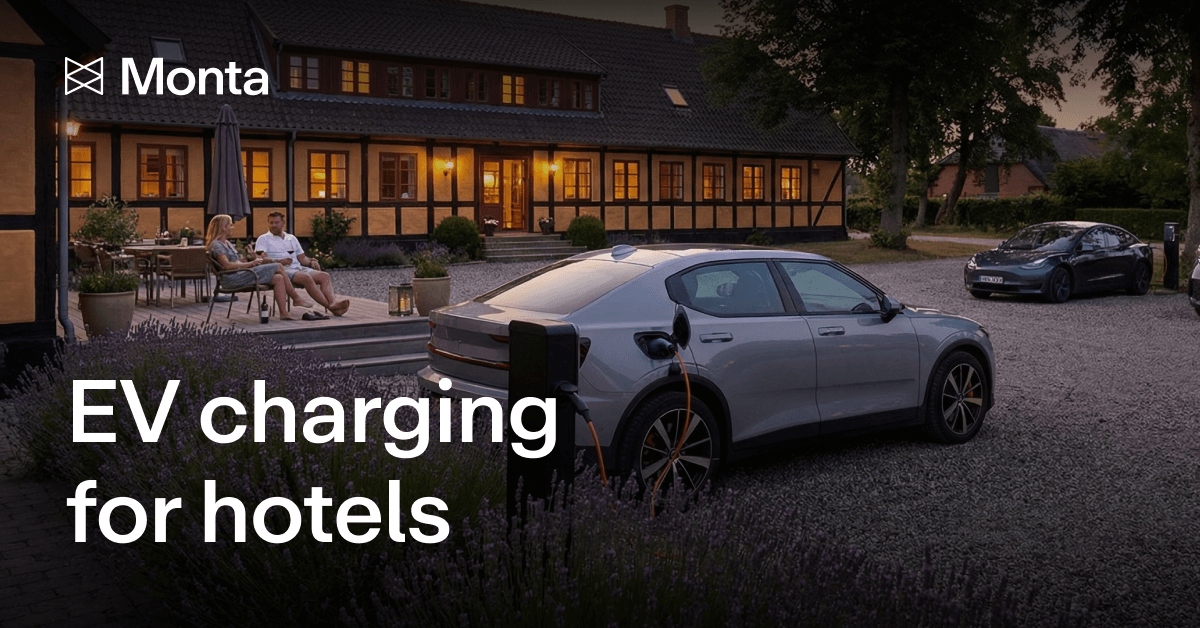
EV charging for hotels and hospitality facilities operates as a combined guest amenity and operational support system that serves visitors and staff within modern lodging environments. Hotel EV charging provides overnight and long-stay guests with reliable access to electricity through dedicated parking bays equipped with EV charge points for hotels, while operational teams view charging infrastructure as a tool for maintaining shuttle fleets, maintenance vehicles, and staff transport. EV charging stations for hotels support traveller confidence, itinerary planning, and sustainable travel expectations, while hotel electric car charging enables workforce mobility and predictable service delivery. Platforms such as Monta EV charging coordinate access control, billing, monitoring, and load management, which allows property managers to balance guest convenience with staff requirements and electrical capacity limits.
What is EV charging for hotels?
EV charging for hotels refers to the installation, management, and operation of on-site charging systems that supply electricity to electric vehicles used by guests, staff, and service fleets within hospitality properties. Hotel operators deploy charging infrastructure in guest parking areas, valet zones, and back-of-house facilities to support overnight and long-duration vehicle charging aligned with typical stay patterns. EV charge points for hotels are designed to handle sustained daily use, shared access by multiple guests, and variable occupancy levels, while operating within the building’s electrical capacity and load management limits. EV charging functions as a core hospitality amenity and operational utility that supports modern travel expectations, sustainability commitments, and consistent service delivery.
How does EV charging for hotels, resorts, and hospitality properties work?
EV charging for hotels, resorts, and hospitality properties works through an integrated service model that supplies electricity to guest vehicles, staff cars, and service fleets during extended parking periods. Property operators install AC charge points in guest parking areas, valet zones, and staff facilities, while deploying limited DC fast charge points at transit-oriented locations. Electrical systems connect charge points to building panels and transformers and regulate power delivery through load management platforms to protect core hospitality operations. Charging sessions are activated via room-linked access, valet management systems, mobile applications, or staff credentials, while central platforms monitor usage, energy consumption, and equipment status. Operations teams coordinate charging activity with guest arrival schedules, departure times, and fleet requirements to maintain consistent vehicle availability and service quality.
EV charging in lodging facilities differs from traditional fuelling because energy is delivered gradually while vehicles remain parked overnight or during extended stays, rather than through short, attended refuelling transactions. Hotels integrate charging into accommodation services and property management systems, while petrol or diesel fuelling operates independently through external retail stations. Charging depends on building electrical capacity, load management, and scheduling, whereas fuelling relies on fuel logistics and pump availability. This operational difference positions EV charging as a hospitality utility embedded within guest services rather than a separate refuelling activity.
What does EV charging infrastructure look like for hotels, resorts, serviced apartments, and hospitality complexes?
EV charging infrastructure for hotels, resorts, serviced apartments, and hospitality complexes consists of an integrated system of charging hardware, electrical distribution assets, digital management platforms, and operational controls deployed across guest parking areas, valet zones, staff facilities, and service depots. Mixed-use and extended-stay properties frequently apply similar design principles to EV charging for apartments within shared residential and hospitality environments. Hotels’ EV charging installations typically rely on widespread AC charge points for overnight and long-stay guests, supported by limited DC fast charge points at transit-oriented or high-turnover properties. Electrical systems connect charge points to upgraded panels, transformers, and protection equipment, while load management software regulates site-wide power use to prevent interference with core hospitality operations. Management platforms integrate charging activity with property systems, guest services, and fleet scheduling to support reliable vehicle readiness and consistent service delivery.
The core layers of EV charging infrastructure in hotels and hospitality facilities operations are listed below.
- Guest, valet, and service-area charging layout: Structured placement of charge points across public parking, valet zones, staff areas, and fleet depots.
- Electrical supply and load management: Panels, transformers, feeders, and power-sharing systems that regulate aggregate charging demand.
- Building and property system integration: Links between charging platforms, property management systems, and energy monitoring tools.
- Access control and guest authentication: Room-based authorisation, valet-operated systems, and staff credential management.
- Billing and revenue management platforms: Software for fee processing, room-account integration, and cost recovery.
- Fleet and shuttle charging infrastructure: Dedicated facilities for buses, vans, carts, and maintenance vehicles.
- Monitoring and diagnostics systems: Central dashboards for uptime tracking, fault detection, and performance reporting.
- Safety and compliance frameworks: Fire protection, grounding, ventilation, and emergency shutdown systems.
- Scalability and future expansion provisions: Spare conduit, reserved capacity, and modular mounting structures.
- Operational workflows and service coordination: Procedures for vehicle rotation, valet charging, and guest support.
What is an EV charging station in hotels?
An EV charging station in hotels refers to a dedicated on-site charging system installed within guest parking areas, valet zones, and service facilities to supply electricity to electric vehicles used by guests, staff, and operational fleets. Hotel operators design charging stations to support overnight and long-duration charging, align with guest stay patterns, and integrate with property management and energy systems. The stations function as hospitality amenities and operational assets that reinforce service quality, sustainability goals, and modern travel expectations.
The fundamental elements that define an EV charging station for hotels are listed below.
- Charging hardware: AC charge points and limited DC fast units installed in guest, valet, and staff parking areas.
- Electrical integration: Connection to building panels, transformers, grounding systems, and protection equipment.
- Load management systems: Power-sharing controls that balance charging demand with hotel energy consumption.
- Access control and authentication: Guest credentials, valet-operated systems, and staff access management tools.
- Billing and payment platforms: Software for guest charging fees, room-account integration, and cost recovery.
- Monitoring and diagnostics tools: Central dashboards for uptime tracking, fault alerts, and performance reporting.
- Site layout and wayfinding: Marked bays, signage, lighting, and traffic flow alignment.
- Safety and compliance features: Fire protection, ventilation, emergency shutoffs, and regulatory compliance systems.
- Fleet charging provisions: Dedicated bays for shuttle buses, maintenance vehicles, and service carts.
- Scalability and expansion capacity: Spare conduit, reserved electrical capacity, and modular mounting structures.
Do hotels and hospitality facilities operate electric service vehicles and internal fleets?
Yes. Hotels and hospitality facilities operate electric service vehicles and internal fleets as part of daily operations, sustainability programmes, and cost-control strategies. Property operators deploy electric vehicles for housekeeping transport, maintenance support, security patrols, guest luggage movement, landscaping, and shuttle services within resort campuses and large hotel complexes. Electrification reduces fuel expenses, lowers noise levels, and improves air quality in guest-facing areas.
Hotels commonly operate electric golf carts, utility carts, housekeeping vehicles, maintenance vans, security patrol vehicles, airport shuttle buses, and guest transfer shuttles. Large resorts and conference properties increasingly add electric minibuses and low-speed electric transport vehicles for inter-building mobility and internal logistics. The fleets rely on structured back-of-house charging systems to maintain continuous service availability.
What are the types of EV charging used in hotels and hospitality facilities?
The types of EV charging used in hotels and hospitality facilities are listed below.
- AC charging for guest parking: AC charging delivers moderate-power alternating current to vehicles parked overnight or for several hours. Hotels and city hotels rely on this charging type for standard overnight guests, resorts deploy it across large surface and garage parking areas, and serviced apartments use it to support resident-style long-term parking. AC charging remains the most common solution across hospitality properties because charging speed aligns with typical stay duration.
- Destination charging for long-stay guests: Destination charging supports extended charging sessions for guests staying multiple nights or weeks. Serviced apartments and extended-stay hotels use destination charging to mirror residential charging patterns, while resorts apply it for holiday guests who remain on-site for long periods. City hotels adopt destination charging selectively for business travellers on multi-day visits. The charging type prioritises consistency and full-battery readiness over rapid turnover.
- Fleet charging for hotel operations: Fleet charging supplies electricity to shuttle buses, maintenance vans, housekeeping vehicles, and internal transport carts used in daily operations. Resorts and large hotel campuses depend heavily on fleet charging to support internal mobility, airport hotels use it for transfer shuttles, and serviced apartments apply it for facilities and logistics vehicles. Fleet charging focuses on overnight replenishment and predictable scheduling.
- Limited DC fast charging for motorway or transit hotels: Limited DC fast charging delivers high-power direct current for rapid vehicle replenishment at properties with short guest dwell times. Motorway hotels, airport hotels, and transit-oriented city hotels deploy this charging type to support travellers making brief stops. Resorts and serviced apartments rarely install fast charge points because guest vehicles typically remain parked for extended periods. This charging model serves mobility corridors rather than long-stay hospitality use.
-
AC charging for guest parking
Guest car parks and resort parking areas commonly rely on AC charging for guest parking to deliver alternating current power to vehicles that remain parked overnight or for several hours. Hospitality operators deploy AC charging for guest parking as the primary charging solution because the charging speed aligns with typical stay duration and available electrical capacity. AC charging for guest parking remains very common across urban hotels, resorts, and conference properties. Typical installed costs range from £15,000 to £35,000 ($19,000 to $45,000 / €17,500 to €41,000) per charging point, depending on cabling distance, panel upgrades, and site layout.
-
Destination charging for long-stay guests
Extended-stay properties and resort campuses frequently implement destination charging for long-stay guests to support vehicles parked for multiple days. Property managers adopt destination charging for long-stay guests to provide residential-style convenience and improve repeat visitation and guest retention. Destination charging for long-stay guests appears frequently in serviced apartments, holiday resorts, and conference hotels. Installation costs typically reach £18,000 to £40,000 ($23,000 to $51,000, €21,000 to €47,000) per charge point, reflecting higher-capacity wiring and network integration.
-
Fleet charging for hotel operations
Back-of-house service zones and secured depots regularly use fleet charging for hotel operations to power shuttle vans, maintenance vehicles, housekeeping carts, and security fleets. Facilities teams deploy fleet charging for hotel operations to support predictable overnight replenishment and multi-shift vehicle availability. Fleet charging for hotel operations remains common in large resorts, airport hotels, and campus-style hospitality properties. Total project costs generally range from £25,000 to £80,000 ($32,000 to $100,000, €29,000 to €94,000) per site, depending on fleet size, charge point quantity, and load management requirements.
-
Limited DC fast charging for motorway or transit hotels
Motorway-adjacent and transit-oriented properties selectively install limited DC fast charging for motorway or transit hotels to support short-stay travellers who require rapid energy replenishment. Hotel operators adopt limited DC fast charging for motorway or transit hotels only where brief dwell times justify higher capital and grid upgrade costs. Limited DC fast charging for motorway or transit hotels remains less common than AC deployment across most hospitality portfolios. Installed costs range from £120,000 to £280,000 ($150,000 to $360,000, €140,000 to €330,000) per charge point, driven by equipment rating, transformer upgrades, and civil works.
How much does EV charging infrastructure cost for hotels and resort car parks?
EV charging infrastructure for hotels and resort car park areas typically costs £25,000 per AC charging point ($31,000, €29,000) once hardware, installation, and basic electrical work are included, and £150,000 per DC fast charging station ($185,000, €173,000) when higher-power equipment and site upgrades are required. A small resort deployment with four AC charge points and one DC fast charge point commonly totals about £250,000 ($307,000, €287,000) for a complete installation. Larger properties planning multiple fast charge points, extensive trenching, transformer upgrades, or additional grid connection work should budget £400,000–£800,000 ($492,000–$984,000, €459,000–€918,000) depending on site complexity and electrical capacity. These figures cover equipment, trunking and conduit work, panel and transformer upgrades, commissioning and connection fees, but exclude ongoing operating costs.
Is DC fast charging necessary for hotels and hospitality EV charging?
No. DC fast charging is not necessary for most hotel and hospitality EV charging operations because guest vehicles typically remain parked overnight or for extended periods, which supports full charging via AC systems. Hotels rely on predictable dwell time to replenish batteries without requiring rapid turnaround, which makes moderate-power charging more cost-effective and easier to integrate with building electrical systems.
DC fast charging becomes valuable only at motorway-adjacent hotels, airport hotels, and transit-oriented properties where guests stay briefly and require rapid recharging before continuing travel, which justifies investment in direct current fast charging (DCFC). Widespread AC deployment combined with overnight charging provides the most practical, economical, and operationally efficient solution for most hospitality properties.
What are the benefits of EV charging for hotels?
The benefits of EV charging for hotels are listed below.
- Improved guest experience: On-site charging enables guests to recharge vehicles overnight or during extended stays without leaving the property, improving travel convenience and satisfaction.
- Increased booking attractiveness: Charging availability strengthens appeal among business travellers, leisure guests, and conference attendees who prioritise EV-friendly accommodation.
- Higher occupancy and retention: Reliable charging encourages repeat visits and longer stays among electric vehicle drivers.
- Competitive differentiation: Charging infrastructure distinguishes hotels within crowded hospitality markets where modern amenities influence booking decisions.
- Support for premium and loyalty programmes: Preferred charging access can be integrated into loyalty tiers, valet services, and executive packages.
- Revenue generation opportunities: Metered charging enables cost recovery and supplemental income through guest usage fees.
- Operational support for service fleets: On-site charging supports shuttle vans, maintenance vehicles, and housekeeping transport units.
- Sustainability positioning: Charging infrastructure reinforces environmental commitments and emissions reduction targets.
- Alignment with corporate and government contracts: EV-ready facilities strengthen eligibility for sustainability-focused travel programmes and procurement frameworks.
- Long-term asset resilience: Early investment in charging protects property relevance as electric vehicle adoption increases.
What are the benefits of EV charging for serviced apartments and extended-stay accommodation?
The benefits of EV charging for serviced apartments and extended-stay accommodation are listed below.
- Increased guest convenience: On-site charging allows long-stay guests to recharge vehicles overnight and during extended residence periods without relying on public charging networks.
- Higher property attractiveness: Charging availability strengthens appeal among business travellers, relocating professionals, and digital nomads who prioritise reliable home-based charging.
- Improved guest retention: Consistent access to charging reduces friction for repeat visitors and long-term occupants, which supports longer stays and contract renewals.
- Support for residential-style living: EV charging aligns serviced apartments with modern residential expectations by integrating mobility infrastructure into daily living routines.
- Competitive market differentiation: Charging infrastructure distinguishes properties within dense extended-stay markets where amenities influence booking and leasing decisions.
- Operational efficiency for management: Centralised charging systems simplify access control, monitoring, and maintenance across multi-unit properties.
- Future-ready infrastructure: Early deployment prepares buildings for rising EV adoption without disruptive retrofits.
- Sustainability and compliance alignment: Charging supports emissions reduction targets and regulatory requirements applicable to long-term accommodation providers.
- Potential revenue generation: Metered charging enables cost recovery or supplemental income through usage-based pricing models.
- Stronger brand positioning: Visible charging facilities reinforce a modern, environmentally responsible brand image among long-stay guests and corporate clients.
How do guests benefit from EV charging at hotels and resorts?
Hotel guests benefit from EV charging at hotels and resorts through reliable on-site access to electricity, allowing vehicles to recharge during overnight stays, extended holidays, and conference visits without requiring off-property charging stops. On-site charging eliminates range anxiety during travel, supports itinerary planning, and enables guests to depart each morning with a full battery. Increased charging availability increases convenience for business travellers, leisure guests, and families by integrating vehicle replenishment into standard lodging routines, while reinforcing property quality, modern service standards, and sustainability commitments.
How do hotel staff and operational teams use EV charging on hospitality properties?
Hotel staff and operational teams use EV charging on hospitality properties through dedicated staff parking charge points and secured service-area charging bays that support overnight, multi-shift, and full-day vehicle operations. Management teams allocate charging access to housekeeping supervisors, maintenance crews, security staff, shuttle drivers, and facilities personnel to maintain continuous vehicle availability for guest services, logistics, and property operations.
Hotel staff benefits from night shifts and EV charging through reliable overnight vehicle replenishment that aligns with extended working hours and low daytime electricity demand. Night-shift housekeeping teams, security units, and engineering staff charge vehicles during low-occupancy periods, reducing congestion at charging bays and lowering energy costs under off-peak tariffs. Overnight charging ensures service vehicles, shuttle vans, and staff commuter cars begin each shift fully charged, improving response times, reducing operational delays, and supporting consistent service delivery across 24-hour hospitality operations.
Will hotels and hospitality facilities transition fully to electric service vehicle fleets?
Yes. Hotels and hospitality facilities will transition to fully electric service vehicle fleets as part of long-term sustainability strategies, operating cost reduction plans, and regulatory compliance programmes. Property operators increasingly replace petrol-powered carts, shuttle vans, maintenance vehicles, and housekeeping transport units with electric alternatives to reduce emissions, noise, and fuel expenses. Major hotel chains, resort groups, and convention centres already integrate fleet electrification into brand-wide environmental commitments and capital planning frameworks.
Future EV charging trends within hospitality facilities focus on expanding back-of-house depot charging, integrating load management with building energy systems, and aligning charging schedules with off-peak utility tariffs. Operators invest in networked charging platforms that support fleet monitoring, maintenance scheduling, and energy reporting across multiple properties. Hospitality developments increasingly include EV-ready infrastructure, solar integration, and battery storage to support growing fleet and guest charging demand. These trends position electric service fleets as a standard operational feature rather than a specialised sustainability initiative.