
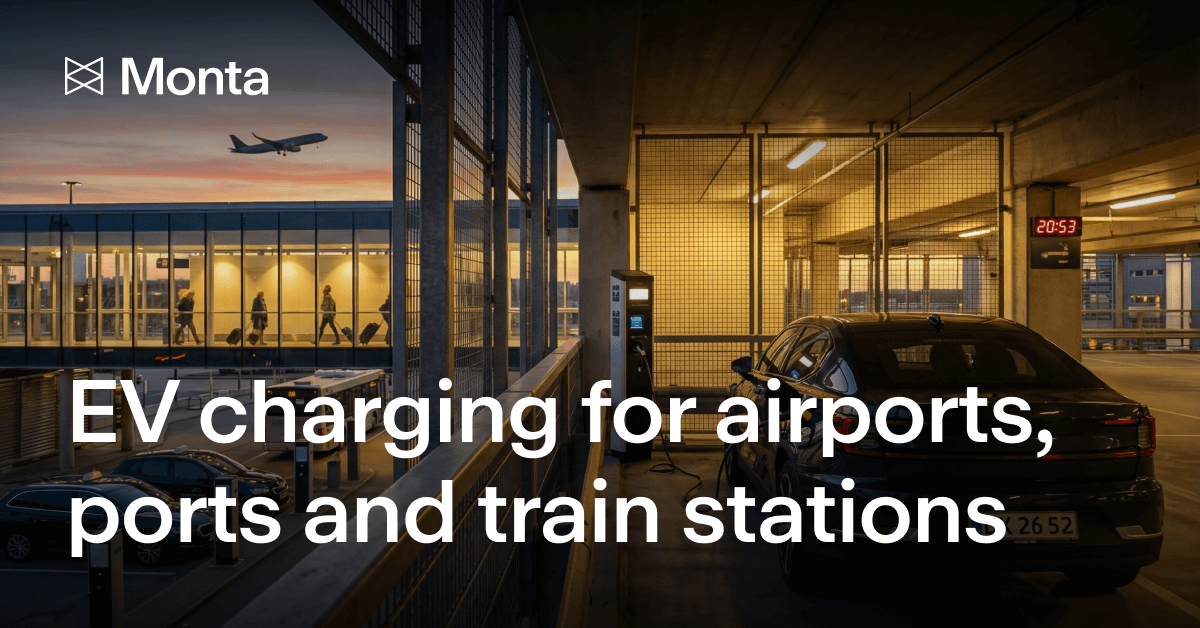
EV charging for airports, ports, train stations, and transportation hubs operates as an integrated infrastructure that supports operational requirements and passenger travel patterns across complex transport environments. Airport EV charging, airport charging stations, and airport charging serve staff groups such as ground crews, security teams, maintenance units, and fleet operators who view charging as mission-critical infrastructure tied to shift schedules, vehicle availability, and operational continuity. Passengers and travellers perceive charging differently, with charging access framed as a convenience feature that supports long parking durations, return-journey readiness, and travel confidence during flights, cruises, or rail trips. Transport authorities design charging systems to reconcile operational reliability with passenger expectations through controlled access, predictable availability, and software-driven oversight delivered through platforms like Monta EV charging from Monta. It allows charging assets to function simultaneously as grid-integrated infrastructure and visible customer services within transportation hubs.
What is EV charging for airports, ports, and train stations?
EV charging for airports, ports, and train stations refers to the planning, installation, and operation of electric vehicle charging infrastructure within major transport hubs to support travellers, workforce vehicles, and operational fleets under high-utilisation conditions. Transport authorities and facility operators design charging systems to function as an integrated electrical infrastructure capable of supporting long parking durations, high vehicle turnover, secure operational zones, and continuous daily use.
Airport EV charging focuses on long-stay passenger parking, staff car parks, taxis, rideshare vehicles, shuttle buses, and airside service fleets that operate on fixed schedules and extended shifts. Charging systems at airports prioritise reliability, access control, and a mix of AC and high-power DC charging to match diverse dwell times.
Port EV charging supports logistics vehicles, drayage trucks, service fleets, and workforce transport operating within industrial and security-controlled environments. Charging deployments at ports emphasise fleet and depot charging, high-capacity electrical integration, and coordination with broader decarbonisation strategies tied to freight movement and terminal operations.
Train station EV charging serves daily commuters, long-distance rail passengers, station staff, and rail operator fleets through car park-based charging and controlled-access staff facilities. Charging infrastructure at rail terminals prioritises predictable dwell times, grid-aligned load management, and efficient integration with public transport usage patterns.
EV charge points deployed across airports, ports, and train stations are engineered to handle sustained utilisation, regulatory oversight, electrical load management, and long asset lifecycles rather than short-term or convenience-based charging use.
How does EV charging for airports, ports, and railway stations work?
EV charging for airports, ports, and railway stations works through coordinated electrical planning, site engineering, access management, and ongoing operational control rather than a single refuelling interaction. Transport authorities deploy charging systems across public parking, staff areas, and fleet depots based on dwell time, vehicle turnover, and grid capacity. Operational teams manage charging through load controls, access rules, and monitoring platforms that align charging demand with site electrical limits and utility requirements. Charging activity functions as part of daily transport operations, with infrastructure designed for continuous use, safety compliance, and long asset lifecycles.
EV charging in transport hubs operates as an integrated electrical infrastructure rather than a transactional, point-of-sale service. Transport operators plan charging around power availability, dwell duration, and operational schedules, while traditional fuelling relies on rapid retail transactions disconnected from energy system management. EV charging integrates with site electrical networks, utility coordination, and remote monitoring, with minimal staff involvement at the charge point itself compared with staffed or attended fuel stations.
What does EV charging infrastructure look like for transport hubs like airports, ports and rail terminals?
EV charging infrastructure for transport hubs functions as a layered, site-integrated system designed to support high vehicle volumes, varied dwell times, and operational fleets across airports, ports, and rail terminals. Transport authorities and facility operators deploy charging infrastructure as part of core electrical and transport operations, with systems engineered for reliability, access control, safety compliance, and coordination with utility networks rather than single-site convenience. Airport EV charging, port charging, and rail terminal charging operate as embedded infrastructure assets that serve travellers, staff, service vehicles, and fleets while aligning with long-term electrification and capacity planning objectives.
The core layers of EV charging infrastructure in transport hub operations are listed below.
- Charging hardware layer: Charging hardware includes an AC charge point for long-stay parking and DC fast charge points for high-turnover traffic and fleet operations. Equipment selection reflects dwell time, vehicle mix, and operational intensity across transport hub environments.
- Electrical supply and make-ready layer: Electrical infrastructure consists of transformers, switchgear, service connections, and protective devices designed to support clustered charging loads. Make-ready assets integrate charging systems with existing airport, port, or rail electrical networks.
- Grid interconnection and protection layer: Grid interconnection systems manage load visibility, fault protection, and isolation within complex transport facilities. Protection schemes align charging operations with safety and reliability requirements.
- Access control and user management layer: Access systems regulate charging use by travellers, staff, fleets, and authorised operators through authentication platforms, parking management integration, and security controls. Site coordination supports secure and efficient vehicle movement.
- Energy and load management layer: Load management platforms control charging schedules, power limits, and simultaneous demand to prevent local overload. Managed charging supports peak control and capacity optimisation across transport hub operations.
- Software, monitoring, and operations layer: Software systems provide real-time status monitoring, fault alerts, usage analytics, and remote control. Operational visibility supports maintenance planning and service continuity.
- Data, reporting, and compliance layer: Data systems capture utilisation, energy consumption, and operational performance metrics. Reporting supports regulatory compliance, infrastructure planning, and long-term electrification strategy development.
What is an EV charging station in airports and ports?
An EV charging station in airports and ports functions as a purpose-built charging asset deployed within transportation hubs to support travellers, workforce vehicles, operational fleets, and service contractors. Airport and port authorities design EV charging stations as infrastructure assets integrated with site electrical systems, access controls, and safety requirements rather than as standalone convenience amenities. EV charging stations at airports and ports support long parking durations, high vehicle turnover, secure operational zones, and fleet duty cycles while aligning with grid capacity, regulatory compliance, and transport electrification objectives.
The fundamental elements that define an EV charging station for transport hubs are listed below.
- Charging equipment and power levels: Charging equipment consists of AC charge points for long-stay parking and DC fast charge points for high-turnover traffic and fleet operations. Power selection reflects dwell time, vehicle type, and operational intensity.
- Electrical supply and grid connection: Electrical systems include dedicated feeders, transformers, protection devices, and metering integrated with airport or port electrical infrastructure. Grid connection design supports reliability and safe operation within complex transport environments.
- Access control and site integration: Access systems manage use by travellers, staff, fleets, or authorised operators through barriers, authentication platforms, and parking management integration. Site layout aligns charging locations with traffic flow and security boundaries.
- Operational and safety compliance: Safety systems address fire protection, emergency access, signage, and compliance with transport authority standards. Operational controls support continuous use within high-traffic and regulated environments.
- Load management and system coordination: Load management platforms regulate charging schedules and power delivery to prevent local overload. Coordination with utility capacity limits supports stable operation during peak travel periods.
- Monitoring, reporting, and maintenance: Monitoring systems track charge point status, usage patterns, and fault conditions. Reporting supports asset management, operational planning, and compliance with transport authority and utility requirements.
Do airports, ports, and railway terminals operate electric service vehicles and fleets?
Yes. Airports, ports, and railway terminals operate electric service vehicles and electric fleets as part of ground operations, emissions reduction programmes, and operational efficiency strategies, with EV charging for electric buses forming a core part of fleet electrification planning. Transport authorities and facility operators deploy electric vehicles for airside movement, passenger transfer, maintenance activity, security patrols, and internal logistics within controlled transport zones.
Airports operate electric shuttle buses, electric vans, electric maintenance vehicles, electric security vehicles, and electric ground support equipment. Airports operate aeroplane-to-terminal EV people carriers to transport passengers between aircraft stands and terminal buildings, particularly at remote gates and large airfields.
EV buses typically require high-power charging to maintain service availability across continuous duty cycles. Airport shuttle buses and terminal circulator buses commonly use DC charging systems ranging from 100 kW to 450 kW, depending on route length, vehicle size, battery capacity, and turnaround time requirements.
Is it safe to leave an EV car in the airport parking?
Yes. Leaving an electric vehicle in airport parking is safe because modern electric vehicles and airport parking facilities operate under established safety, fire protection, and electrical standards. Airport operators manage long-stay parking areas to accommodate extended vehicle storage, and electric vehicles are designed to remain parked for prolonged periods without operational risk. Airport charging and parking policies align with regulatory guidance on battery safety, ventilation, and emergency response, which supports secure long-duration parking for electric vehicles.
What are the types of EV charging used in transportation hubs?
Transportation hubs use several distinct EV charging types to support varied vehicle dwell times, operational intensity, and fleet requirements.
- AC charging: Level 2 charging supports long-duration parking at airports, rail stations, and ferry terminals where vehicles remain parked for several hours. Transport authorities deploy AC charge points in public car parks, staff parking areas, and long-stay facilities to match predictable dwell patterns.
- DC fast charging: DC fast charging supports high-turnover activity at transportation hubs with time-sensitive vehicle movement. Airports, ports, and rail hubs rely on DC fast charge points to serve taxis, rideshare vehicles, service fleets, and short-stay drivers who require rapid energy replenishment.
- Fleet and depot charging: Fleet and depot charging supports electric vehicles operated by hub authorities, logistics operators, and service contractors. Transportation hubs deploy dedicated charging systems for buses, shuttles, maintenance vehicles, and security fleets operating on fixed routes and schedules.
- Workplace and staff charging: Workplace charging supports employees working extended or irregular shifts within secure transport facilities. Hub operators install controlled-access charge points in staff-only parking zones to support workforce electrification.
- Managed and smart charging: Managed charging systems regulate charging times and power levels across multiple charge points. Transportation hubs use smart charging to control peak demand, balance simultaneous loads, and align charging activity with utility capacity limits.
- Public access charging: Public access charging supports private electric vehicle drivers using airports, ports, and rail stations. Hub operators deploy publicly accessible charge points with payment, access control, and monitoring systems suited to transient users.
-
AC charging
AC charging delivers mid-power alternating current through dedicated charging equipment to electric vehicles at transport hubs where vehicles park for extended periods. AC charging is widespread at airports, train stations, and port car parks because long parking durations align with moderate-power charging profiles. Typical installation cost for a single AC charge point is around £20,000 ($25,000, €23,500 ), including hardware, installation, and basic site preparation associated with AC charging.
-
DC fast charging
DC fast charging supplies high-power direct current directly to an electric vehicle’s battery to support rapid energy transfer for vehicles with short dwell times. DC fast charging appears frequently at major transportation hubs where high-turnover vehicles (for instance, taxis and rideshare fleets) require quick replenishment. Typical installation cost for a single DC fast charge point at a hub ranges around £200,000 ($250,000, €235,000), including power upgrades and civil works associated with DC fast charging.
-
Fleet and depot charging
Fleet and depot charging refers to charging systems dedicated to electric vehicles used by operational teams, security units, ground support, and logistics within hub boundaries. Fleet and depot charging is common at larger airports and ports where institutional vehicles operate on fixed schedules, and centralised charging supports operational readiness. The average cost for a depot charging bay with multiple charge points and electrical upgrades is about £150,000 ($190,000, €176,000) per bay, depending on site complexity linked to fleet and depot charging.
-
Workplace and staff charging
Workplace and staff charging comprises charging points located within controlled staff parking areas at transportation hubs for employees who work long shifts. Workplace and staff charging is moderately common at larger hubs that electrify employee commuting or on-site utility vehicles. Cost per staff charging point generally falls near £18,000 ($22,500, €21,000) for hardware and installation in dedicated staff parking zones aligned with workplace and staff charging.
-
Managed and smart charging
Managed and smart charging uses software platforms and control systems to schedule charging, regulate power delivery, and balance demand across multiple charge points to remain within grid capacity limits. Transportation hubs increasingly rely on this approach to coordinate simultaneous charging sessions without overloading electrical systems. Software, control hardware, and commissioning for a medium-sized hub typically cost about £60,000 ($75,000, €70,500) under managed and smart charging.
-
Public access charging
Public access charging refers to EV charge points available to travellers and visitors at airports, ports, and rail stations with payment and user authentication capabilities. Public access charging is very common at major transportation hubs to support private electric vehicles during travel-related parking. Installation cost for a public access charge point with payment infrastructure and signage generally amounts to about £28,000 ($35,000, €33,000), covering payment systems, signage, and electrical works associated with public access charging.
How much does EV charging infrastructure cost for airports and transportation hubs?
Electric vehicle charging infrastructure for airports and transportation hubs typically costs £45,000 per AC charge point ($57,000, €53,000) and £250,000 per DC fast charging station ($315,000, €294,000). Capital expenditure for a small hub installation with four AC charge points and two DC fast charge points totals roughly £690,000 ($870,000, €810,000). Larger hub deployments with ten DC fast charge points and multiple high-capacity feeders exceed £2,500,000 ($3,150,000, €2,940,000) when including electrical upgrades, civil works, and grid interconnection. Site-specific factors such as land preparation, transformer reinforcement, planning consents, and network capacity can raise total costs beyond these figures. Actual costs depend on detailed engineering design and utility network requirements.
What charging power do airports and transportation hubs’ EV charging systems typically require?
Airports and transportation hubs typically require a mix of medium- and high-power EV charging to support varied vehicle dwell times and operational needs. Facility operators deploy Level 2 charging for long-duration parking areas serving travellers and staff, while deploying DC fast charging to support taxis, rideshare vehicles, service fleets, and high-turnover traffic zones. Charging power selection aligns with vehicle turnover rates, parking duration, grid capacity, and operational continuity requirements rather than a single standardised power level.
A transportation hub EV charging installation needs sufficient power to support simultaneous charging across public parking, workforce areas, and fleet operations without disrupting grid stability. Typical installations combine AC charge points in the 7–22 kW range for extended dwell use with DC fast charge points ranging from 50 kW to 350 kW for rapid turnaround vehicles. System sizing reflects peak demand periods, fleet electrification targets, and long-term expansion plans managed through utility-integrated load control and capacity planning.
Is DC fast charging necessary for transportation hubs’ EV charging?
Yes. DC fast charging is necessary for transportation hub EV charging because airports, ports, rail stations, and logistics terminals serve vehicles with short dwell times, high utilisation, and operational turnover requirements. Transportation hubs support taxis, rideshare vehicles, commercial fleets, service vehicles, and time-sensitive travellers who require rapid energy replenishment rather than extended parking-based charging. DC fast charging supports operational continuity at transportation hubs by enabling vehicles to return to service quickly without disrupting schedules or workflows. Hub operators rely on high-power charging to meet peak demand periods, manage congestion, and support fleet electrification, where slow charging limits vehicle availability through direct current fast charging (DCFC).
What are the benefits of EV charging for airports?
The benefits of EV charging for airports are listed below.
- Extended parking dwell utilisation: EV charging at airports uses long parking durations associated with business travel, leisure travel, and staff shifts to support full vehicle charging without schedule disruption.
- Improved traveller experience: Charging access at airport car parks allows electric vehicle drivers to return to a charged vehicle after flights, which supports seamless onward travel.
- Support for airport workforce electrification: Charging infrastructure enables ground crew, security staff, maintenance teams, and airline personnel to rely on electric vehicles during long and irregular shifts.
- Fleet and airside vehicle readiness: Airport-based charging supports electric vehicles used for operations, inspections, and airside logistics that require dependable energy access within controlled zones.
- Reduced local emissions and noise: Electric vehicle charging lowers tailpipe emissions and noise levels in areas with high traffic density and strict air quality requirements.
- Alignment with aviation decarbonisation goals: EV charging infrastructure supports airport sustainability strategies linked to emissions reduction, clean ground transport, and regulatory commitments.
- Utility-coordinated load management: Utility-integrated charging enables controlled power delivery that aligns charging demand with grid capacity and peak management objectives.
- Infrastructure asset modernisation: Charging installations increase the functional value of airport parking assets and support long-term transport electrification planning.
What are the benefits of EV charging for ports?
The benefits of EV charging for ports are listed below.
- Extended vehicle dwell time utilisation: EV charging at ports captures long parking and waiting periods associated with cargo handling, customs clearance, and shift-based operations, which supports full charging without operational delay.
- Support for port workforce electrification: Charging infrastructure enables dock workers, security staff, logistics coordinators, and port authority personnel to rely on electric vehicles for daily commuting and on-site movement.
- Fleet and service vehicle readiness: Port-based charging supports electric trucks, vans, and utility vehicles used for inspections, maintenance, and terminal operations that require consistent energy access within secure zones.
- Reduced local emissions and noise: Electric vehicle charging contributes to lower exhaust emissions and reduced noise levels in port environments where surrounding communities and regulatory limits affect operations.
- Alignment with maritime decarbonisation goals: EV charging infrastructure supports broader port sustainability strategies tied to low-emission logistics, shore power adoption, and clean transport corridors.
- Improved logistics efficiency: Reliable charging access reduces downtime for electric drayage vehicles and service fleets moving containers and equipment within port boundaries.
- Utility-integrated load management: Utility-coordinated charging enables controlled power delivery that aligns with port energy demand profiles and grid capacity constraints.
- Infrastructure asset modernisation: Charging installations increase the functional value of port land, parking areas, and operational zones while supporting long-term electrification planning.
What are the benefits of EV charging for train stations?
The benefits of EV charging for train stations are listed below.
- Extended dwell-time utilisation: EV charging at train stations captures long parking durations associated with daily commuting and intercity travel, which allows full vehicle charging without schedule disruption.
- Improved commuter convenience: Charging access at station car parks supports predictable daily routines for rail passengers who combine private electric vehicles with public transport.
- Modal shift support: EV charging infrastructure at rail hubs encourages combined use of electric vehicles and trains, which reduces reliance on single-occupancy combustion vehicle trips.
- Fleet and service vehicle readiness: Station-based charging supports electric vehicles used by rail operators, maintenance crews, and security teams that require dependable on-site energy access.
- Grid-aligned load management: Utility-coordinated charging at train stations enables controlled charging profiles that align with off-peak rail and electricity demand patterns.
- Reduced local emissions: Electric vehicle charging at stations lowers tailpipe emissions in dense urban transport zones where air quality constraints affect surrounding communities.
- Asset value and infrastructure modernisation: Charging installations increase the functional value of station car parks and align rail assets with long-term transport electrification strategies.
- Revenue and partnership opportunities: Charging services create opportunities for rail authorities to partner with utilities, local councils, and charging operators under regulated deployment models.
How do travellers benefit from EV charging at airports and ports?
Travellers benefit from EV charging at airports and ports through access to reliable vehicle charging during long parking durations associated with flights, cruises, and ferry travel. Airport and port charging allows private electric vehicles to recharge while drivers remain off-site for extended periods, which supports return journeys without additional charging stops. Transport authorities and facility operators use EV charging to improve journey continuity, reduce range-related disruption, and support low-emission travel linked to aviation and maritime transport.
How do airport and aviation staff use EV charging at airports?
Airport and aviation staff use EV charging at airports to support predictable commuting, extended on-site work periods, and operational fleet requirements tied to long shifts and secure airside access. Airport operators deploy EV charging to serve ground crew, security staff, maintenance teams, airline personnel, and airport-owned vehicle fleets through controlled access charging located in staff car parks, operations zones, and fleet depots.
Aviation staff benefits from long shifts because extended dwell times allow full vehicle charging without interrupting operational schedules. Secure staff parking areas provide reliable access to charging during work hours, which reduces range concerns and supports consistent attendance across early-morning, overnight, and rotating shifts. Airport employers benefit through improved staff retention, reduced fleet fuel costs, and lower on-site emissions tied to workforce commuting and airside vehicle use.
Will airports and transportation hubs transition fully to electric vehicle fleets?
No. Airports and transportation hubs will not transition fully to electric vehicle fleets in the near term. Airport operators electrify ground support equipment, airside service vehicles, shuttle buses, and administrative fleets where duty cycles remain predictable and return-to-base charging supports daily operations. Emergency response vehicles, specialised heavy-duty equipment, snow removal fleets, and long-range airside units continue to rely on mixed propulsion due to extreme reliability requirements, payload demands, and continuous availability expectations. Fleet transition strategies prioritise operational certainty, regulatory compliance, and safety over full electrification targets.
Future trends in EV charging at airports and transportation hubs focus on scale, resilience, and operational integration. Infrastructure planning expands depot-based Level 2 and medium-power DC charging for fleet vehicles parked overnight or between shifts. High-power charging deployment grows selectively for shuttle buses, logistics vehicles, and time-sensitive airside operations where turnaround time affects service flow. Energy management systems coordinate charging with terminal loads, airfield systems, and peak travel periods to protect grid stability. Integration with on-site substations, battery storage, and renewable generation increases as airports treat EV charging as critical transport infrastructure rather than a passenger amenity.