
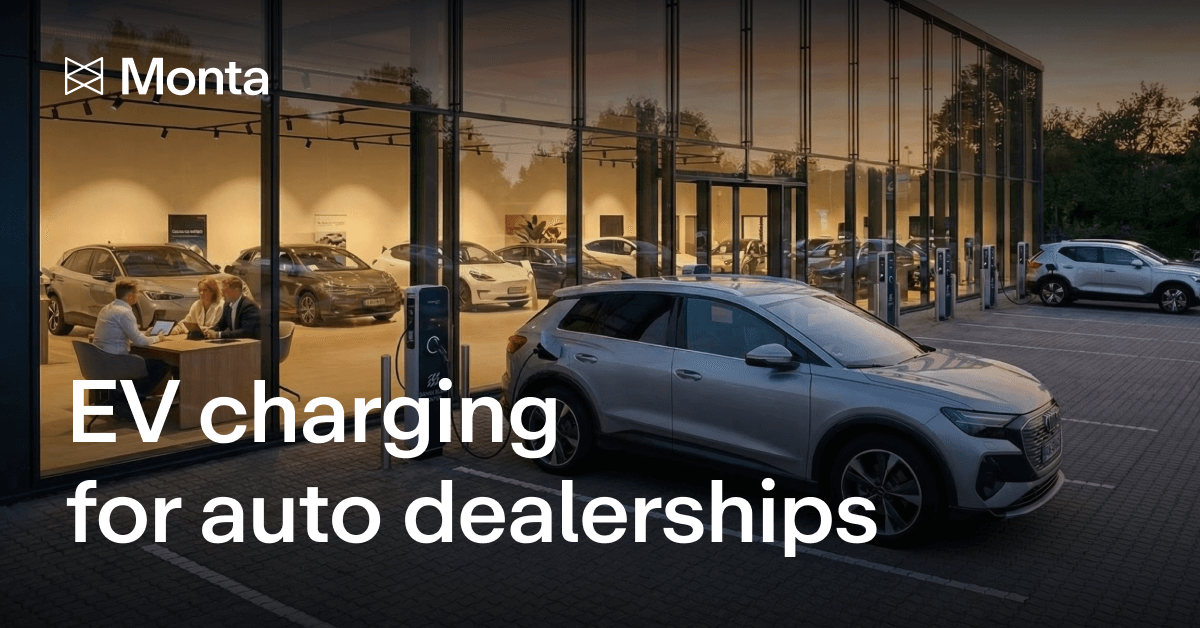
EV charging for auto dealerships functions as an integrated operational system that supports vehicle sales, demonstrations, servicing, and customer delivery within modern automotive retail environments. EV charging for car dealerships enables inventory vehicles, courtesy fleets, and service units to remain fully charged through structured overnight and daytime charging schedules. Car dealerships with EV charging use the infrastructure to strengthen customer confidence, improve test-drive readiness, and streamline vehicle preparation workflows across the showroom, lot, and workshop. Platforms such as Monta EV Charging provide centralised tools for access control, billing, monitoring, and load management, which allow dealership operators to coordinate charging activity with inventory systems and maintain consistent vehicle availability as electric vehicle adoption expands.
What is EV charging for auto dealerships?
EV charging for auto dealerships refers to the installation, management, and operation of on-site charging systems used to supply electricity to electric vehicles within showroom forecourts, service centres, preparation areas, and storage lots. Dealership operators deploy charging infrastructure to support vehicle sales, demonstrations, servicing, and customer delivery while integrating charging activity with inventory control and operational workflows. Charging functions as an internal energy utility that maintains vehicle readiness rather than as a public retail service.
EV charging in auto dealership operations represents a coordinated process in which charging equipment, electrical capacity, and digital management platforms align with sales schedules, service activities, and vehicle rotation plans. Operators manage charging as part of daily dealership logistics, ensuring vehicles remain prepared for test drives, inspections, and handover.
Dealership-based charging infrastructure supports electric passenger cars, demonstration vehicles, courtesy cars, service loaners, technician test vehicles, internal transport units, and light commercial vehicles used for parts delivery and site operations.
Charging supports continuous vehicle readiness, efficient inventory management, and reliable customer service by maintaining stable battery levels across sales and service fleets. Operators use charging to reduce reliance on external infrastructure, shorten vehicle preparation time, improve delivery consistency, and strengthen EV sales capability.
An auto dealership EV charging system consists of charging hardware (primarily AC charge points and limited DC fast units), electrical infrastructure (panels, transformers, feeders, and protection devices), load management platforms (power sharing and demand control), access and control systems (staff authentication and vehicle assignment), operational software (inventory integration, monitoring, and reporting), site layout elements (designated bays, traffic flow, and safety features), and maintenance tools (remote diagnostics and firmware management).
How does EV charging for auto dealerships work?
EV charging for auto dealerships works through a coordinated operational system that supplies electricity to inventory vehicles, demonstration units, service cars, and courtesy fleets across sales, service, and vehicle preparation areas. Dealership operators install AC charge points throughout showroom lots, delivery zones, and storage rows to support overnight and full-day charging for sales inventory. Service departments integrate dedicated charge points in workshop bays to support diagnostics, software updates, battery conditioning, and post-repair verification.
Vehicle preparation teams use assigned charging stations in detailing and inspection areas to ensure cars reach target charge levels before customer handover. Load management platforms regulate site-wide power demand by sequencing charging sessions across sales, service, and preparation zones. Management software tracks charging status, energy use, and vehicle readiness in coordination with inventory and scheduling systems. The integrated workflow ensures every electric vehicle remains charged, compliant, and available for test drives, delivery, and servicing without disrupting dealership operations.
How does EV charging in automotive dealerships operation differ from traditional fuelling?
EV charging in automotive dealership operations differs from traditional fuelling because energy delivery occurs over extended parking periods through integrated electrical systems rather than through short, attended refuelling transactions. Dealership charging relies on scheduled overnight and full-day charging coordinated with inventory management, service workflows, and vehicle preparation processes, while petrol or diesel fuelling depends on rapid pump-based dispensing managed by external fuel suppliers. Charging infrastructure connects directly to dealership electrical panels, transformers, and load management platforms, whereas fuelling systems operate independently through underground storage tanks and tanker refilling. Dealership charging supports continuous vehicle readiness and battery conditioning as part of daily operations, while traditional fuelling focuses on immediate range restoration without operational integration. The structural difference positions EV charging as an internal utility function within dealership facilities rather than a standalone refuelling activity.
What does EV charging infrastructure look like for auto dealerships, showrooms, service centres, and storage lots?
EV charging infrastructure for auto dealerships consists of an integrated system of charging hardware, electrical distribution assets, digital management platforms, and operational controls deployed across showrooms, service centres, and vehicle storage lots. Dealership operators install AC charge points throughout inventory rows, delivery bays, and workshop areas, while deploying limited DC fast charge points at high-turnover locations. Electrical systems connect charge points to upgraded panels, transformers, and protection equipment supported by load management software that regulates site-wide power use. Management platforms link charging activity with inventory systems, service scheduling, and vehicle preparation workflows. The infrastructure supports continuous vehicle readiness, predictable charging cycles, and efficient stock rotation rather than short-term public access.
The core layers of EV charging infrastructure in auto dealership operations are listed below.
- Showroom, service, and lot charging layout: Structured placement of charge points across display areas, storage rows, delivery zones, and service bays to support inventory flow.
- Electrical supply and load management: Panels, transformers, feeders, and power-sharing systems that regulate aggregate charging demand.
- Dealership system and inventory integration: Software links between charging platforms, dealer management systems, and vehicle tracking tools.
- Operational processes for vehicle preparation and rotation: Standard procedures for charging, detailing, inspection, staging, and customer handover.
- Access control and user management: Staff authentication systems and restricted customer charging permissions.
- Monitoring and diagnostics platforms: Central dashboards for uptime tracking, fault detection, and energy reporting.
- Safety and compliance systems: Fire protection, grounding, ventilation, and regulatory safeguards.
- Scalability and expansion provisions: Reserved electrical capacity, spare conduit, and modular mounting structures.
Auto dealership charging infrastructure differs from public charging because system design prioritises inventory management, operational reliability, and internal workflow integration rather than open access and high customer turnover. Dealership systems focus on long-duration charging, controlled access, and coordination with sales and service processes. Public charging emphasises rapid availability, open payment systems, and high utilisation by transient drivers. Dealership operators invest in load-managed, workflow-driven charging networks instead of stand-alone retail charging stations.
What is an EV charging station in auto dealerships?
An EV charging station in auto dealerships refers to a dedicated on-site charging system installed within showroom forecourts, inventory lots, service areas, and delivery zones to supply electricity to electric vehicles used for sales, demonstrations, servicing, and customer handover. Dealership operators design charging stations to support vehicle preparation, battery conditioning, test-drive readiness, and inventory management while integrating with site electrical infrastructure and operational workflows. The stations function as core dealership assets rather than public convenience amenities, with priority placed on reliability, access control, and alignment with sales and service activities.
Yes. Auto dealerships operate electric demonstration vehicles, courtesy cars, and internal service fleets to support sales promotion, customer support, and maintenance operations. Demonstration vehicles support test drives and buyer education, courtesy cars provide temporary mobility during servicing, and internal fleet vehicles support parts movement, inspections, and logistics. All fleet categories depend on structured on-site charging to maintain daily availability and service continuity.
The fundamental elements that define an EV charging station for automotive dealerships are listed below.
- Charging hardware: AC and limited DC fast charge points installed in inventory areas, service bays, and delivery zones.
- Electrical integration: Connection to dealership panels, transformers, protection devices, and backup systems.
- Load management systems: Power-sharing controls that balance charging across inventory, service, and staff vehicles.
- Access control and authentication: Staff credentials, vehicle assignment systems, and restricted public access features.
- Operational software platforms: Systems for monitoring, reporting, scheduling, and multi-site coordination.
- Site layout integration: Bay markings, traffic flow design, safety barriers, and vehicle staging alignment.
- Metering and energy tracking: Sub-metering and data systems for cost allocation and performance analysis.
- Safety and compliance features: Fire protection, ventilation, grounding, and regulatory compliance equipment.
- Maintenance and diagnostics tools: Remote fault detection, firmware updates, and service support systems.
- Scalability provisions: Spare conduit, reserved capacity, and modular mounting for future expansion.
How are EV charging depots designed for car dealerships?
EV charging depots for car dealerships are designed through coordinated planning that aligns showroom and lot layout, inventory size, demonstration and service vehicle turnover, grid capacity limits, and dealership operational workflows. Engineering teams assess vehicle dwell time, daily test-drive volume, service bay demand, and delivery schedules to determine the number and placement of charge points. Electrical designers integrate charge points with existing panels, transformers, and backup systems while applying load management to protect site stability. Operations managers coordinate charging zones with vehicle staging, detailing, and handover areas to maintain efficient inventory flow and avoid congestion. The integrated approach ensures that the charging infrastructure supports sales, service, and logistics functions without disrupting core dealership activities.
The key design considerations for EV charging in auto dealership operations are listed below.
- Inventory volume and turnover patterns: Charging capacity reflects the number of EVs in stock, test-drive frequency, and delivery schedules.
- Showroom and lot layout integration: Charge point placement aligns with vehicle display zones, storage rows, and traffic circulation routes.
- Service department charging demand: Design accounts for diagnostic testing, software updates, and post-repair charging needs.
- Electrical capacity and grid constraints: System sizing reflects available panel capacity, transformer limits, and utility connection rules.
- Load management and power sharing: Control systems balance charging activity across inventory, staff, and service vehicles.
- Vehicle preparation and delivery workflows: Charging zones support detailing, inspection, and customer handover processes.
- Future expansion capability: Conduit, spare capacity, and mounting provisions support inventory growth.
- Safety and compliance requirements: Installations meet fire safety, ventilation, and electrical protection standards.
- Network and software integration: Platforms support access control, reporting, and multi-site management.
- Customer and staff access separation: Layouts distinguish public charging, staff use, and operational charging areas.
Yes. Auto dealerships support EV demonstration fleets, service vehicles, and courtesy car fleets through dedicated charging for inventory, service bay charge points, and managed depot systems. These fleets rely on predictable overnight and daytime charging to maintain readiness for test drives, maintenance activities, and temporary customer use. Charging infrastructure is designed to prioritise operational vehicles alongside retail inventory to ensure consistent availability and service quality.
What types of EV charging are used in automotive dealerships?
Types of EV charging used in automotive dealerships are listed below.
- AC inventory charging: AC charging supports overnight and full-day charging for showroom vehicles, test-drive units, and delivery-ready inventory. Dealerships rely on such a charging type to maintain consistent battery levels across passenger EVs parked for extended periods.
- Dedicated vehicle preparation charging: Dedicated charge points serve vehicles undergoing pre-delivery inspection, software updates, and detailing. Service departments use assigned charging bays to ensure vehicles remain fully charged before customer handover.
- Service bay and workshop charging: Service bay charging supports diagnostic testing, battery conditioning, and post-repair verification. Technicians use moderate-power charge points to maintain vehicle readiness during maintenance activities.
- Limited DC fast charging: DC fast charging supports rapid turnaround at high-volume or flagship dealerships where same-day delivery or frequent test drives require quick replenishment. Dealerships deploy fast charge points selectively due to the higher cost and electrical impact.
- Managed and load-balanced charging: Load-managed charging systems distribute available power across multiple charge points to protect the site’s electrical capacity. Dealers rely on such an approach to scale inventory charging without major infrastructure upgrades.
- Networked and dealer-managed charging: Networked charging integrates authentication, usage tracking, and reporting with dealership management systems. Operators use software-controlled charging to coordinate inventory preparation, staff use, and customer access.
-
AC inventory charging
Vehicle storage areas and showroom parking zones commonly rely on AC inventory charging to deliver alternating current power for overnight and full-day charging of sales and demonstration vehicles. Dealership operators deploy AC inventory charging as the primary method for maintaining consistent battery levels across inventory because charging speed aligns with long dwell times. AC inventory charging remains very common across small, medium, and large dealerships. Typical installed costs range from £15,000 to £40,000 ($19,000 to $51,000, €17,500 to €47,000) per charging point, depending on wiring distance, panel upgrades, and site layout.
-
Dedicated vehicle preparation charging
Pre-delivery inspection areas and detailing bays frequently use dedicated vehicle preparation charging to support software updates, battery conditioning, and final vehicle readiness before customer handover. Service departments adopt dedicated vehicle preparation charging where predictable turnaround and quality control justify assigned charging access. Dedicated vehicle preparation charging appears commonly in high-volume dealerships and brand-certified delivery centres. Installed costs range from £18,000 to £45,000 ($23,000 to $57,000, €21,000 to €53,000) per charge point, including metering, cabling, and bay-specific electrical design.
-
Service bay and workshop charging
Maintenance facilities integrate service bay and workshop charging to support diagnostics, post-repair testing, and battery calibration during servicing activities. Technicians rely on service bay and workshop charging to maintain vehicle charge levels without interrupting repair workflows. Service bay and workshop charging remains moderately common in dealerships with dedicated EV service departments. Installation costs generally range from £12,000 to £30,000 ($15,000 to $38,000, €14,000 to €35,000) per charging unit, reflecting workshop safety standards and electrical routing requirements.
-
Limited DC fast charging
High-volume and flagship locations selectively deploy limited DC fast charging to support rapid turnaround for same-day delivery, frequent test drives, and urgent vehicle preparation. Dealership management adopts limited DC fast charging only where operational pressure justifies higher capital investment and grid capacity upgrades. Limited DC fast charging remains less common than AC deployment across most automotive retailers. Total installed costs range from £120,000 to £300,000 ($150,000 to $380,000, €140,000 to €350,000) per charge point, driven by equipment rating, transformer upgrades, and civil works.
-
Managed and load-balanced charging
Multi-charge point sites rely on managed, load-balanced charging systems to distribute available electrical capacity across inventory, service, and staff charging bays. Energy managers implement managed and load-balanced charging to avoid peak-demand penalties and defer major electrical upgrades. Managed and load-balanced charging has become increasingly common as dealership EV inventories expand. Software platforms and control hardware cost £40,000 to £80,000 ($50,000 to $100,000, €47,000 to €94,000) per site, depending on system scale and integration depth.
-
Networked and dealer-managed charging
Centralised charging platforms enable networked and dealer-managed charging, supporting authentication, usage tracking, billing allocation, and operational reporting across multiple dealership locations. Operations teams use networked and dealer-managed charging to coordinate inventory preparation, staff access, and customer charging privileges. Networked and dealer-managed charging remains common among professionally managed dealer groups and multi-site operators. Licensing, connectivity, and commissioning costs typically reach £50,000 to £90,000 ($63,000 to $115,000, €58,000 to €105,000) per medium-sized dealership, with ongoing annual service fees added separately.
How much does EV charging infrastructure cost for auto dealerships?
EV charging infrastructure for auto dealerships costs £15,000 to £40,000 per AC charging point ($19,000 to $51,000, €17,500 to €47,000) and £120,000 to £300,000 per DC fast charge point ($150,000 to $380,000, €140,000 to €350,000) when charge points, electrical upgrades, grid connections, and professional installation are included. A small dealership installation with four to six AC charge points requires a total capital investment of £80,000 to £200,000 ($100,000 to $250,000, €94,000 to €235,000), depending on panel capacity, cabling distance, and site layout.
Infrastructure budgets extend beyond charging hardware to cover distribution board upgrades, transformer reinforcement, trenching, conduit installation, load management systems, commissioning, and utility coordination. Dealership operators budget for higher upfront costs than light-duty workplace charging because inventory charging requires higher utilisation, greater electrical resilience, and integration with service operations.
High-volume dealerships and flagship locations benefit from strategic investment in DC fast charging to support rapid vehicle preparation, customer demonstrations, and public-facing charging services. Targeted deployment improves operational flexibility, inventory readiness, and long-term competitiveness in EV-focused automotive retail, though fast charge points increase capital and grid-upgrade costs.
What charging power do auto dealership EV charging systems typically require?
Auto dealership EV charging systems typically require a combination of AC charging and DC fast charging matched to vehicle dwell time, inventory turnover, and battery capacity. Most dealerships rely on AC charge points rated between 7 kW and 22 kW to support overnight and full-day charging for passenger EVs with battery capacities ranging from 50 kWh to 80 kWh (compact and mid-size electric sedans and SUVs), allowing vehicles to reach full charge in 2 to 12 hours depending on charge point power and battery size. Larger premium models and electric pickups with batteries between 90 kWh and 120 kWh benefit from higher-end AC charging near 22 kW, which reduces preparation time for test drives and customer delivery.
High-volume or flagship dealerships deploy a limited number of DC fast charge points, ranging from 50 kW to 150 kW, to support rapid turnaround for vehicles with 70 kWh to 100 kWh batteries when same-day preparation is required. Service departments and fleet demonstration units with frequent daily use combine moderate DC charging with overnight AC charging to balance cost and availability. Dealership operators prioritise aggregate site capacity and load management over maximising per-vehicle power, ensuring stable operation as EV inventories grow.
Is DC fast charging necessary for auto dealership EV operations?
No. DC fast charging is not necessary for most auto dealership EV operations because vehicle inventory, demonstration cars, and service vehicles typically remain parked for extended periods that support overnight or full-day AC charging. Dealerships rely on predictable charging schedules to prepare vehicles for test drives, customer delivery, and showroom display without requiring rapid turnaround, which limits reliance on direct current fast charging (DCFC).
DC fast charging becomes useful only at high-volume dealerships, flagship locations, or motorway-adjacent sites where frequent same-day vehicle rotation, rapid pre-delivery preparation, or public charging services justify higher power investment. Widespread AC deployment combined with overnight charging provides the most cost-effective and operationally efficient solution for most dealerships.
What are the benefits of EV charging for auto dealerships?
The benefits of EV charging for auto dealerships are listed below.
- Improved vehicle readiness: On-site charging ensures electric vehicles remain fully charged for test drives, demonstrations, and customer delivery without operational delays.
- Enhanced customer experience: Charging availability increases convenience for visitors who arrive in electric vehicles and reinforces the dealership’s commitment to modern mobility.
- Stronger sales support: Reliable charging enables sales teams to confidently present EV inventory, demonstrate real-world range, and address customer charging concerns.
- Operational efficiency: Centralised charging reduces manual vehicle movement and external charging trips, which improves workflow across sales, service, and preparation areas.
- Brand positioning and differentiation: Visible charging infrastructure signals technological leadership and environmental responsibility within competitive automotive retail markets.
- Inventory management optimisation: Charging systems support structured vehicle rotation and preparation processes that maintain consistent battery levels across stocked EV models.
- Revenue and partnership opportunities: Public or semi-public charging creates potential income streams and supports partnerships with manufacturers, utilities, and charging networks.
- Future readiness: Early investment in charging infrastructure prepares dealerships for increasing EV inventory volumes and evolving manufacturer requirements.
How do customers benefit from EV charging at auto dealerships?
Customers benefit from EV charging at auto dealerships through convenient access to reliable charging during vehicle purchase, servicing, and maintenance visits. Dealership charging allows customers to arrive with low battery levels and leave with their vehicles replenished, reducing range anxiety and eliminating the need to locate public charge points after appointments. Charging access supports extended test drives and accurate vehicle demonstrations by ensuring demo vehicles remain fully operational. On-site charging improves service efficiency by shortening post-service delays and increasing appointment flexibility. Dealership-based charging strengthens customer confidence in electric vehicle ownership by integrating charging support into routine sales and after-sales interactions.
How can Monta help automotive dealerships with EV charge point supply?
Monta helps automotive dealerships with EV charge point supply by providing an integrated software platform that manages charge point deployment, user access, billing, monitoring, and load management across showroom, service, and storage areas. Dealership operators use Monta’s system to coordinate charging for demonstration vehicles, service fleets, and customer vehicles while controlling electrical capacity and preventing infrastructure overload. The platform enables automated scheduling, real-time performance tracking, remote diagnostics, and transparent energy cost allocation, reducing operational complexity and improving charge point utilisation. Monta supports scalable deployment by integrating with multiple hardware manufacturers and utility programmes, allowing dealerships to expand charging capacity efficiently as EV inventory grows.
Will auto dealerships transition fully to electric demo fleets and service vehicles?
Yes. Auto dealerships are transitioning towards fully electric demo fleets and service vehicles as electric vehicle adoption increases, manufacturer electrification targets expand, and regulatory pressure on emissions intensifies. Major automotive brands require dealerships to maintain EV demonstrators, electric courtesy cars, and battery-electric service loaners to support sales, test drives, and customer education. Service departments increasingly replace internal combustion courtesy vehicles and light-duty service cars with electric models to reduce operating costs and align with brand sustainability commitments.
Full transition depends on the availability of charging infrastructure, grid capacity, and capital investment timelines at each dealership site. Urban and high-volume dealerships adopt electric fleets more rapidly because customer demand, utility incentives, and public charging access remain stronger. Rural and smaller dealerships follow more gradually due to higher upgrade costs and lower near-term utilisation. Long-term industry trends indicate that electric demo fleets and service vehicles will become standard as vehicle lineups shift towards battery-electric platforms and charging infrastructure matures.
The primary barriers to EV charging adoption in car dealerships include limited panel, transformer, and feeder capacity, which prevent simultaneous charging without major upgrades. High upfront infrastructure costs for DC fast charge points, service-area installations, and utility reinforcements strain operating budgets. Dense vehicle storage areas and outdated forecourt layouts restrict efficient charge point placement and cable routing. Utility interconnection approvals and transformer upgrades require long lead times, delaying deployment. Trenching, conduit installation, and electrical reconstruction disrupt daily sales and service operations. Low early-stage EV inventory reduces charge point utilisation and delays financial returns. Sales and service teams require additional technical training to manage charging systems and customer support. Local planning rules, fire codes, and accessibility requirements further extend permitting and project timelines.