
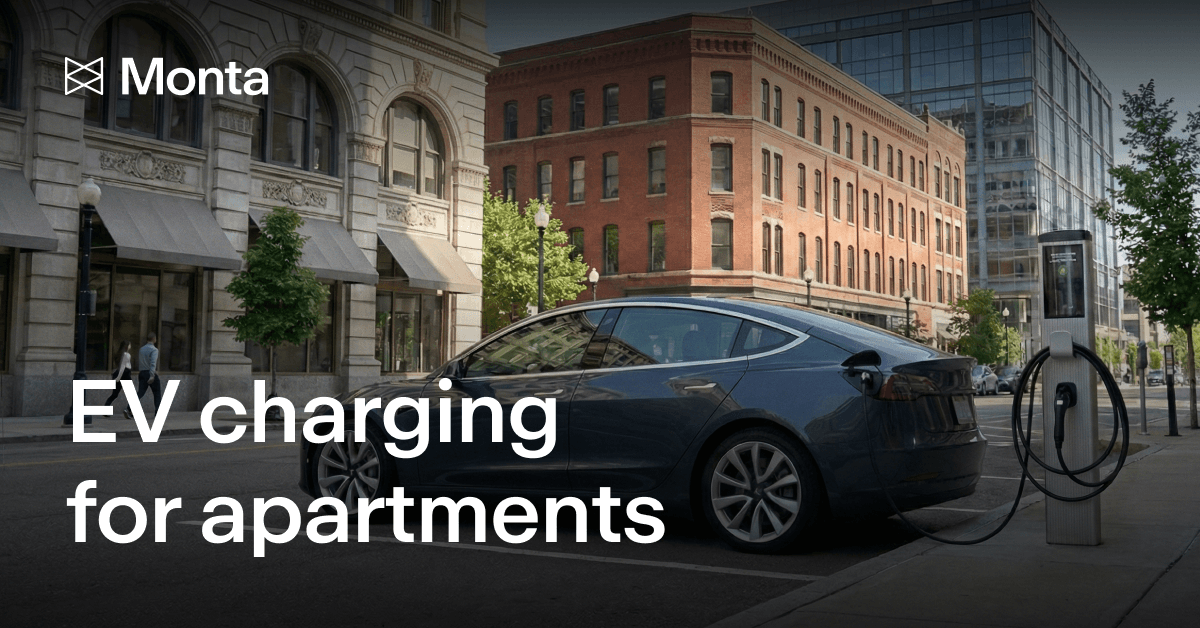
EV charging for apartments functions as a multifamily residential charging solution designed for apartment buildings, condominiums, and mixed-use residential properties where vehicles remain parked overnight or for extended periods. Apartment EV charging serves residents by providing predictable, home-based charging that fits daily routines and supports long-term electric vehicle ownership without reliance on public infrastructure. Property owners and building operators view Electric Vehicle (EV) charging for apartments as a strategic infrastructure upgrade that modernises parking assets, protects electrical capacity through managed load allocation, and strengthens long-term property competitiveness. Technology platforms (Monta EV charging management software from Monta) support the dual role by enabling resident access control, billing allocation, and operational oversight, which allows charging systems to operate reliably as a resident amenity and a core building utility.
What is EV charging for apartments?
EV charging for apartments refers to the installation, management, and operation of electric vehicle charging infrastructure within multi-family residential properties such as apartment buildings, condominiums, and mixed-use residential complexes. Apartment EV charging is designed to support resident-focused, long-duration charging that typically occurs overnight while vehicles remain parked within shared garages or surface lots and operate within existing building electrical constraints.
Apartment-specific EV charging models differ from single-family homes and public charging through shared infrastructure, multi-user access, and property-level oversight. Common models include dedicated or assigned charge points linked to individual residents, shared charging stations located in common parking areas, managed or networked charging systems that allocate access and control electrical load, and property-wide EV-ready infrastructure that supports phased expansion over time. Apartment EV charging solutions are engineered to serve multiple residents simultaneously while maintaining fair access, accurate billing allocation, and compliance with building-level electrical limits rather than prioritising high turnover or short-duration charging sessions.
How does EV charging for apartment buildings work?
EV charging for apartment buildings works through a shared residential charging model where charging infrastructure operates within common parking areas and serves multiple residents over extended dwell periods, typically overnight. Property management teams oversee access rules, electrical capacity allocation, and billing. Load management systems distribute available power across charge points to stay within building limits. Apartment charging design prioritises fair resident access, predictable availability, and protection of shared electrical systems rather than rapid vehicle turnaround.
EV charging in apartment buildings occurs passively over many hours while vehicles remain parked as part of daily residential living. Petrol fuelling functions as a short, attended transaction that requires active driver participation and dedicated retail infrastructure. Apartment EV charging integrates with residential routines and building systems, requiring coordination among residents, property management, and shared electrical infrastructure rather than on-site fuelling staff.
What does EV charging infrastructure look like for apartment complexes?
EV charging infrastructure for apartment complexes functions as a building-scale, multi-layer system that combines charging equipment, shared electrical capacity, load management software, and parking layout within a residential setting. Apartment EV charging infrastructure is designed to support overnight and long-duration charging for multiple residents while operating within panel, feeder, and transformer limits already serving the property.
Property operators design apartment charging systems to deliver fair access, predictable availability, and controlled electrical demand rather than high-power, single-vehicle charging. Infrastructure planning supports phased expansion, so additional charge points are added as resident EV adoption grows without repeated electrical reconstruction.
The core layers of EV charging infrastructure in apartment complexes are listed below.
- Charging hardware layer: Charging hardware primarily consists of AC charge points installed as wall-mounted or pedestal units within garages or surface parking areas.
- Building electrical capacity layer: Electrical infrastructure includes main panels, subpanels, risers, and shared circuits that define the total available charging capacity across the property.
- Load management and power-sharing layer: Load management systems distribute available power dynamically across multiple charge points to prevent overload and maintain electrical stability.
- Software and resident management layer: Software platforms manage resident authentication, charge point access, usage tracking, and billing allocation tied to individual apartments or users.
- Parking layout and site integration layer: Parking configuration determines charge point placement across assigned or shared spaces in enclosed garages or open lots, balancing accessibility and installation efficiency.
- Data, monitoring, and maintenance layer: Monitoring systems track charge point performance, energy consumption, and fault conditions to support maintenance, reporting, and long-term operational planning.
What is an EV charging station in a multi-family residential environment?
An EV charging station in a multi-family residential environment functions as a resident-focused charging unit installed within shared apartment or condominium parking areas to support long-duration, overnight vehicle charging. Property owners and building managers design each charging station to operate within shared electrical infrastructure while serving multiple residents rather than short-term public users.
Multi-family residential EV charging stations integrate with property management systems to control access, allocate electricity costs, and manage electrical capacity across many households. System design prioritises reliability, fair access, and compatibility with existing building panels and circuits to support sustained residential use as electric vehicle adoption increases.
The fundamental elements that define an EV charging station in a multi-family residential environment are listed below.
- Charging hardware: Charging hardware typically consists of AC charge points installed as wall-mounted or pedestal units suitable for residential parking areas.
- Electrical integration: Electrical integration connects charge points to building panels, subpanels, and shared circuits designed to support multiple simultaneous users.
- Load management and power sharing: Load management systems dynamically allocate available power across charge points to prevent overload and protect building electrical limits.
- Software and resident interface: Software platforms manage resident authentication, charge point assignment, and billing allocation tied to individual usage.
- Site integration: Site design aligns charging stations with assigned or shared parking spaces located in garages or surface parking lots.
- Data and reporting: Data systems track energy consumption, charge point status, and fault conditions to support maintenance, billing accuracy, and operational oversight.
Do apartment buildings support electric vehicles for property management or services?
Yes. Apartment buildings support electric vehicles for property management and on-site services as part of daily operations, cost control strategies, and sustainability programmes. Property owners and management companies deploy electric vehicles to support maintenance, inspections, security patrols, and internal transport within residential complexes.
The types of electric vehicles commonly used in apartment property management are listed below.
- Electric maintenance carts and utility vehicles: Electric maintenance carts support groundskeeping, waste handling, and minor repair activity across large apartment sites.
- Electric vehicles for property staff: Electric cars or small vans support leasing teams, property managers, and security staff who move between buildings or nearby properties.
- Electric service vans: Electric service vans support light maintenance, inspections, and equipment transport within urban or campus-style apartment developments.
- Third-party electric service vehicles: Electric delivery and service vehicles operated by contractors support resident services (parcel delivery, cleaning, and facilities management).
Apartment property management EVs operate on predictable schedules tied to daily building operations rather than overnight dwell patterns. Charging access prioritises operational readiness and availability for staff vehicles rather than equitable sharing among residents or visitor turnover. Apartment property management EVs typically rely on alternating current charging (AC) sized for overnight or off-shift charging. Power requirements remain modest because vehicle routes, mileage, and duty cycles remain limited to property boundaries and nearby service areas.
How is EV charging designed for rental apartment buildings?
EV charging for rental apartment buildings is designed to balance resident demand, shared electrical capacity, and property management control while supporting long-term scalability as electric vehicle adoption increases. Property operators and engineering teams structure charging systems to deliver predictable access, controlled power allocation, and transparent cost recovery without disrupting daily building operations or existing residents. Design strategies focus on shared infrastructure, managed charging, and phased expansion rather than high-power, single-user installations.
Charging design prioritises fair access through shared or policy-governed charging spaces, limits electrical impact through power sharing, and preserves management oversight across multi-tenant environments. Rental properties adopt flexible configurations that allow additional charge points to be added over time without requiring repeated construction or major electrical upgrades.
What are the key design considerations for EV charging in rental apartment buildings?
- Shared versus assigned charging spaces: Shared charging supports equitable access and lower upfront cost, while assigned spaces provide predictability for long-term residents.
- Building electrical capacity: Panel ratings, transformer limits, and feeder capacity define how much charging load a building can support without service upgrades.
- Load management systems: Power sharing distributes available capacity across multiple charge points to prevent overload and maintain reliability.
- Resident authentication and billing: Access control and billing allocation ensure electricity costs align with individual usage rather than shared property expenses.
- Parking layout constraints: Garage installations and surface lot deployments influence conduit routing, weather protection, and installation complexity.
- Phased deployment planning: Incremental installation supports growth in EV adoption without unnecessary early capital expenditure.
- Regulatory and code compliance: Local electrical codes and right-to-charge regulations shape system design, access policies, and installation approval processes.
How are EV charging areas planned for apartment parking garages and shared lots?
EV charging areas in apartment parking garages and shared lots are planned to maximise resident accessibility, electrical efficiency, and long-term scalability while limiting disruption to existing parking layouts and daily operations. Property owners and design teams position charging zones close to electrical rooms, panels, or risers to reduce conduit length, installation cost, and electrical losses. Layout decisions balance convenience for residents with practical construction constraints across enclosed garages and open surface lots.
Planning processes account for shared parking usage, predictable overnight dwell times, and available building electrical capacity. Charging areas are grouped into zones that support power sharing and load management, which allows multiple residents to charge without exceeding panel or transformer limits. Apartment operators design charging layouts to support phased expansion, ensuring additional charge points can be added as resident EV adoption increases without reworking core infrastructure.
How does EV charging design for apartments differ from single-family homes?
EV charging design for apartments differs fundamentally from single-family homes because apartment buildings operate shared electrical infrastructure across multiple residents, parking spaces, and users. Apartment charging systems require coordinated load management, access control, and property-level oversight to allocate limited electrical capacity fairly while maintaining system reliability. Building owners and managers design apartment EV charging around shared panels, feeders, and transformers, with charging governed by policies, software controls, and usage rules rather than individual choice.
Single-family homes rely on dedicated electrical service sized for one household, which allows private charge point installation without access management or shared capacity constraints. Homeowners prioritise simplicity, direct control, and fixed overnight charging, while apartment operators prioritise fairness, scalability, and protection of building electrical systems as resident EV adoption grows.
What types of EV charging are used in apartment buildings?
Types of EV charging used in apartment buildings are listed below.
- AC residential charging: AC charging delivers alternating current suitable for overnight and long-duration parking, common in apartment garages and surface lots. Apartment operators rely on AC charging to balance charging speed with building electrical limits.
- Dedicated or assigned resident charging: Assigned charging provides a specific charge point linked to an individual apartment or parking space. Property managers use assigned charging to support residents with predictable charging needs and stable long-term tenancy.
- Shared common-area charging: Shared charging stations operate in common parking areas and serve multiple residents on a scheduled or first-available basis. Apartment buildings deploy shared charging to reduce upfront cost and maximise utilisation of limited electrical capacity.
- Managed and load-balanced charging: Managed charging systems regulate power distribution across multiple charge points to prevent panel or transformer overload. Apartment buildings depend on load-balanced charging to support growth in resident EV adoption without immediate electrical upgrades.
- Networked and software-controlled charging: Networked charging integrates authentication, usage tracking, and billing allocation through central management platforms. Property operators use software-controlled charging to maintain fair access and transparent cost recovery.
- EV-ready infrastructure without active charge points: EV-ready infrastructure installs conduit, panels, and capacity allowances without immediately deploying charge points. Apartment developments use EV-ready designs to enable phased charge point installation as resident demand increases.
1. AC residential charging
AC residential charging delivers alternating current through dedicated charge points installed in apartment garages or surface parking areas to support overnight and long-duration resident charging. An AC residential charging represents the most common charging type deployed in apartment buildings because the charging speed aligns with overnight dwell time and shared electrical capacity. The installed cost for a single AC residential charge point reaches approximately £18,000–£25,000 ($22,500–$32,000, €21,000–€29,000), depending on wiring distance and panel availability.
2. Dedicated or assigned resident charging
Dedicated resident charging assigns a specific charge point to an individual apartment unit or parking space under long-term resident use. Dedicated charging appears frequently in higher-end apartment properties and long-tenancy buildings where predictable resident demand justifies individual allocation. Installed cost per assigned charge point typically reaches £20,000–£30,000 ($25,000–$38,000, €23,500–€35,000) due to additional wiring, metering, and administrative setup required for dedicated or assigned resident charging.
3. Shared common-area charging
Shared common-area charging places charge points in communal parking zones for use by multiple residents under scheduled or managed access rules. Shared charging remains very common in multi-family housing because shared access reduces upfront capital cost and electrical impact. The installation cost per shared charge point averages £15,000–£22,000 ($19,000–$28,000, €17,500–€26,000), influenced by charge point density and conduit routing associated with shared common-area charging.
4. Managed and load-balanced charging
Managed and load-balanced charging uses control systems to distribute available electrical capacity dynamically across multiple charge points. Managed charging adoption continues to increase in apartment buildings with limited electrical headroom or high EV adoption growth. Load management hardware and software integration costs £40,000–£70,000 ($50,000–$88,000, €47,000–€82,000) per building for managed and load-balanced charging.
5. Networked and software-controlled charging
Networked charging connects charge points to central platforms that manage authentication, billing allocation, monitoring, and reporting. Networked charging remains common in professionally managed apartment buildings that require resident billing and access oversight. Software licensing, connectivity, and commissioning costs typically reach £50,000–£80,000 ($63,000–$100,000, €59,000–€94,000) for networked and software-controlled charging.
6. EV-ready infrastructure without active charge points
EV-ready infrastructure installs conduit, panels, spare capacity, and mounting provisions without installing charge points immediately. EV-ready design appears frequently in new apartment construction to support phased deployment without repeated disruption. EV-ready preparation costs £3,000–£6,000 per parking space ($3,800–$7,500, €3,500–€7,000) for EV-ready infrastructure without active charge points.
How much does EV charging infrastructure cost for apartment complexes?
EV charging infrastructure for apartment complexes typically costs £25,000 to £40,000 per installed AC charging point ($32,000 to $50,000, €29,000 to €47,000), with total project costs for a small multi-family property commonly ranging from £150,000 to £400,000 ($190,000 to $510,000, €176,000 to €470,000) depending on scale and building conditions. Cost variation depends on charge point quantity, existing electrical capacity, parking configuration, and the degree of load management required. Apartment EV charging costs extend beyond charging hardware and frequently include electrical upgrades, conduit and trenching, networking software, and ongoing system management, particularly in older buildings where electrical infrastructure was not designed for vehicle charging loads.
Cost components that apartment complexes budget for when installing EV charging are listed below.
- EV charging hardware: Charging hardware primarily consists of AC charge points designed for shared or assigned residential parking.
- Electrical upgrades: Electrical work may involve panel upgrades, transformer reinforcement, subpanels, or new circuits to support additional load.
- Make-ready work: Make-ready construction covers conduit installation, trenching, wiring, and physical preparation within garages or outdoor parking areas.
- Load management systems: Load management and power-sharing systems distribute available capacity across multiple charge points to avoid electrical overload.
- Software platforms: Software systems manage resident authentication, usage tracking, billing allocation, and charge point monitoring.
- Permitting and commissioning: Permitting, inspections, commissioning, and maintenance ensure compliance, safety, and long-term reliability.
Apartment owners and operators should consider the following when budgeting for EV charging are listed below.
- Retrofit versus new construction costs: Existing buildings often require higher investment due to limited electrical capacity and structural constraints.
- Shared versus dedicated charge point strategies: Shared charge points reduce upfront cost, while dedicated installations increase predictability and resident satisfaction.
- Phased deployment planning: Incremental installation allows capacity expansion to track resident EV adoption rather than overbuilding early.
- Cost allocation models: Cost-sharing decisions influence whether expenses fall on property owners, residents, or blended billing structures.
- Incentives and rebates: Utility programmes, government incentives, and local grants can materially reduce upfront capital expenditure.
- Long-term scalability requirements: Early planning for future electrical capacity avoids repeated construction and disruptive upgrades as demand grows.
What power capacity do apartment EV charging systems typically require?
Apartment EV charging systems typically rely on alternating current (AC) charging with total power capacity planned at the building or parking-zone level rather than at the individual vehicle level. Building operators design capacity to support overnight charging across multiple residents by spreading available power through shared circuits and managed charging controls. Apartment charging strategies prioritise aggregate load control to remain within existing electrical service limits while delivering reliable overnight energy replenishment.
Required power capacity depends on charge point count, expected simultaneous use, available building electrical capacity, and deployment of load management systems, rather than maximum charging speed per vehicle. Electrical planners size installations to balance resident demand with panel ratings, transformer limits, and feeder capacity, which allows gradual expansion without triggering immediate service upgrades.
Factors influencing charging power selections for apartment EV charging are listed below.
- Overnight vehicle dwell time: Long overnight parking periods allow lower per-vehicle power while still achieving full battery charging.
- Resident EV adoption levels: Projected growth in EV ownership influences how much aggregate capacity a building allocates from the outset.
- Existing electrical capacity: Available panel, transformer, and feeder limits define the upper boundary for total charging power.
- Load management systems: Power-sharing and managed charging platforms distribute electricity dynamically to prevent overload.
- Parking configuration: Assigned parking supports predictable charging allocation, while shared parking requires more conservative power planning.
- Utility rate structures: Electricity tariffs and demand charges influence charging schedules and acceptable peak loads.
What are the benefits of EV charging for apartments and multi-family housing?
The benefits of EV charging for apartments and multi-family housing are listed below.
- Increased property competitiveness: EV charging increases appeal among renters who own electric vehicles and evaluate housing options based on charging availability.
- Higher resident retention: On-site charging reduces friction for existing renters who adopt electric vehicles, which lowers turnover and vacancy risk.
- Future-proofed building infrastructure: EV charging prepares properties for continued growth in electric vehicle ownership without requiring disruptive retrofits later.
- Increased property value: Charging infrastructure strengthens long-term asset relevance by aligning parking facilities with modern residential utility expectations.
- Support for sustainability and compliance goals: EV charging supports ESG targets, emissions reduction plans, and alignment with local or national electrification policies.
- Phased infrastructure investment: Planned charging deployment allows property operators to expand capacity gradually rather than responding to urgent demand under constrained timelines.
- Improved alignment with utility programmes: EV charging enables participation in utility incentives, managed charging schemes, and capacity planning initiatives that reduce capital exposure.
- Market differentiation: Charging availability differentiates properties within dense rental markets where amenities influence leasing decisions.
EV charging holds strategic importance for apartment buildings and multi-family housing because charging converts parking areas into long-term residential utilities rather than static amenities, which reinforces the role of EV charging for multifamily housing in long-term property strategy. Property operators that integrate charging early maintain competitiveness as electric vehicle ownership becomes standard and avoid costly last-minute electrical upgrades driven by regulatory pressure or resident demand.
How do apartment residents benefit from on-site EV charging?
Apartment residents benefit from on-site EV charging through the following.
- Convenient residential access: On-site EV charging gives apartment residents direct access to charging within their own building, which removes the need to travel to off-site charging locations during daily routines.
- Overnight charging during long dwell periods: Overnight parking allows electric vehicles to charge fully while residents sleep, which aligns naturally with residential schedules and reduces daily planning effort.
- Reduced reliance on public charging: Residential charging decreases dependence on public or roadside charging stations, which limits exposure to queues, downtime, and variable availability.
- Lower charging costs: Apartment-based charging typically costs less than public DC fast charging because electricity pricing reflects residential or building tariffs rather than premium retail rates.
- Improved charging reliability: Dedicated residential charge points provide consistent availability tied to assigned parking or managed access, which avoids uncertainty associated with shared public infrastructure.
- Greater confidence in EV ownership: Reliable home charging increases confidence when purchasing or switching to an electric vehicle because daily charging needs remain predictable and manageable within the residential environment.
How do property owners and building managers operate EV charging at apartments?
Property owners and building managers operate EV charging at apartments through structured control of access rights, electrical capacity allocation, billing administration, and ongoing equipment maintenance within shared residential parking facilities. Apartment charging operations centre on equitable resident access, predictable availability, and protection of building electrical systems rather than high turnover or revenue optimisation. Management teams assign charge points through permits, registrations, or unit-linked access, while electrical engineers define load limits that prevent panel overload and service interruptions. Billing systems allocate electricity costs accurately to residents through sub-metering or software platforms, which avoids disputes and supports transparent cost recovery. Maintenance protocols cover uptime monitoring, fault response, and safety compliance to ensure reliable daily operation across multi-tenant properties.
Will apartment buildings transition to fully electrified residential mobility?
Yes. Apartment buildings will transition to fully electrified residential mobility as electric vehicle adoption, building electrification policy, and utility-led infrastructure planning converge. Property owners, housing developers, and local authorities increasingly treat residential EV charging as a core building service rather than an optional amenity, which drives systematic deployment across new developments and retrofit programmes.
Future trends shaping electrified residential mobility include mandatory EV-ready building codes, declining battery costs, and expanded utility incentives that reduce installation barriers for multi-unit housing. Energy providers and network operators design managed charging frameworks that allow apartment EV charging to operate within existing grid constraints while supporting overnight load balancing. Real estate operators integrate charging infrastructure with building energy management systems to coordinate parking access, billing, and electrical capacity. Industry reporting and policy updates tracked through apartment EV charging news reinforce momentum towards large-scale residential electrification across urban housing stock.