
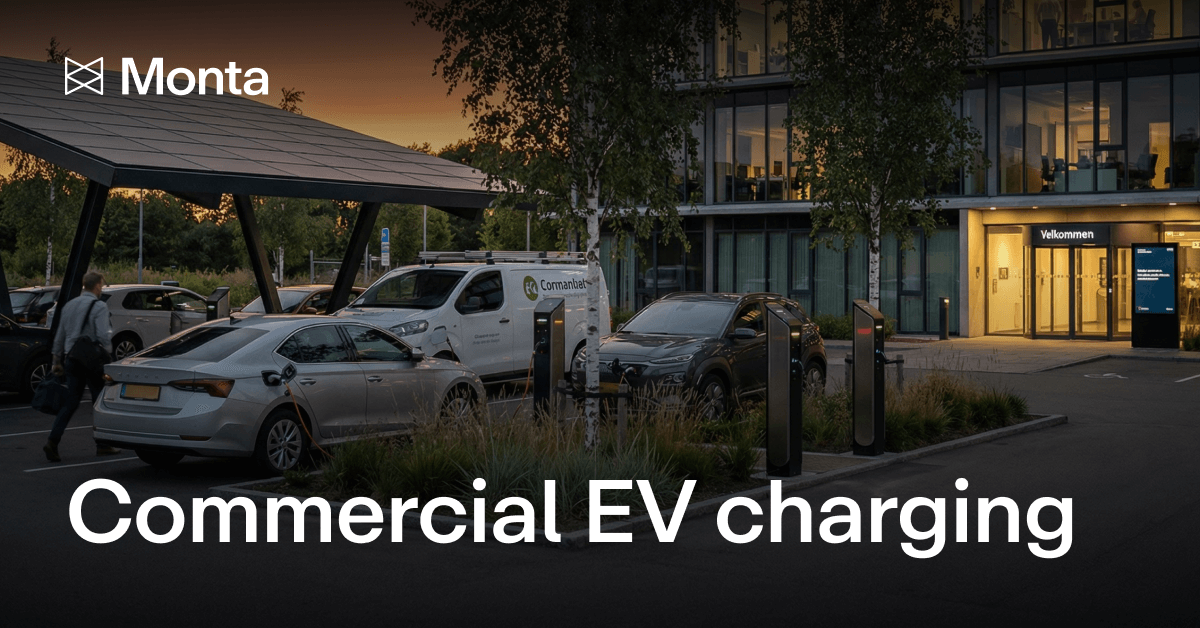
Commercial EV charging refers to charging infrastructure installed by businesses, property owners, and organisations to support electric vehicle use across public, semi-public, and private environments. These systems serve a wide range of use cases, including employee workplace charging, customer and visitor access at retail and hospitality sites, and dedicated fleet operations, with deployments scaling based on traffic, dwell time, and operational needs. Planning often considers equipment selection, power availability, and the long-term commercial EV charging station cost, while modern commercial electric vehicle charging stations increasingly rely on networked software to manage access, pricing, and reporting. As adoption grows, commercial electric vehicle chargers integrated with platforms such as Monta EV charging software help operators balance reliability, user experience, and energy management across diverse commercial settings.
What is commercial EV charging?
Commercial EV charging is the installation and operation of electric vehicle chargers at non-residential properties such as workplaces, retail centres, hotels, parking facilities, and fleet depots. Commercial EV chargers are designed for shared access, managed usage, or revenue-generating purposes, with systems that control access, track energy consumption, apply pricing when required, and support reliable charging for customers, employees, tenants, or fleet vehicles.
How does commercial EV charging work?
Commercial EV charging works by delivering electricity from the local power supply to an electric vehicle through installed charging equipment at a business or commercial property. Vehicles connect to a charger via a standard charging cable, and the charger supplies power at a specified level, depending on the charger type, site electrical capacity, and vehicle capability. Charging sessions are typically managed through access controls, pricing rules, and software platforms that track energy use, monitor performance, and process payments when applicable. Businesses operate commercial EV charging by aligning charger availability with parking durations, managing electrical load to avoid peak-demand issues, and integrating charging operations into daily site management.
What are the types of commercial EV charging stations?
The types of commercial EV charging stations are listed below.
- Level 2 commercial EV chargers: Level 2 commercial EV chargers provide reliable AC charging for locations where vehicles remain parked for several hours, such as workplaces, retail centres, hotels, and multifamily properties.
- DC fast chargers for commercial use: DC fast chargers provide high-power charging for rapid vehicle turnaround at high-traffic sites such as fuel stations, travel corridors, and fleet operations.
- Networked commercial EV charging stations: Networked commercial EV charging stations use connected software to manage access, monitor usage, control pricing, and support reporting across one or multiple locations.
- Non-networked commercial EV charging stations: Non-networked commercial EV charging stations offer basic plug-and-charge functionality without software connectivity, making them suitable for private or low-management charging environments.
1. Level 2 commercial EV chargers
Level 2 commercial EV chargers deliver AC power suited for locations where vehicles remain parked for several hours, such as workplaces, retail sites, hotels, and multifamily properties. Adoption remains the most common across commercial settings due to balanced cost and charging speed. Typical total costs for Level 2 commercial EV chargers range from £2,800 to £12,000 ($3,500 to $15,000, €3,300 to €14,000) per port, including equipment and standard installation, with higher costs driven by site complexity and electrical capacity.
2. DC fast chargers for commercial use
DC fast chargers provide high-power direct current charging designed for rapid turnaround at high-traffic locations such as fuel stations, travel centres, and fleet hubs. Adoption is less common than Level 2 due to higher costs and grid requirements, but it continues to grow along major corridors and among commercial fleets. Total installed costs for DC fast chargers for commercial use generally range from £14,000 to £280,000 ($18,000 to $350,000, €16,500 to €325,000) per port, depending on power level, utility upgrades, and equipment specifications.
3. Networked commercial EV charging stations
Networked commercial charging stations connect to cloud-based software that enables pricing control, user authentication, monitoring, reporting, and load management. Adoption is widespread among businesses that charge for usage or manage multiple chargers across sites. Costs for networked commercial EV charging stations typically include standard charger pricing plus software and connectivity fees, resulting in £3,200 to £14,000 ($4,000 to $18,000, €3,800 to €16,500) per Level 2 port installed, with ongoing network fees added annually.
4. Non-networked commercial EV charging stations
Non-networked commercial EV charging stations operate without software connectivity and provide simple plug-and-charge functionality. Adoption remains common in private workplaces and small sites where billing, access control, or monitoring is unnecessary. Installed costs are generally lower, ranging from £2,200 to £9,500 ($2,800 to $12,000, €2,600 to €11,200) per Level 2 charger, since there are no recurring software or networking expenses, which keeps long-term ownership predictable and maintenance minimal for site operators using non-networked commercial EV charging stations.
How much does a commercial electric vehicle charging station cost?
A commercial electric vehicle charging station typically costs £2,800 to £12,000 ($3,500 to $15,000, €3,300 to €14,000) per port for Level 2 chargers and £14,000 to £280,000 ($18,000 to $350,000, €16,500 to €325,000) per port for DC fast chargers, with final pricing driven by charger type, power level, and site conditions. Level 2 installations are suitable for workplaces, retail, hospitality, and multifamily properties where vehicles park for several hours, whereas DC fast charging targets high-traffic locations and fleets requiring rapid turnaround. Businesses must budget beyond hardware to include professional installation, permitting, trenching, cabling, and potential electrical upgrades such as panel expansions or new transformers. Many sites plan to integrate with an EV charging payment system to support managed access, billing, and revenue recovery as part of the overall project scope.
How long does it take to install a commercial EV charger?
Installing a commercial EV charger typically takes four to twelve weeks from planning to commissioning, depending on site readiness, permitting timelines, and electrical capacity. Projects at locations with existing electrical infrastructure and minimal trenching can be completed closer to the lower end of the range, while installations requiring utility coordination, panel upgrades, or transformer work extend timelines due to engineering reviews, approvals, and construction sequencing.
Is installing commercial electric vehicle charging stations a profitable investment?
Yes. Installing commercial electric vehicle charging stations can be a profitable investment when charging infrastructure aligns with location demand, parking duration, and a clear pricing or value strategy. Revenue comes from direct charging fees, increased customer dwell time, higher foot traffic, and improved tenant or employee retention, while long-term value is supported by rising EV adoption and predictable utilisation at workplaces, retail sites, hotels, fleets, and parking facilities. Profitability depends on charger utilisation, electricity pricing, installation scope, and whether charging serves as a paid service, a customer amenity that drives core business revenue, or a cost-recovery model integrated into broader commercial operations.
What are the common applications of commercial EV charging?
The common applications of commercial EV charging are listed below.
- Commercial EV charging for workplaces: Workplace charging supports employee and company vehicle charging during standard business hours, aligning energy use with predictable parking durations and daily schedules.
- Commercial EV charging for retail and shopping centres: Retail charging provides convenient access while customers shop, encouraging longer visits and supporting locations where dwell time naturally matches charging duration.
- Commercial EV charging for hotels and hospitality businesses: Hospitality charging serves overnight and extended stays, allowing guests to recharge vehicles while parked and meeting growing expectations among EV-driving travellers.
- Commercial EV charging for parking garages and commercial car parks: Parking garage charging supports long-duration parking in dense urban areas, transit hubs, and event venues where vehicles remain stationary for several hours.
- Commercial EV charging for fleet and depot charging: Fleet and depot charging enables centralised charging for delivery vans, service vehicles, buses, and trucks that return to a common operating base on fixed schedules.
- Commercial EV charging for multifamily and mixed-use properties: Multifamily and mixed-use charging provides shared access for residents, tenants, and visitors with varying dwell times, supporting long-term property usability and EV adoption.
1. Commercial EV charging for workplaces
Employee and fleet charging programmes support vehicles parked during standard business hours and rely on predictable daily usage patterns. Adoption remains strong among medium and large employers, with typical installation costs ranging from £1,800–£5,000 ($2,300–$6,300, €2,100–€5,900) per Level 2 charger based on electrical capacity and installation scope. Many employers implement structured programmes using commercial EV charging for workplaces to support retention and electrification goals.
2. Commercial EV charging for retail and shopping centres
Retail charging aligns vehicle dwell time with shopping behaviour and encourages longer visits across urban and suburban centres. Deployment remains widespread, with costs generally between £2,000–£7,000 ($2,500–$8,800, €2,300–€8,200) per Level 2 charger, excluding major electrical upgrades. Customer-focused installations frequently rely on commercial EV charging for retail and shopping centres to support foot traffic and brand positioning.
3. Commercial EV charging for hotels and hospitality businesses
Hospitality charging supports overnight and extended stays where vehicles remain parked for several hours. Adoption continues to increase across mid-range and premium properties, with installation costs typically falling between £2,500–£8,000 ($3,200–$10,000, €2,900–€9,400) per charger depending on parking layout and power availability. Guest amenities increasingly depend on commercial EV charging for hotels and hospitality businesses to meet traveller expectations.
4. Commercial EV charging for parking garages and commercial car parks
Dense urban locations benefit from long-duration charging where vehicles remain parked for workdays or events. Deployment remains common in city centres, with costs ranging from £2,500–£9,000 ($3,200–$11,400, €2,900–€10,500) per charger due to conduit routing and structural constraints. Urban infrastructure strategies frequently incorporate commercial EV charging for parking garages and commercial car parks to support sustained utilisation.
5. Commercial EV charging for fleet and depot charging
Centralised charging supports predictable schedules for delivery, service, and municipal fleets returning to a common base. Adoption continues to expand, with AC chargers typically costing £800–£2,500 ($1,000–$3,200, €900–€2,900) and DC chargers ranging from £10,000–£35,000 ($12,500–$45,000, €11,700–€41,000), excluding electrical upgrades. Operational reliability often depends on commercial EV charging for fleet and depot charging integrated with load planning.
6. Commercial EV charging for multifamily and mixed-use properties
Shared developments require charging access for residents, tenants, and visitors with varying dwell times. Adoption is increasing alongside EV ownership growth, with typical costs of £2,000–£6,000 ($2,500–$7,600, €2,300–€7,000) per Level 2 charger, depending on parking access and shared infrastructure. Property strategies increasingly rely on commercial EV charging for multifamily and mixed-use properties to support long-term asset value.
What are the benefits of commercial EV charging?
The benefits of commercial EV charging are listed below.
- Attracting customers and visitors: Commercial EV charging draws EV drivers to retail, hospitality, and destination sites, increasing foot traffic and visit duration.
- Supporting employee retention and benefits: Workplace charging provides a practical benefit for employees who drive electric vehicles, improving satisfaction and daily convenience.
- Generating new revenue streams: Paid charging enables businesses to recover energy and infrastructure costs through per-kWh, per-minute, or session-based pricing.
- Strengthening brand and sustainability positioning: EV charging signals environmental commitment and aligns operations with corporate sustainability and ESG objectives.
- Future-proofing property and operations: Charging infrastructure prepares commercial sites for continued EV adoption and protects long-term asset value.
- Reducing fleet operating costs: On-site charging lowers fuel expenses for company vehicles compared with public fast-charging or fossil fuel alternatives.
- Increasing property value and marketability: Commercial properties with EV charging appeal more strongly to tenants, customers, and investors.
- Enabling data and energy management: Smart charging platforms provide usage data, cost tracking, and load control that improve operational planning.
- Supporting regulatory and policy alignment: EV charging helps businesses meet local regulations, planning requirements, and sustainability mandates.
- Encouraging longer dwell time: Charging availability keeps vehicles parked longer, which increases spending potential at retail and leisure locations.
How to choose the right commercial EV charging solution
To choose the right commercial EV charging solution, follow the 10 steps listed below.
- Assess charging use case. Define whether charging supports fleets, employees, customers, or mixed use, since dwell time, access control, and utilisation patterns directly affect charger type and layout.
- Evaluate vehicle mix and power needs. Review vehicle battery sizes, daily mileage, and turnaround requirements to determine appropriate power levels (AC Level 2 versus DC fast charging).
- Analyse site electrical capacity. Confirm available electrical service, panel capacity, and upgrade requirements to avoid unexpected infrastructure costs and deployment delays.
- Select the right charger types. Match charger hardware to operational needs by balancing upfront cost, charging speed, durability, and long-term scalability.
- Plan for load management and software. Choose a solution with smart charging, scheduling, and monitoring capabilities to control demand charges, ensure uptime, and support reporting.
- Consider user access and payment models. Decide whether charging will be free, reimbursed, or paid, and confirm the platform supports pricing, authentication, and usage tracking.
- Review installation and maintenance support. Evaluate installer experience, warranty coverage, and ongoing maintenance services to protect long-term reliability.
- Account for future growth. Design the system with expansion in mind by reserving electrical capacity and selecting hardware and software that scale with additional chargers.
- Compare total cost of ownership. Weigh equipment, installation, energy costs, and operational expenses over time rather than focusing only on the initial purchase price.
- Validate compliance and incentives. Confirm regulatory compliance and identify available grants, rebates, or tax incentives that reduce net project cost.