
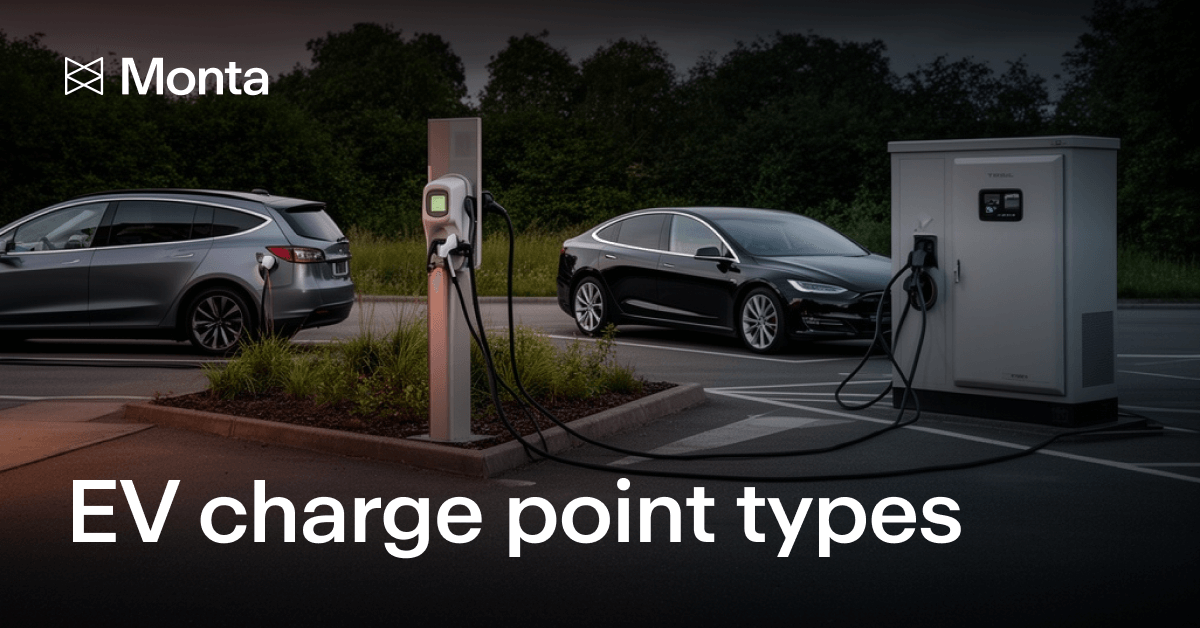
EV charge point types vary by power output, charging speed, installation requirements, and intended use environment, making charge point selection a critical decision for electric vehicle owners and property operators. EV charge point types range from low-power residential solutions to high-capacity public and fleet systems, with each category designed to match specific parking durations and electrical constraints. Understanding charge point types allows drivers and businesses to select appropriate equipment for home charging, workplace use, or public access, while avoiding unnecessary cost and infrastructure upgrades. Clear knowledge of different types of charge points improves charging reliability, supports battery health, and aligns charging behaviour with daily travel patterns across residential, commercial, and public environments.
The different types of charge points are listed below.
- AC slow EV charge points: Entry-level, using standard household outlets for slow overnight or emergency charging in residential settings.
- AC fast EV charge points: AC fast charge points provide moderate-power AC charging for homes, workplaces, and car parks where vehicles remain parked for several hours.
- DC fast charge points (Level 3): DC fast charge points deliver high-power direct current for rapid charging at service stations, travel corridors, and high-turnover locations.
What are the different types of EV charge points?
The different types of EV charge points are listed below.
- AC slow EV charger: An AC slow EV charger delivers low-power alternating current through a standard household outlet at 1.4 kW to 2.3 kW, requires 20 to 40 hours to recharge 40 kWh to 70 kWh batteries.
- AC fast EV charger: An AC fast EV charger supplies alternating current through dedicated circuits at 7 kW to 22 kW, recharges 50 kWh to 80 kWh batteries in six to ten hours.
- DC fast charge point (Level 3): A DC fast charge point delivers direct current at 50 kW to 350 kW for rapid EV charging that restores up to eighty per cent of 60 kWh to 100 kWh batteries in twenty to forty minutes.
1. AC slow EV charge point
An AC slow EV charge point delivers low-power alternating current through a standard household outlet and serves as an entry-level charging solution for residential and emergency use. An AC slow EV charge point operates at AC slow charging standard, with a power output of 1.4 kW to 2.3 kW. Charging time ranges from 20 to 40 hours for a full recharge of batteries with capacities between 40 kWh and 70 kWh. Equipment costs generally range from £200 to £600 ($250 to $750 / €230 to €700), with minimal installation expense when existing outlets meet electrical safety requirements.
2. AC EV charge point
An AC fast EV charge point supplies higher-power alternating current through dedicated electrical circuits and represents the most common solution for homes, workplaces, and commercial sites. An AC EV charge point operates at the AC fast charging standard with power levels between 7 kW and 22 kW. Charging time ranges from six to ten hours for batteries with capacities between 50 kWh and 80 kWh. Installed costs range from £1,500 to £5,000 ($1,900 to $6,300 / €1,750 to €5,900) per unit, depending on wiring distance, panel upgrades, and site conditions.
3. DC fast charge point (Level 3)
A DC fast charger, often referred to as Level 3 charging, delivers high-power direct current directly to the vehicle battery to support rapid energy replenishment in public and fleet environments. A DC fast charge point (level 3) operates under DC fast-charging standards, with power outputs ranging from 50 kW to 350 kW. Charging time usually ranges from twenty to forty minutes to reach eighty per cent capacity for batteries between 60 kWh and 100 kWh. Installed costs range from £120,000 to £300,000 ($150,000 to $380,000 / €140,000 to €350,000) per charger, driven by equipment rating, transformer upgrades, and grid connection requirements.
What are the different charging connector types?
The different charging connector types are listed below.
- CCS (Combined Charging System): A universal AC and DC charging standard operating at 50 kW to 350 kW, enabling most passenger vehicles to recharge from 20% to 80% in 20 to 40 minutes through direct battery connection and onboard system communication.
- CHAdeMO: A Japanese-developed DC fast charging standard operating at 50 kW to 100 kW that supports 30 to 60 minute partial recharging through a dedicated connector and digital safety controls within established EV charging connector types.
- Tesla Supercharger: Tesla Superchargers are proprietary DC charging systems that deliver 150 kW to 250 kW, using automated vehicle recognition and integrated battery management software to restore significant driving range in 15 to 25 minutes.
- Wireless EV charging: Wireless EV charging transfers power through electromagnetic induction at 3 kW to 11 kW using ground pads and vehicle receivers to support unattended overnight and long-duration parking.
- Portable EV charge points: Portable EV charge points provide flexible 2 kW to 7 kW charging via household or industrial outlets, with built-in safety electronics for slow or emergency power delivery.
- Bidirectional charge points: Bidirectional charge points operate at 7 kW to 22 kW and enable controlled two-way energy flow between vehicles and buildings or grids through advanced power electronics.
- Pantograph charging for buses: Pantograph charging systems deliver 150 kW to 600 kW via automated overhead connectors, recharging electric buses within minutes during scheduled operational stops.
1. CCS (Combined Charging System)
CCS is a universal charging standard that supports both AC and DC charging through a single vehicle inlet, widely used across European and North American EV models. CCS fast charging operates at 50 kW to 350 kW, enabling most passenger vehicles to recharge from 20% to 80% in 20 to 40 minutes. Installed DC fast-charging systems using CCS (Combined Charging System) cost £40,000 to £180,000 ($50,000 to $230,000 / €47,000 to €210,000) per charger. CCS works by supplying direct current from the charge point directly to the vehicle battery while communicating with onboard systems to regulate voltage, current, and temperature.
2. CHAdeMO
CHAdeMO is a DC fast charging standard developed in Japan and used primarily by older Nissan and Mitsubishi models. CHAdeMO charge points operate at 50 kW to 100 kW, enabling partial recharging in 30 to 60 minutes. Installed CHAdeMO fast charge points cost £35,000 to £120,000 ($44,000 to $150,000 / €41,000 to €140,000) per unit. CHAdeMO uses a dedicated DC connector to deliver power directly to the battery while managing charging safety through digital communication protocols.
3. Tesla Supercharger
Tesla Superchargers are proprietary high-power DC charging systems originally developed for Tesla vehicles, though the European Supercharger network now supports other CCS2-compatible EVs. Modern Superchargers deliver 150 kW to 250 kW, enabling many Tesla models to recover up to 250 kilometres of range in 15 to 25 minutes. Commercial-grade Tesla Supercharger installations cost £80,000 to £250,000 ($100,000 to $320,000 / €94,000 to €290,000) per charging unit. Tesla Superchargers use automated vehicle recognition and integrated battery management software to optimise charging speed and efficiency.
4. Wireless EV charging
Wireless EV charging transfers energy through electromagnetic induction without physical cables, using ground-mounted pads and vehicle-mounted receivers. Wireless systems usually operate between 3 kW and 11 kW, which is suitable for overnight and long-duration parking rather than rapid charging. Installed wireless EV charging systems cost £6,000 to £18,000 ($7,500 to $23,000 / €7,000 to €21,000) per parking space. Wireless charging works by creating an alternating magnetic field between the transmitter and receiver coils, which converts into electrical energy inside the vehicle.
5. Portable EV charge points
Portable EV charge points are compact plug-in devices that allow vehicles to charge from standard wall outlets or industrial sockets. Portable charge points usually deliver between 2 kW and 7 kW, which supports slow overnight charging or emergency use. High-quality portable EV charge points cost £200 to £900 ($250 to $1,100 / €230 to €1,050) per unit. Portable charge points convert household or industrial AC power into a controlled charging current for the vehicle through built-in safety electronics.
6. Bidirectional charge points
Bidirectional charge points enable electricity to flow into and out of an electric vehicle battery, supporting vehicle-to-grid, vehicle-to-building, and backup power applications. Bidirectional systems usually operate between 7 kW and 22 kW for residential and fleet use. Installed bidirectional charge points cost £5,000 to £15,000 ($6,300 to $19,000 / €5,800 to €17,500) per unit. Bidirectional charge points use advanced power electronics to manage controlled battery discharge while synchronising with grid voltage and frequency.
7. Pantograph charging for buses
Pantograph charging systems deliver very high-power electricity to electric buses through overhead conductive arms installed at depots or route stops. Pantograph charge points operate at 150 kW to 600 kW, enabling buses to recharge in 5 to 20 minutes during scheduled stops. Installed pantograph charging for buses costs £100,000 to £350,000 ($125,000 to $440,000 / €117,000 to €410,000) per site. Pantograph charging works by automatically lowering a conductive arm onto roof-mounted contacts, enabling rapid and secure power transfer without manual cable handling.
How to choose the right EV charge point type?
To choose the right EV charge point type, follow the 10 steps listed below.
- Evaluate daily driving distance. Drivers calculate average daily mileage to determine how much energy needs to be replenished between charging sessions.
- Review vehicle battery capacity and range. Owners assess battery size and rated driving range to match charging speed with realistic energy requirements.
- Identify the primary charging location. Users confirm whether charging will occur at home, at work, at a depot, or at public sites, since location determines electrical access and installation options.
- Assess available electrical capacity. Property owners examine outlet ratings, panel capacity, and wiring condition to confirm compatibility with higher-power charge points.
- Define the required charging speed. Drivers and operators decide whether overnight charging meets needs or whether rapid turnaround requires DC fast charging.
- Set a realistic budget. Buyers consider equipment cost, installation expense, permitting fees, and potential electrical upgrades.
- Evaluate installation complexity. Decision-makers review trenching requirements, cabling distance, ventilation rules, and structural constraints.
- Consider long-term usage patterns. Users account for future mileage growth, additional vehicles, and increases in battery size.
- Compare operating and maintenance costs. Owners review electricity tariffs, network fees, software subscriptions, and servicing requirements.
- Plan for scalability and compliance. Buyers select systems that support future expansion and meet safety and regulatory standards.
What is the fastest EV charge point type?
The fastest EV charge point type is megawatt-level DC charging, which delivers ultra-high-power direct current at levels exceeding 1,000 kW and is designed primarily for heavy-duty electric trucks and buses. The charging technology enables very large battery systems to recharge within minutes rather than hours, making it the highest-speed charging solution currently available for commercial and industrial electric vehicles.
How long does it take to charge an electric car?
Charging an electric car takes between 30 minutes and 24 hours, depending on charge point type, battery capacity, and starting state of charge. AC slow charging through a standard household outlet takes 12 to 24 hours or more to recharge a full battery because the power output is very low. AC fast charging at homes, workplaces, and public sites usually restores a typical 60-80 kWh battery in 6-10 hours, which is suitable for overnight or full-day parking.
DC fast charging supplies high-power direct current that can recharge most electric vehicle batteries by 20 per cent to 80 per cent in 20 to 60 minutes, depending on the charging point and battery design. Charging speed slows as batteries approach full capacity to protect long-term performance, which explains why rapid charging focuses on partial replenishment rather than complete charging.
Can I use an AC slow charge point at home?
Yes, you can use an AC slow charge point at home. An AC slow charge point can be used at home because it plugs into a standard household outlet and requires no special electrical installation. The charging method suits drivers with low daily mileage, long overnight parking periods, and access to reliable residential power.
AC slow charging delivers very low power, so full charging often takes 12 to 24 hours or longer for modern electric vehicles. Drivers who travel longer distances or require faster turnaround benefit from upgrading to AC fast home charging for greater convenience and reliability.
How much does installation cost for EV charge points?
EV charge point installation costs £800 to £3,000 ($1,000 to $3,800, €900 to €3,500) for basic AC slow charge points and simple AC fast residential setups. Commercial and multi-unit AC fast charge points installations cost £2,000 to £8,000 ($2,500 to $10,000, €2,300 to €9,400) per charge point when electrical upgrades and professional commissioning are required as part of a broader EV charging infrastructure. Complex commercial sites, fleet depots, and public facilities that require panel expansions, transformer upgrades, trenching, and utility coordination incur installation costs between £10,000 and £50,000 ($12,500 to $63,000, €11,700 to €58,500+) per charger.
Installation costs depend primarily on the charge point type, available electrical capacity, cabling distance, trenching requirements, and permitting complexity. AC fast charge point installation is more expensive than AC slow because it requires dedicated circuits, higher-capacity wiring, and panel upgrades. Sites with limited electrical headroom or long cable runs face higher costs due to additional engineering and construction work.
How much does an EV charge point cost?
EV charge points cost £200 to £600 ($250 to $750, €230 to €700) for AC slow units, £500 to £2,500 ($630 to $3,200, €580 to €2,900) for AC fast charge points, and £20,000 to £120,000 ($25,000 to $150,000, €23,500 to €140,000) for DC fast charge points, depending on power rating, brand reputation, durability, and software features. Basic charge points with limited connectivity and standard safety functions fall at the lower end of each range. Networked systems with load management, billing integration, and advanced monitoring command higher prices.
Charge point costs vary by power level, manufacturer quality, enclosure rating, communication capability, and warranty coverage. AC slow charge points remain the least expensive because they use standard outlets and minimal electronics, while DC fast charge points are the most expensive due to industrial-grade power components, cooling systems, and grid integration requirements.
How much does it cost to operate EV charge points?
Operating EV charge points costs £0.12 to £0.30 per kWh ($0.15 to $0.38, €0.14 to €0.35) in electricity expenses, depending on local energy tariffs, time-of-use pricing, and charging volume. A moderately used AC fast charge point serving 8,000 to 12,000 kWh per year, therefore incurs annual electricity costs between £1,000 and £3,600 ($1,250 to $4,500, €1,150 to €4,200). Public and commercial DC fast charge points face higher energy and demand charges, which can raise operating costs to £3,000 to £8,000+ per unit per year ($3,800 to $10,000, €3,500 to €9,400+).
Operating costs depend on electricity rates, charge point efficiency, and usage frequency, with high-utilisation sites experiencing higher monthly expenses. Public charge points incur additional network fees, software subscriptions, payment processing charges, and maintenance contracts, ranging from £200 to £1,000 per charge point per year ($250 to $1,250, €230 to €1,150). Routine inspections, firmware updates, and component replacements further affect long-term operating budgets.
How are different EV charge points used?
The different EV charge points used are listed below.
- Home charging: Home charging supports private vehicle owners through AC slow or fast charge points installed in garages and driveways, where long overnight dwell time allows slow and moderate charging aligned with household electrical capacity.
- Workplace charging: Workplace charging serves employees and company vehicles through shared AC fast charge points in staff car parks, where predictable daytime parking enables managed charging and controlled access.
- Public charging: Public charging provides open-access charging at retail centres, motorway services, and urban locations using a mix of AC and DC fast charge points to support short-stay and transit-based users.
- Fleet charging: Fleet charging supplies electricity to commercial, municipal, and service vehicles through managed depot systems that coordinate charging schedules, power limits, and operational priorities.
- Depot charging: Depot charging supports centralised overnight and turnaround charging for delivery vans, buses, and logistics vehicles using structured layouts, high-capacity electrical infrastructure, and load management platforms.
1. Home charging
Home charging supplies electricity to private vehicles through AC slow or fast charge points installed in garages and driveways. Most households use 2 kW to 7 kW charge points that recharge typical 50 kWh to 70 kWh batteries in eight to thirty hours. A home charging equipment and installation usually costs £500 to £2,500 ($630 to $3,200, €580 to €2,900) depending on electrical upgrades and charge point features.
2. Workplace charging
Workplace charging provides power to employee and company vehicles through shared AC fast charge points installed in staff car parks, operating at 7 kW to 22 kW and capable of charging 50 kWh to 80 kWh batteries in four to ten hours. A workplace charging installation costs £1,500 to £5,000 ($1,900 to $6,300, €1,750 to €5,900) per charger, including equipment and standard installation.
3. Public charging
Public charging delivers electricity through networked AC and DC fast charge points at retail centres, service stations, and transport hubs. A public charging power level ranges from 7 kW to 350 kW and charging times from 20 minutes to 8 hours. Public charging infrastructure costs £2,000 to £200,000+ ($2,500 to $250,000, €2,300 to €235,000+) per unit, depending on equipment rating and site complexity.
4. Fleet charging
Fleet charging supplies energy to commercial and municipal vehicles through managed fast AC and DC charging systems at operating bases, providing 7 kW to 150 kW per charge point and recharging vehicles within two to twelve hours under scheduled control. A fleet charging system requires approximately £6,000 to £15,000 per vehicle ($7,500 to $19,000, €7,000 to €17,500) in installed infrastructure investment.
5. Depot charging
Depot charging supports centralised overnight and turnaround charging for delivery vans, buses, and logistics fleets using high-capacity AC fast, DC fast, and pantograph systems, with depot charging outputs ranging from 22 kW to 600 kW. Depot charging restores most commercial vehicle batteries within one to eight hours and requires £50,000 to £900,000+ per site ($63,000 to $1,140,000, €58,000 to €1,050,000), depending on fleet size and electrical upgrades.