
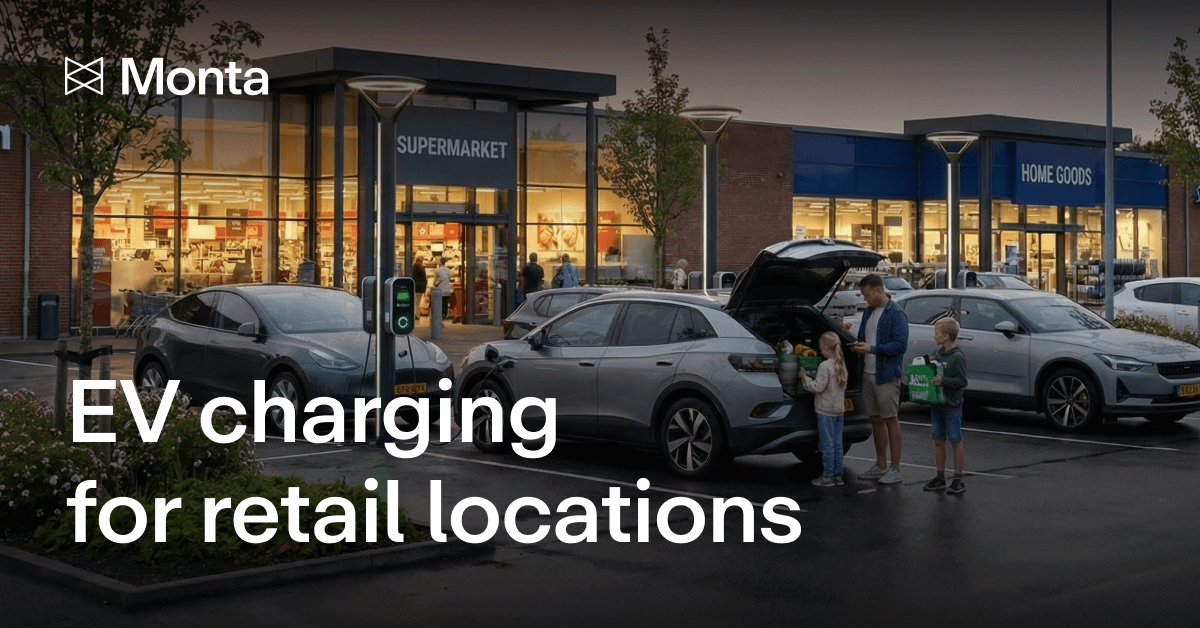
EV charging for retail locations functions as a commercial electric vehicle (EV) infrastructure solution integrated directly into shopping centres, big-box stores, grocery outlets, and mixed-use consumer destinations where vehicles already park as part of routine visits. Retail EV charging supports longer dwell time, incremental foot traffic, brand differentiation, and potential revenue through paid sessions or bundled retail incentives tied to a retail commercial EV charging station from a business operator’s perspective. Retail EV charging provides convenient, time-aligned charging during shopping or dining without altering travel behaviour, which improves the overall visit experience from a customer or visitor perspective. Retail staff view EV charging as a workplace amenity that supports multi-hour shifts and predictable parking patterns, often managed separately from public chargers to preserve availability. Fleet and service operators rely on charging access at retail sites to support light-duty delivery, maintenance, or kerbside operations that occur during business hours. Coordinating these overlapping use cases requires software-driven control, pricing, and load management, which positions Monta EV charging management software as a critical layer for balancing access, uptime, and energy costs across diverse retail charging demands.
What is EV charging for retail locations?
EV charging for retail locations refers to the installation and operation of electric vehicle charging stations at shopping malls, big-box stores, grocery stores, and mixed-use retail properties to support vehicle charging during customer visits. Retail EV charging primarily serves shoppers who charge while parked, while extending access to retail staff, on-site tenants, and occasional service or delivery vehicles that operate from the same locations. Use cases vary by retail format, since shopping malls and lifestyle centres support longer dwell times and multiple chargers, big-box and grocery stores prioritise shorter visits with higher parking turnover, and standalone retail or strip malls manage charging within limited parking areas shared by many users. Charging systems at retail locations are designed to handle frequent daily public use, accommodate different dwell times, and maintain availability in high-traffic environments with constant customer turnover.
How does EV charging for retail locations work?
EV charging for retail locations works by allowing a vehicle to park in a designated charging space, connect to a charger, authenticate access when required, and draw electricity while the driver shops, dines, or browses on-site. Charging sessions are intentionally aligned with typical retail dwell time rather than full battery refuelling, which means vehicles gain a partial but useful range increase during a normal visit. Retail charging access and payment are commonly managed through free charging offered as an amenity, time-based pricing to encourage turnover, energy-based pricing per kilowatt-hour, or app-based and card-based payment systems that operate without staff involvement.
EV charging in retail environments differs from traditional fuelling because energy is delivered gradually over the duration of a parking stay instead of through a short, attended refuelling stop. Charging becomes part of the parking experience, allowing customers to leave vehicles unattended while shopping, and removes the need for dedicated staff interaction, pump handling, or constant vehicle supervision that defines petrol or diesel refuelling.
What does EV charging infrastructure look like for commercial retail locations?
EV charging infrastructure for commercial retail locations consists of a coordinated system of physical charging hardware, electrical supply and distribution equipment, software platforms, and on-site layout elements integrated into retail parking areas to support safe, convenient, and managed charging during shopping visits. Commercial EV charging infrastructure is designed to align charging duration with customer dwell time while fitting within the operational, electrical, and space constraints of retail properties, making commercial retail EV charging installation a planned extension of the site rather than a standalone asset.
Core layers of EV charging infrastructure in retail operations are listed below.
- Charging hardware layer: The charging hardware layer includes Level 2 or DC fast chargers, connectors, pedestals, and mounting systems that physically deliver power to vehicles parked in retail car parks.
- Electrical supply and distribution layer: The electrical layer consists of service connections, panels, transformers, conduit, and cabling that supply and distribute power to chargers while maintaining compliance with site capacity and utility limits.
- Energy and load management layer: Energy management controls power balance across multiple chargers, limits peak demand, and coordinates charging activity to protect the electrical infrastructure and reduce operating costs.
- Software and platform layer: Software platforms handle charger monitoring, session control, pricing, access permissions, and reporting, providing centralised visibility and operational control across the retail site.
- Payment and user interface layer: The payment layer supports customer transactions via mobile apps, RFID cards, or card terminals, ensuring clear pricing and a consistent customer experience during retail visits.
- Site layout and integration layer: The site integration layer covers charger placement, parking design, signage, lighting, accessibility, and traffic flow to ensure charging fits naturally into retail parking patterns.
- Data, analytics, and reporting layer: Data systems collect usage, uptime, and revenue metrics that support performance tracking, operational decisions, and long-term planning for commercial EV charging infrastructure expansion.
What is an EV charging station in a retail location setting?
An EV charging station in a retail location setting is a customer-facing electric vehicle charging unit installed within retail parking areas to support short- to medium-duration charging while shoppers visit stores, dine, or access on-site services, aligning charging time with typical retail dwell periods.
Fundamental elements that define an EV charging station for retail locations are listed below.
- Charging hardware: Charging hardware consists of Level 2 or DC fast chargers with defined connector types and power ratings that determine charging speed and suitability for typical retail visit lengths.
- Energy and load management: Energy and load management systems balance charging demand with the site’s electrical capacity to prevent overloads, control peak demand, and maintain reliable operation across multiple chargers.
- Software and control systems: Software platforms manage user access, session initiation, pricing rules, and charger status, enabling controlled operation and integration with broader retail or property systems.
- Payment and customer interface: Payment and customer interfaces support transactions through mobile apps, RFID cards, or credit card terminals, providing clear pricing and a frictionless charging experience for shoppers.
- Site integration and visibility: Site integration focuses on charger placement, signage, lighting, accessibility, and wayfinding to maximise convenience, safety, and awareness within the retail parking environment.
- Data and reporting: Data and reporting tools track usage metrics, revenue performance, charger uptime, and customer behaviour, supporting operational optimisation and informed investment decisions.
Do retail locations operate electric delivery vehicles or service fleets?
Yes, retail locations increasingly operate electric delivery vehicles and electric service fleets to support last-mile delivery, kerbside fulfilment, store operations, and sustainability goals, especially in urban and suburban markets where predictable routes and return-to-base operations favour electrification.
Types of electric vehicles commonly used by retail locations are listed below.
- Electric delivery vans: Electric delivery vans handle local and last-mile deliveries from stores or micro-fulfilment centres, operating on fixed routes with predictable daily mileage and overnight return to a retail or depot location.
- Electric service and maintenance vehicles: Electric service vehicles support facilities, security, cleaning, and maintenance functions across retail properties, typically driving short distances with frequent stops.
- Electric kerbside pickup and micro-fulfilment vehicles: Smaller electric vehicles move goods between on-site storage, pickup zones, and nearby delivery points, prioritising manoeuvrability and frequent access to charging.
- Third-party electric delivery fleets: External logistics providers use electric vans or trucks to service retail stores and customers, often charging at shared depots or designated retail charging areas under commercial agreements.
Retail EV fleets operate on scheduled, operational charging rather than opportunistic public charging. Charging is planned around shifts, delivery windows, and vehicle availability, with controlled access, predictable dwell time, and centralised management instead of ad-hoc customer usage. Retail delivery and service vehicles primarily rely on Level 2 AC charging (7–22 kW) for overnight or multi-hour dwell periods at stores, depots, or service yards. Select high-utilisation or multi-shift operations supplement with DC fast charging (50–150 kW) to enable rapid turnaround between routes without extending downtime.
How are EV charging areas designed for retail car parks?
EV charging areas in retail car parks are designed to maximise customer convenience, visibility, safety, and parking efficiency, while matching charging durations to typical shopping dwell times. Retail operators place chargers in high-visibility, easy-access zones near store entrances, integrate clear signage and lighting, and select charger power levels that support multi-hour visits without disrupting parking flow or turnover.
Key design considerations for EV charging in retail operations are listed below.
- Location and visibility: Chargers are positioned near primary entrances or main aisles to improve wayfinding, encourage use, and signal the amenity to arriving drivers.
- Parking layout and circulation: Stall placement preserves traffic flow, minimises conflicts with pedestrians and trolleys, and avoids bottlenecks during peak shopping hours.
- Charger power selection: Power levels are selected to align with average visit length, favouring Level 2 for longer dwell times and selective DC fast charging in higher-turnover areas.
- Safety and accessibility: Design includes adequate lighting, kerb protection, bollards, and compliant access routes to protect equipment and ensure safe use for all drivers.
- Electrical and infrastructure readiness: Conduit routing, panel capacity, and future expansion space are planned in advance to minimise disruption and support additional chargers later.
- Signage and user guidance: Clear pavement markings and posted instructions reduce misuse, improve compliance with time limits, and support efficient charger turnover.
- Operational policies: Time limits, idle fees, or staff-managed enforcement align charger availability with customer demand and parking objectives.
What are the types of EV charging used at retail locations?
The types of EV charging used at retail locations are listed below.
- Level 2 AC charging: Level 2 AC charging delivers moderate, steady power that aligns with typical retail dwell times, making it the most common retail charging option due to balanced speed and simpler installation.
- DC fast charging (DCFC): DC fast charging supplies direct current for rapid energy delivery at high-turnover retail sites, supporting Level 3 EV charging for retail properties.
- High-power DC charging: High-power DC charging provides very high output for short on-site stops at select flagship or travel-oriented retail locations, but remains relatively uncommon due to grid demands.
1. Level 2 AC charging
Level 2 AC charging uses alternating current to deliver steady, moderate charging power that matches typical retail dwell times, allowing vehicles to recharge while customers shop or dine. The charging type is the most common option at retail locations because it balances charging speed, installation complexity, and cost. Equipment and installation of Level 2 AC charging typically range from £2,000–£7,000 ($2,500–$8,800, €2,300 to €8,200) per charger, depending on site conditions and electrical capacity.
2. DC fast charging (DCFC)
DC fast charging supplies direct current straight to the vehicle battery, enabling much faster energy delivery for short retail stops or high-turnover locations. Adoption remains growing but is less common than Level 2 due to higher power requirements and grid constraints, with deployments often positioned at large shopping centres or motorway-adjacent retail hubs that support Level 3 EV charging for retail properties. Total costs of direct current fast charging (DCFC) usually range from £14,000–£280,000 ($18,000–$350,000, €16,500 to €330,000) per charger once equipment, installation, and electrical upgrades are included.
3. High-power DC
High-power DC charging represents the upper end of DC fast charging, delivering very high output to support rapid charging for drivers with limited time on site. This option remains relatively uncommon at retail locations because it requires significant grid capacity and careful site planning, and it is typically reserved for flagship or travel-oriented retail sites. Costs of high-power DC generally exceed £80,000 ($100,000, €94,000) per charger when accounting for hardware, utility interconnection, and supporting infrastructure.
How much does commercial EV charging infrastructure cost for retail locations?
Commercial EV charging infrastructure for retail locations typically costs £2,500 to £12,000 ($3,200 to $15,000) per Level 2 charging port and £14,000 to £280,000 ($18,000 to $350,000, €16,500 to €330,000) per DC fast charging port, with wide variation driven by charger type, site conditions, available electrical capacity, and installation complexity. Total infrastructure cost extends beyond the charger itself and includes charging hardware, electrical upgrades, utility interconnection, civil works, software and payments, permitting, and professional installation.
Cost components retail businesses should budget for are listed below.
- EV charging hardware (Level 2 vs. DC fast chargers): Level 2 chargers carry lower upfront costs and suit typical shopping dwell times, while DC fast chargers require significantly higher capital for rapid charging use cases.
- Electrical upgrades (panels, transformers, service upgrades): Many retail sites need panel expansions or transformer upgrades to support added load, which often represents the highest variable cost.
- Utility and grid connection costs: Interconnection fees, demand studies, and service modifications depend on local utility requirements and site capacity.
- Civil works (trenching, conduit, resurfacing): Groundwork to route power to parking areas adds cost based on distance, surface type, and site layout.
- Software, networking, and payment systems: Management platforms, networking hardware, and payment processing enable pricing, monitoring, and uptime control across retail locations.
- Permitting, inspections, and ongoing maintenance: Local permits, inspections, and routine maintenance protect compliance, safety, and long-term reliability.
Budgeting considerations for retail locations are listed below.
- Higher upfront costs than residential charging: Commercial installations require heavier electrical infrastructure and compliance, raising initial investment levels.
- Trade-offs between Level 2 and DC fast charging: Level 2 prioritises coverage and cost control, while DC fast charging targets speed and visibility at a higher capital cost.
- Expected utilisation and customer dwell time: Accurate estimates of visit length and turnover help right-size power levels and charger counts.
- Incentives, rebates, and utility programmes: Public funding, utility make-ready programmes, and tax incentives can materially reduce net project cost when planned early.
What charging power do commercial retail location EV charging systems require?
Commercial retail location EV charging systems typically require Level 2 charging power between 7 kW and 22 kW per port, which matches common shopping dwell times of one to four hours and supports steady parking turnover without stressing site electrical capacity. Select sites with rapid turnover or motorway-adjacent retail sometimes deploy DC fast charging at 50 kW to 150 kW, but Level 2 remains the standard for most retail environments.
Factors that influence charging power selection are listed below.
- Average customer dwell time: Longer visits support lower power Level 2 charging, while short stays push requirements towards higher power to deliver meaningful range quickly.
- Parking turnover and visit frequency: High turnover favours moderate power levels that balance availability across many vehicles rather than maximising speed for a few sessions.
- Available electrical service and load capacity: Existing panel capacity and transformer limits often cap per-port power, steering installations towards 7–11 kW unless upgrades occur.
- Business goals (amenity vs. destination charging): Amenity-focused retail prioritises cost control and coverage with Level 2, while destination retail may justify higher power to attract EV-specific traffic.
- Utility constraints and demand charges: Demand charges and interconnection limits incentivise right-sized power levels and managed charging to avoid peak cost exposure.
What are the benefits of commercial EV charging for retail locations?
The benefits of commercial EV charging for retail locations are listed below.
- Increased customer dwell time: Commercial EV charging extends on-site visit duration while vehicles charge, which supports higher in-store engagement and purchase activity.
- Higher foot traffic and destination choice: Charging availability attracts EV drivers who actively select retail destinations that support charging during shopping trips, expanding the potential customer base.
- Incremental revenue streams: Retail sites can generate direct income through paid charging or indirect revenue through increased sales tied to longer visits.
- Competitive differentiation: Charging infrastructure positions a retail property as modern and convenience-driven, strengthening market position against nearby retail competitors.
- Tenant and brand value support: Retail landlords use charging amenities to support tenant retention and attract brands that prioritise sustainability and future-ready locations.
- Sustainability and ESG alignment: Commercial EV charging demonstrates environmental commitment, supporting corporate sustainability goals and public ESG reporting.
Retail operations benefit from commercial EV charging by increasing dwell time, attracting new customer segments, supporting higher sales conversion, and improving long-term asset competitiveness through infrastructure aligned with electric vehicle adoption and the documented benefits of EV charging at retail locations.
What are the benefits of EV charging for shopping malls?
The benefits of EV charging for shopping malls are listed below.
- Increased dwell time: EV charging encourages shoppers to stay longer while vehicles charge, which raises time spent on-site and supports higher in-store spending across retail and food tenants.
- Higher foot traffic and visit frequency: EV drivers actively seek locations with charging, which attracts new visitors and increases repeat visits from customers who plan shopping trips around available chargers.
- Stronger tenant value proposition: Mall operators use EV charging for shopping malls as an amenity that supports tenant sales performance, improves lease attractiveness, and strengthens long-term tenant retention.
- New revenue opportunities: Charging sessions create direct revenue through per-kWh or time-based pricing and indirect revenue through higher retail and dining conversion during charging sessions.
- Sustainability and brand positioning: EV charging supports environmental goals and positions the shopping mall as a forward-looking, sustainability-aligned destination, which appeals to modern consumers and corporate tenants.
- Future-ready infrastructure: Installing EV charging prepares shopping centres for rising electric vehicle adoption and protects long-term asset value as transportation electrification accelerates.
Shopping mall owners and operators benefit from EV charging by increasing customer dwell time, driving higher retail spend, attracting new visitor segments, and creating additional revenue streams while strengthening long-term property value and sustainability positioning.
Mall visitors benefit from EV charging by combining shopping and vehicle charging in a single trip, which eliminates the need for separate charging stops and reduces range-related planning. Charging access allows shoppers to complete errands, dine, or attend entertainment activities while replenishing vehicle range, improving convenience and overall visit efficiency.
Which manufacturers supply EV chargers suitable for retail locations?
Manufacturers supplying EV chargers suitable for retail locations are listed below.
- ABB: ABB supplies AC and DC fast chargers widely used at supermarkets, shopping centres, and big-box retail sites where reliability, high uptime, and scalable power options matter, making the hardware well-suited for EV chargers for retail locations with consistent daily demand.
- Siemens: Siemens provides commercial-grade charging hardware designed for high-traffic retail environments, often integrated with broader electrical and building systems.
- ChargePoint: ChargePoint offers networked Level 2 and DC fast chargers commonly deployed at retail properties, with strong software support for pricing, access control, and reporting.
- EVBox: EVBox manufactures AC and DC chargers suited for destination charging at retail locations, focusing on modular designs and flexible installation options.
- Wallbox: Wallbox supplies compact commercial chargers often used by smaller retail sites and urban locations where space efficiency and smart load control are priorities.
- Tritium: Tritium specialises in DC fast chargers frequently installed at retail sites along travel corridors where faster customer turnaround is required.
Retailers must evaluate charger manufacturers based on hardware reliability, warranty coverage, and the ability of the equipment to operate consistently in public, high-usage environments. Selection criteria must include charging speed options aligned with customer dwell time, compatibility with payment and access systems, software support for pricing and monitoring, service availability for maintenance, and the manufacturer’s track record of deploying chargers at comparable retail properties.
How do retail staff and store operators use EV charging?
Retail staff and store operators use EV charging primarily during long or multi-hour work shifts, relying on predictable, scheduled charging rather than rapid refuelling. Employee vehicles typically remain parked for the full duration of a shift, which allows charging to occur gradually using Level 2 chargers without disrupting daily operations or requiring high-power infrastructure.
Retail locations manage staff charging through defined access and parking policies that separate employee use from customer charging. Employee chargers are often installed in designated staff parking areas, use restricted access controls, or operate under assigned schedules, while customer-facing chargers remain available for short-term public use. This separation prevents availability conflicts, protects customer experience, and allows store operators to manage electrical load and parking capacity more effectively.
Will retail locations transition fully to electric vehicle fleets?
No. Retail locations will not transition fully to electric vehicle fleets in the near term, although electric vehicles will represent a growing share of retail fleet operations. Retail fleets increasingly adopt EVs for last-mile delivery, local distribution, and service routes where predictable mileage, overnight parking, and centralised depots make electrification practical. Cost reductions in batteries, expanding charging infrastructure, and sustainability targets continue to accelerate adoption for urban and suburban operations. Several factors limit a complete transition. Long-distance hauling, rural delivery routes, seasonal demand spikes, and payload-intensive operations still favour internal combustion or hybrid vehicles due to range, charging time, and infrastructure constraints. Future retail fleet electrification will follow a hybrid model, where electric vehicles dominate short-range and high-frequency routes, while conventional or alternative-fuel vehicles remain in use for long-haul, emergency coverage, and locations with limited grid capacity.