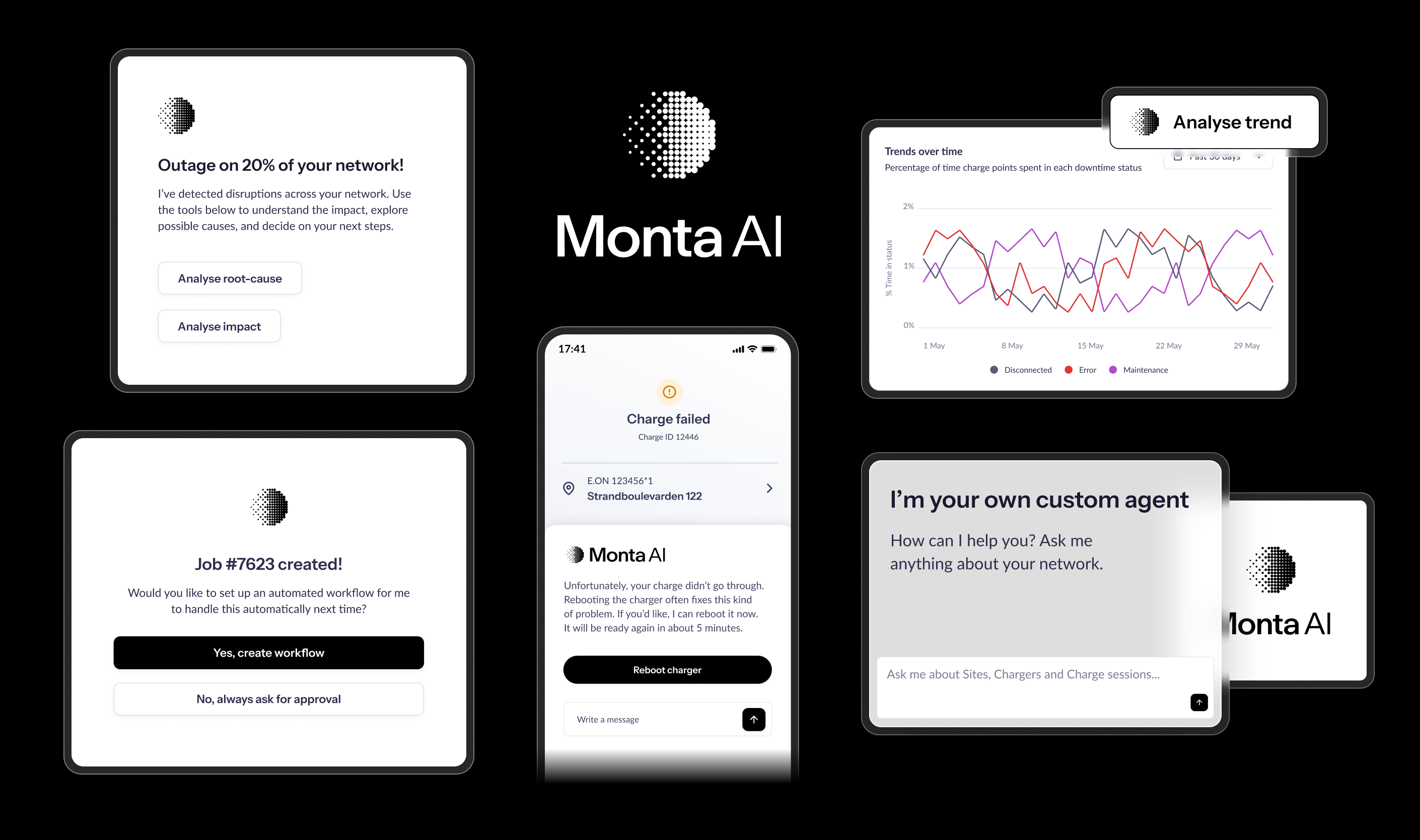
Monta AI continuously analyses network operations in the background, proactively surfacing insights, anomalies, and recommended actions. This includes identifying issues such as firmware mismatches that affect reliability, detecting and instantly acting on fraud activity, and guiding operators on corrective measures.
At the same time, Monta AI allows operators to ask natural-language questions across operations, performance, pricing, expansion, and energy, such as asking the system to suggest potential new charging sites based on local EV equipment and competitive infrastructure.
Embedded directly into the Monta platform, Monta AI transforms complex operational data into clear, decision-ready insights that can be acted on immediately by any team member, not just specialists. The capability is included for all Monta customers at no additional cost, reflecting Monta’s view that AI-driven operational intelligence should be a baseline capability rather than a premium add-on.
Casper Rasmussen, CEO and co-founder of Monta, said, “The real opportunity with AI isn’t just doing existing tasks faster. It’s removing operational constraints that have limited how charging networks can scale. Today, operators are expected to deliver near-perfect reliability while managing exponentially more hardware, data, and complexity with the same-sized teams. Monta AI shifts that burden from people to software by continuously understanding what’s happening across the network and proactively surfacing the actions that will have the biggest impact.”
Today, a single failed charging session can require hours of manual investigation across OCPP logs, firmware versions, payment data, and hardware documentation, often handled by a small number of experts. As networks grow three, five, or tenfold, this operating model becomes costly, slow, and fragile, making it impossible to deliver the level of reliability expected of critical infrastructure.
Monta AI addresses this bottleneck by synthesising fragmented operational signals into a single intelligence layer. The system explains what is happening across the network, diagnoses root causes, and recommends concrete actions, while keeping human operators firmly in control of execution. These capabilities are already delivering measurable results in production environments. In one case, an operator saw a DC charger’s success rate increase from 31.2% to 98.3% in just 25 seconds after Monta AI identified a firmware mismatch responsible for repeated failures.
Across the EV charging lifecycle, Monta AI supports decision-making and proactive action in multiple areas. It enables faster operational diagnostics by identifying root causes of failed charging sessions using live OCPP (Open Charge Point Protocol) logs, firmware data, payment context, and user feedback, and by guiding teams toward the most effective next steps.
“Monta AI is fast-tracking our case resolutions for many of the basic issues, freeing up time for our team to handle the more complex issues. Overall, this gives our customers an enhanced service,” said Arron Rothwell, Operations Director at Rolec.
It improves overall network performance by detecting recurring issues and performance patterns across chargers, sites, and regions, helping operators increase reliability and uptime at scale. Monta AI also informs pricing strategies, analyses utilisation trends, and identifies underserved areas or potential new deployment opportunities.
In parallel, it explains smart-charging behaviour, energy constraints, and load management factors that affect network performance, while supporting customer service by proactively resolving 79% of driver queries without the need for human support intervention, enabling real-time, always-available troubleshooting.
What previously required multiple tools, specialist knowledge, and long investigation cycles can now begin with a single question from a single user.
Monta AI is built on AI systems already running in production across the Monta platform, including automated support resolution and AI-powered diagnostics such as the NOC (Network Operations Centre) Agent.
These capabilities are unified through a conversational interface and continuously improve as they learn from live network activity. The system is trained on one of the industry’s richest operational datasets, spanning more than 260,000 connected charge points, three million monthly charging sessions, and 14,000 support requests per month across a unified global platform.
Monta AI reflects a broader shift from reactive charging operations toward proactive systems by default. In the near term, Monta AI provides charge point operators with AI-powered support to troubleshoot charge points, understand performance issues, manage firmware updates, and adjust pricing. By analysing operational signals in real time, the system detects anomalies early and delivers clear, role-specific recommendations that enable teams to act faster and with greater confidence, without requiring deep technical expertise.
Operational workflows such as maintenance actions, pricing changes, or firmware rollouts can be partially automated while keeping humans in control. Over time, Monta’s ambition is to support fully autonomous charging operations, with software orchestrating fault resolution, optimisation, and network coordination end-to-end.
”Our long-term ambition is to move EV charging from reactive operations to proactive systems by default. Monta AI is a major step in that direction, helping operators anticipate issues, act faster, and manage growing network complexity with confidence as they scale,” concluded Rasmussen.
Monta is the leading platform connecting the dots in the EV charging ecosystem.
From
drivers,
to businesses, and over
700 industry partners,
we offer software solutions which span all EV charging needs.
- Get complete control of your charge points
- Easy setup and integration with over 600 supported hardware models
- Full-featured invoicing and payment platform
- Access the Monta roaming network with over 1 418 349 chargers
- 24/7 dedicated customer support team ready to help you solve any bottlenecks