
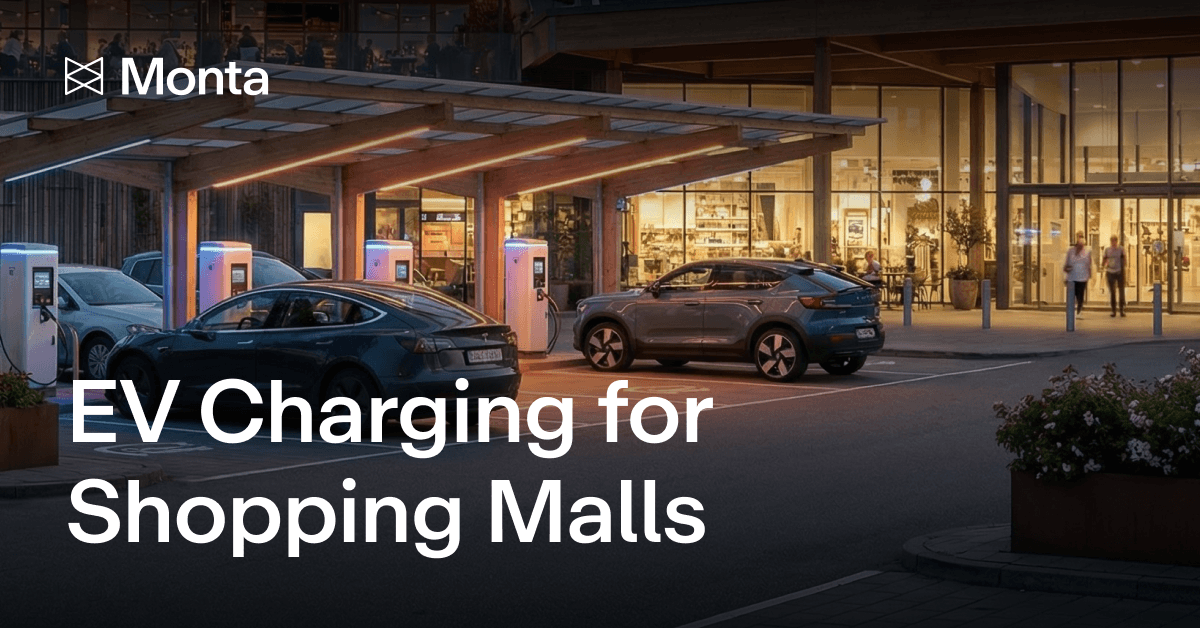
EV charging for shopping malls functions as a commercial Electric Vehicle (EV) charging infrastructure solution designed for large retail complexes, mixed-use shopping centers, and high-traffic consumer destinations where vehicles remain parked for extended periods. Shopping mall owners and property operators use EV charging for shopping malls to support long dwell times and manage parking assets. It aligns infrastructure investment with long-term property value, often supported by platforms such as Monta EV charging management software for monitoring, access control, and billing oversight. Retail tenants rely on charging access to support employee vehicles and daily operations, while shoppers and visitors benefit from convenient, unattended charging during shopping, dining, or entertainment activities. EV charging in shopping malls operates as both a customer-facing amenity and a structured operational asset within modern retail environments.
What Is EV Charging for Shopping Malls?
EV charging for shopping malls refers to the installation, operation, and management of electric vehicle charging stations within shopping mall parking lots, parking garages, and mixed-use retail complexes. Shopping mall EV charging supports vehicle charging during extended shopping, dining, and entertainment visits while providing structured access for mall employees, retail tenants, and occasional service or delivery vehicles. Shopping malls and lifestyle centers rely on longer dwell times, high parking volumes, and distributed charger placement across garages and surface lots, while regional and super-regional malls combine customer-facing AC charging with selective fast-charging options to address varied visit lengths. Outlet malls and open-air shopping centers use destination-based charging aligned with moderate dwell times and shared parking layouts. Shopping mall EV chargers are engineered for frequent public use, variable dwell durations, high daily utilization, and direct integration with large-scale commercial parking infrastructure.
How Does EV Charging for Shopping Malls Work?
EV charging for shopping malls works through a parking-based workflow that aligns charging activity with the time visitors spend inside the property. Drivers park vehicles in designated EV charging spaces, connect a charging cable, and activate the session through a mobile app, QR code (including app-clip activation), Radio Frequency Identification (RFID) card, credit card reader, or automatic access rule, then receive electrical energy while shopping, dining, or using entertainment amenities. Charging sessions focus on adding a practical amount of driving range during a typical visit rather than completing a full battery recharge, which matches long dwell times and high parking volumes. Shopping mall charging programs commonly use free charging as a customer amenity, low per-kilowatt-hour pricing, time-based fees to manage turnover, or app-based payment systems integrated with parking or loyalty platforms.
EV charging at shopping malls differs from traditional fueling because electrical energy transfers gradually while customers engage in retail activities rather than through a short, attended refueling stop. EV charging operates as part of the parking experience, functions continuously during mall operating hours, and relies on unattended equipment and digital systems rather than staffed fueling transactions.
What Does EV Charging Infrastructure Look Like for Shopping Malls?
Shopping mall EV charging infrastructure consists of a multi-layer system that combines physical charging hardware, electrical capacity, and distribution equipment, software platforms, and integrated parking layout design across mall-owned surface lots and parking garages. Shopping mall EV charging infrastructure supports high visitor volumes, long parking dwell times, and phased expansion across large retail properties, with shopping mall EV charging installation planned to align charging availability with traffic patterns, operating hours, and long-term property redevelopment strategies.
Core Layers of EV Charging Infrastructure in Shopping Mall Operations are listed below.
- Charging Hardware Layer: Charging hardware includes AC chargers and selective DC fast chargers installed at designated parking stalls to match visitor dwell time and expected turnover.
- Electrical Supply and Distribution Layer: Electrical infrastructure consists of utility service connections, transformers, panels, switchgear, and conduit that deliver sufficient power across parking areas without exceeding site capacity.
- Energy and Load Management Layer: Energy management systems balance simultaneous charging demand across multiple chargers to control peak load and maintain stable electrical operation during high-traffic periods.
- Software and Control Layer: Software platforms manage charger access, session control, pricing rules, monitoring, and fault detection across all chargers deployed on the property.
- Payment and User Access Layer: Payment systems support mobile applications, RFID credentials, or card-based transactions that allow drivers to start and complete charging sessions without staff assistance.
- Parking Layout and Site Integration Layer: Site design integrates chargers into surface lots and garages using clear signage, lighting, pedestrian routing, and traffic flow planning to maintain safety and accessibility.
- Data, Reporting, and Operations Layer: Operational data systems collect usage metrics, uptime statistics, and revenue performance data to guide maintenance planning and future infrastructure expansion decisions.
What Is an EV Charging Station in a Shopping Mall Environment?
An EV charging station in a shopping mall environment is a customer-facing electric vehicle charging unit installed within mall parking lots or parking garages that supports short- to medium-duration charging while mall visitors shop, dine, or use entertainment facilities. A shopping mall EV charging station supports high public utilization, unattended operation, and continuous availability while integrating seamlessly into normal parking, traffic flow, and pedestrian access patterns across large commercial properties.
Fundamental Elements That Define an EV Charging Station in a Shopping Mall Environment are listed below.
- Charging Hardware: Charging hardware consists of AC chargers or DC fast chargers with defined connector types and power ratings that match typical mall dwell times and visitor turnover.
- Energy and Load Management: Energy and load management systems distribute available electrical capacity across multiple chargers to prevent overloads while supporting simultaneous public charging activity.
- Software and Control Systems: Software and control systems manage charging session activation, user authentication, pricing enforcement, and operational rules without requiring on-site staff involvement.
- Payment and Customer Interface: Payment and customer interface components support mobile applications, QR code or app-clip activation, RFID cards, credit card readers, and integrated charger display screens. Many jurisdictions require on-screen transparency that clearly shows pricing, session status, energy delivered, and payment confirmation directly on the EV charger to meet consumer protection and accessibility standards.
- Site Integration and Visibility: Site integration and visibility features use clear EV signage, lighting, wayfinding markers, and ADA-compliant stall layouts to guide drivers and maintain safe pedestrian movement.
- Data and Reporting: Data and reporting tools track charger utilization, session duration, revenue performance, uptime, and fault conditions to support mall operations and infrastructure planning.
Do Shopping Malls Operate Electric Service Vehicles or Delivery Fleets?
Yes. Shopping malls operate electric service vehicles and support electric delivery fleets as part of daily property operations, tenant logistics, and third-party delivery activity.
Common Types of Electric Vehicles Used by Shopping Malls are listed below.
- Electric Maintenance and Facilities Vehicles: Mall operators use electric carts and light-duty vehicles for janitorial work, landscaping, waste handling, and routine repairs across large properties.
- Electric Security Patrol Vehicles: Security teams rely on electric patrol carts and low-speed vehicles to conduct continuous monitoring of parking lots, garages, and interior service corridors.
- Electric Utility and Operations Vehicles: Facilities teams deploy electric utility vehicles to manage lighting, signage, parking infrastructure, and garage operations over wide site footprints.
- Electric Delivery and Logistics Vehicles: Mall management and retail tenants use electric vans for internal deliveries, stock transfers, and curbside pickup coordination.
- Third-Party Electric Delivery Fleets: Logistics providers operate electric delivery vans and cargo vehicles to serve restaurants, retailers, and last-mile fulfillment programs tied to mall locations.
Shopping mall EV fleets follow scheduled, predictable charging patterns based on work shifts, patrol cycles, and delivery windows rather than short, opportunistic charging sessions. Fleet charging occurs under property-controlled access rules, assigned parking zones, and operational policies that differ from customer-facing public chargers.
Mall service and delivery vehicles rely primarily on AC charging that supports multi-hour parking during work shifts and overnight dwell periods. Fleet managers select moderate power levels that prioritize reliability, load stability, and shared electrical capacity over rapid charging speeds.
How Are EV Charging Areas Designed for Shopping Mall Parking Lots and Garages?
EV charging areas in shopping mall parking lots and garages are designed to support long customer dwell times, high vehicle volumes, and continuous daily operation while maintaining safe traffic flow and clear pedestrian access. Shopping mall designs prioritize visible charger placement near primary entrances, consistent wayfinding across surface lots and multi-level garages, adequate lighting and security coverage, and stall layouts that accommodate vehicles remaining parked for several hours without disrupting circulation or peak shopping traffic.
Key Design Considerations for EV Charging Areas in Shopping Mall Environments are listed below.
- Customer Accessibility and Proximity: Design plans position charging stalls near main mall entrances, elevators, or escalators to minimize walking distance and integrate charging into the standard parking experience.
- Traffic Flow and Circulation Control: Parking layouts separate charging stalls from high-turnover lanes to prevent congestion caused by vehicles parked for extended charging sessions.
- Visibility and Wayfinding: Signage, pavement markings, and digital directory integration guide drivers to charging areas efficiently across large surface lots and multi-level garages.
- Safety and Lighting Standards: Lighting design, camera coverage, and clear sightlines support evening operation and improve perceived and actual security for vehicles and shoppers.
- Scalability and Future Expansion: Electrical conduit routing and stall spacing allow additional chargers to be added as EV adoption increases without major parking reconfiguration.
- Pedestrian Integration: Walkways, curb ramps, and crossing points connect charging stalls to mall entrances without forcing pedestrians to cross active drive lanes.
- Garage-Specific Structural Constraints: Garage installations account for ceiling height, ventilation, column spacing, and load-bearing limits to support safe charger mounting and cable management.
- Operational Consistency Across Parking Types: Site standards maintain uniform charger access, signage, and policies across surface parking and garages to avoid driver confusion and uneven utilization.
How Is EV Charging for Shopping Malls Designed Compared to Other Retail Locations?
EV charging for shopping malls is designed around longer customer dwell times, higher parking volumes, and larger physical footprints, while EV charging for retail locations focuses on faster turnover and a smaller number of charging spaces. Shopping mall designs distribute chargers across multiple parking garages and surface lots to support sustained, multi-hour visits and future expansion, whereas big-box stores and grocery locations concentrate chargers near entrances to serve short visits with simpler, centralized layouts.
What Are the Types of EV Charging Used at Shopping Malls?
Types of EV Charging Used at Shopping Malls are listed below.
- AC Charging: AC charging delivers moderate power that aligns with typical shopping, dining, and entertainment dwell times, which allows vehicles to gain meaningful range while parked. Shopping mall operators deploy AC chargers as the primary option because the charging speed, electrical requirements, and parking duration match daily visitor behavior.
- DC Fast Charging (DCFC): Direct Current fast charging (DCFC) supplies direct current to vehicle batteries for faster energy delivery during shorter visits or high-turnover parking areas. Shopping mall operators install DC fast chargers selectively at large regional malls or highway-adjacent properties where faster sessions support higher traffic flow and premium charging use cases.
- High-Power DC Charging: High-power DC charging provides very high output for rapid charging sessions intended for drivers with limited time on site. Shopping mall operators deploy high-power chargers infrequently due to grid capacity demands and higher infrastructure complexity, reserving such an option for flagship locations or travel-oriented retail destinations.
1. AC Charging
AC charging delivers steady, moderate power using alternating current, which supports vehicle charging during typical shopping, dining, or entertainment visits at commercial sites. Retail operators and shopping mall owners deploy the charging type widely because the charging speed aligns well with multi-hour parking patterns and standard electrical service. Installation for AC charging typically costs $2,500–$8,800 per charger, depending on electrical capacity, mounting method, and site layout.
2. DC Fast Charging (DCFC)
DC fast charging supplies direct current straight to the vehicle battery, which enables significantly faster charging for drivers with shorter dwell times or high turnover needs. Retail properties deploy DCFC less frequently than AC charging because power demand, utility coordination, and capital requirements are higher, though adoption continues to grow at large shopping centers and travel-oriented retail hubs that support Level 3 EV charging. Total installed costs for DC fast charging typically range from $18,000–$350,000+ per charger, including equipment, installation, and electrical upgrades.
3. High-Power DC Charging
High-power DC charging represents the upper end of DC fast charging capability, delivering very high output to support rapid charging during short on-site stays. Retail operators deploy the option selectively at flagship malls or highway-adjacent destinations because grid capacity, transformer upgrades, and demand charges significantly limit widespread use. Installed costs for high-power DC charging generally exceed $100,000 per charger due to specialized hardware, utility interconnection, and supporting infrastructure.
How Much Does Commercial EV Charging Infrastructure Cost for Shopping Malls?
Commercial EV charging infrastructure for shopping malls typically costs $3,200 to $15,000 per installed AC charging port and $32,000 to $350,000+ per DC fast charging unit, depending on power level, site layout, and electrical capacity. Medium-sized mall projects with 10 to 20 AC chargers commonly require total capital investment of $100,000 to $320,000, while large regional malls that combine multiple DC fast chargers with extensive electrical upgrades often exceed $630,000 to $1,900,000+. The total project cost extends beyond the charging equipment and includes electrical upgrades, utility coordination, civil construction, software platforms, payment systems, commissioning, and ongoing operational support required for high-traffic public environments.
The cost components that shopping malls budget for are listed below.
- EV Charging Hardware: Charging hardware cost depends on the mix of AC chargers for long dwell times versus DC fast chargers for higher turnover parking areas.
- Electrical Upgrades: Electrical upgrades cover panels, transformers, switchgear, and service capacity increases required to support simultaneous public charging demand.
- Utility and Grid Interconnection Fees: Utility coordination costs include application fees, engineering studies, and interconnection work needed to approve the added electrical load.
- Civil Works and Construction: Civil construction includes trenching, conduit installation, concrete restoration, parking garage modifications, and protective bollards.
- Software, Networking, and Payment Processing: Software platforms manage user access, pricing rules, charger monitoring, reporting, and payment transactions through apps, RFID cards, or credit terminals.
- Permitting, Inspections, and Maintenance: Permitting and inspections ensure regulatory compliance, while ongoing maintenance supports uptime, safety checks, and system reliability.
Factors shopping malls should consider when budgeting for EV charging are listed below.
- Large-Site Infrastructure Scale: Large shopping mall footprints require higher upfront investment due to extensive parking areas and public-use durability standards.
- Charger Mix Strategy: Strategic decisions balance a larger number of AC chargers against a smaller number of DC fast chargers based on dwell time patterns.
- Expected Utilization Levels: Customer traffic volume, visit duration, and peak shopping hours determine charger usage rates and infrastructure sizing.
- Phased Deployment Planning: Phased rollout strategies control capital spending while allowing infrastructure expansion as EV adoption increases.
- Available Incentives and Utility Programs: Government incentives, rebates, and utility programs reduce net project cost when incorporated early into project planning.
What Power Capacity Do Shopping Mall EV Charging Systems Typically Require?
Shopping mall EV charging systems typically require a distributed power capacity built around AC chargers supported by selective DC fast chargers at priority locations. Shopping mall operators favor moderate per-vehicle power levels spread across many parking stalls to support long dwell times and high vehicle volume rather than concentrating power into a small number of ultra-high-power units.
A shopping mall EV charging installation needs sufficient total site capacity to support simultaneous charging across multiple stalls while maintaining stable electrical loads. Load management software balances charger output in real time, which allows malls to scale charger count without proportionally increasing peak demand or triggering costly electrical upgrades.
Factors that Influence Charging Power Selection for Shopping Malls are listed below.
- Average Customer Dwell Time: Shopping duration tied to retail, dining, or entertainment determines whether AC charging meets operational needs or whether limited DC fast charging supports faster turnover areas.
- Parking Turnover and Visit Frequency: High daily vehicle turnover favors moderate charging power across many stalls to serve more vehicles without long queue formation.
- Available Electrical Service Capacity: Existing utility service size, transformer capacity, and panel availability define upper limits for total charging power deployment.
- Business Charging Objectives: Customer-amenity charging prioritizes distributed AC power, while destination or revenue-driven strategies justify selective higher-power chargers.
- Utility Rates and Demand Charges: Local demand pricing structures influence charger power levels to prevent peak-load penalties during busy shopping hours.
- Smart Load Management Systems: Energy management platforms dynamically allocate power across chargers to maintain uptime and protect electrical infrastructure.
A supermarket charging session typically lasts 20 to 60 minutes and delivers a partial battery top-up rather than a full recharge. AC charging aligns with grocery shopping duration and adds practical driving range without requiring extended parking time.
What Are the Benefits of Commercial EV Charging for Shopping Malls and Supermarkets?
The benefits of Commercial EV Charging for Shopping Malls and Supermarkets are listed below.
- Increased Dwell Time and Spend: Commercial EV charging encourages shoppers to stay on-site for the full charging session, increasing time spent in stores and raising average basket size, a core benefit of EV charging at shopping malls.
- Higher Foot Traffic and Visit Frequency: Commercial EV charging attracts EV-driving customers who actively seek locations with charging access, driving incremental visits and repeat trips directly tied to the benefits of commercial EV charging.
- Tenant and Employee Support: Commercial EV charging supports retail tenants and on-site staff who park for long shifts, improving daily operations and reducing friction around employee commuting.
- Stronger Property Competitiveness: Commercial EV charging positions malls and supermarkets as modern, future-ready destinations, which supports leasing, tenant retention, and long-term property relevance.
- Alignment With Sustainability and ESG Goals: Commercial EV charging supports corporate sustainability targets by reducing transportation-related emissions tied to customer and staff travel.
Commercial EV charging benefits shoppers and supermarket customers by allowing vehicles to charge during routine shopping visits, which eliminates the need for separate charging stops and turns parking time into productive charging time, reinforcing the practical benefits of EV charging at shopping malls.
Charging an EV at a supermarket typically costs less than public DC fast charging, with pricing set by the site owner through free charging, low per-kWh rates, or time-based fees depending on region and business strategy. Supermarket charging focuses on convenience and customer attraction rather than profit maximization, which keeps prices lower than high-power roadside charging and aligns with broader commercial EV charging benefits.
How Do Shopping Mall Owners, Operators, and Retail Tenants Use EV Charging?
Shopping mall owners, property operators, and retail tenants use EV charging primarily to support employee vehicles, facility operations, and tenant transportation needs during long, predictable work shifts rather than short customer visits. Mall management teams deploy EV charging to serve security vehicles, maintenance fleets, and staff commuter vehicles that remain parked for extended periods, while retail tenants rely on charging access for employees working full-day shifts and for limited operational vehicles tied to store logistics.
Shopping mall EV charging access and parking policies separate staff and tenant charging from customer-facing charging to maintain availability and operational control during peak shopping hours. Mall operators assign dedicated parking zones, restricted-access chargers, scheduled charging windows, or credential-based access systems to prevent conflicts, manage electricity costs, and ensure customer chargers remain available for public use.
Will Shopping Malls Transition Fully to Electric Service and Delivery Vehicles?
No. Shopping malls will not transition fully to electric service and delivery vehicles in the near term, since mall delivery activity relies heavily on third-party carriers, mixed vehicle classes, and staggered replacement cycles that keep internal-combustion vehicles in circulation for years.
Mall electrification will still accelerate as last-mile operators expand electric vans and medium-duty trucks on routes that return to base for depot charging, which fits retail delivery patterns. Utility coordination and grid capacity will shape rollout speed at retail properties, since DC fast charging for frequent delivery turnover requires high-power service upgrades and predictable operating costs. City air-quality rules and fleet mandates will keep pushing commercial electrification, even when policy timing shifts or faces delays at the state level.