
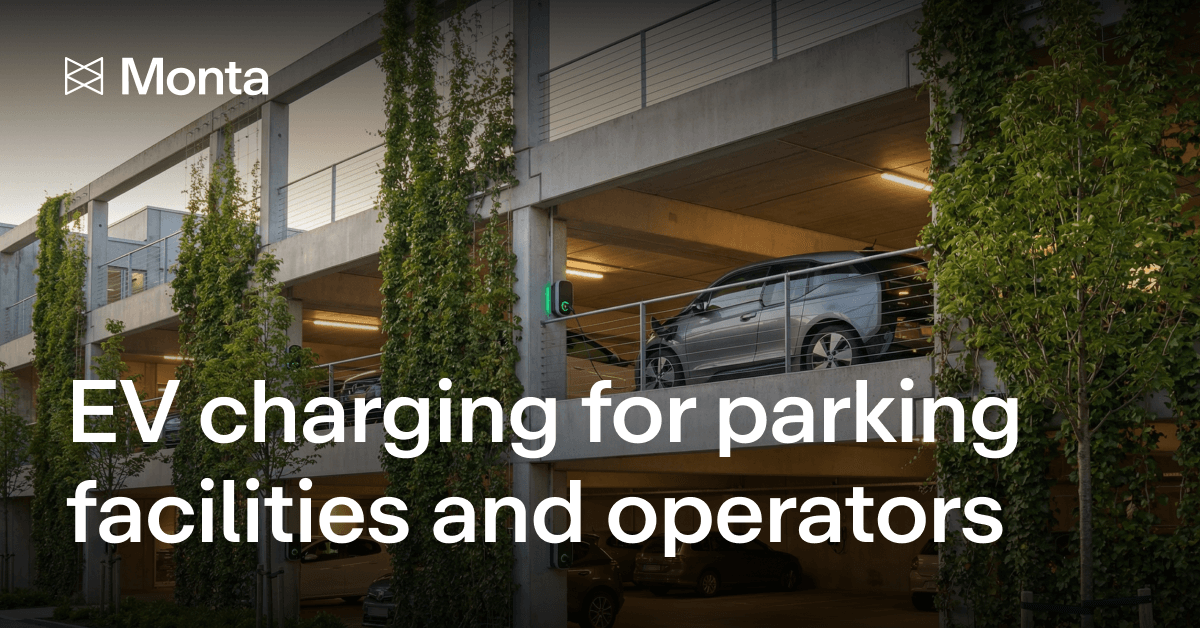
EV charging for parking facilities and operators functions as an integrated service model that combines vehicle storage, energy delivery, and digital management within commercial garages and surface lots. EV charging for parking enables operators to convert standard parking bays into managed charging assets that support long-stay users, commuters, fleets, and subscribers. Parking with EV charging allows drivers to replenish vehicle batteries during routine parking periods, while charging at company parking lots supports employee mobility and corporate fleet operations within controlled environments. Platforms such as Monta EV charging provide centralised tools for access control, billing, monitoring, and load management, which allow operators to scale charging infrastructure efficiently and operate parking facilities as coordinated mobility and energy hubs rather than passive storage spaces.
What is EV charging for parking businesses?
EV charging for parking businesses refers to the installation, operation, and management of electric vehicle charging systems within commercial parking facilities to supply electricity to vehicles during managed parking periods. Parking operators integrate charging into garages, surface lots, and mobility hubs as part of core service delivery, positioning parking assets as combined vehicle storage and energy infrastructure.
EV charging in commercial parking operations is a coordinated service model in which charge point deployment, power allocation, access control, and billing systems align with parking duration, turnover patterns, and customer demand. Operators manage charging as a regulated on-site utility rather than an independent retail activity.
Parking-based charging infrastructure supports private passenger cars, commuter vehicles, shared mobility fleets, taxis, rideshare vehicles, light commercial vans, corporate fleets, and municipal service vehicles that remain parked for defined time periods.
Charging supports revenue diversification, customer retention, and asset modernisation by increasing dwell time, attracting electric vehicle drivers, and safeguarding the long-term relevance of the facility. Operators use charging to stabilise occupancy, support subscription models, and integrate parking assets into broader urban mobility systems.
A parking EV charging system consists of charging hardware (AC and DC fast charge points), electrical infrastructure (panels, transformers, feeders, and protection equipment), access and payment systems (mobile apps, cards, ticket integration, and licence plate recognition), load management software (power sharing and peak control), site layout integration (bay marking, traffic flow, and safety features), and monitoring platforms (uptime tracking, diagnostics, and reporting).
How does EV charging for parking facilities work?
EV charging for parking facilities works through an integrated system that combines charging equipment, shared electrical capacity, access control, and operational management within managed parking environments. Parking operators install AC and DC fast charge points in designated bays, connect them to site panels and transformers, and regulate power delivery through load management software to prevent electrical overload.
Charging sessions are activated through mobile applications, access cards, licence plate recognition, or parking ticket integration, which links vehicle use to billing and authorisation systems. Central platforms monitor charge point status, energy consumption, and user activity, while operational teams coordinate vehicle movement and bay turnover to maximise utilisation. Parking-based charging prioritises dwell-time alignment, predictable availability, and site-level energy control rather than rapid, stand-alone refuelling.
How does EV charging in parking operations differ from traditional fuelling?
EV charging in parking operations differs from traditional refuelling in its energy-delivery method, extended turnaround time, reliance on fixed electrical infrastructure, integration with fleet and parking workflows, and a passive customer handover model. Electrical energy flows continuously to parked vehicles through managed charging systems, while refuelling delivers liquid fuel in short, high-intensity transactions. Parking operations integrate charging into long-duration vehicle storage and scheduling, whereas refuelling relies on rapid, attended service at dedicated retail stations.
EV charging depends on site-level electrical capacity, load management, and software coordination, while refuelling depends on fuel logistics, underground storage tanks, and pump availability. Parking operators manage charging sessions through automated systems and access platforms, which contrasts with the manual, transaction-based model of traditional fuel dispensing. Charging transfers responsibility from active driver participation to system-controlled processes embedded within parking management.
The primary differences between EV charging for parking facilities and petrol or diesel refuelling are listed below.
- Energy delivery method: EV charging supplies electricity gradually through fixed charge points, while refuelling transfers liquid fuel rapidly through pumps.
- Turnaround time: Charging takes hours in most parking contexts, while refuelling takes minutes.
- Infrastructure dependency: Charging relies on electrical panels, transformers, feeders, and software platforms, while refuelling relies on fuel tanks, pipelines, and dispensing equipment.
- Fleet workflow integration: Charging integrates with vehicle scheduling, overnight parking, and rotation planning, while refuelling operates independently of parking workflows.
- Customer handover model: Charging occurs without continuous driver presence, while refuelling requires direct customer involvement at the pump.
EV charging transforms parking garages and parking lots from short-term vehicle storage facilities into managed energy and mobility assets. Operators offering EV charging for parking lots manage dwell time, power allocation, and charging priority alongside space utilisation and access control. Parking facilities evolve into infrastructure platforms that support fleet operations, commuter charging, and subscription-based mobility services rather than functioning solely as passive parking locations.
What does EV charging infrastructure look like for parking garages and parking lots?
EV charging infrastructure for parking garages and parking lots comprises an integrated combination of physical, electrical, and digital systems that enable reliable vehicle charging across enclosed garages and open parking lots. Parking operators design the infrastructure to support long-stay users, high-turnover customers, and fleet vehicles within a single site while operating within shared electrical capacity limits. System architecture links charge point placement, power distribution, software control, and operational workflows to ensure consistent service and scalable expansion.
The core layers of EV charging infrastructure in parking operations are listed below.
- Depot and branch charging layout: Charge point placement aligns with traffic flow, bay allocation, and vehicle movement patterns to support efficient access and minimise congestion.
- Electrical supply and load management: Panels, transformers, feeders, and control systems regulate total site demand and distribute power safely across multiple charge points.
- Fleet and mobility software integration: Software platforms connect charging activity with fleet scheduling, subscription management, and usage reporting.
- Access control and billing systems: Authentication and payment tools manage public users, subscribers, and fleet drivers within unified operational frameworks.
- Operational processes for vehicle rotation: Charging workflows coordinate vehicle movement, bay turnover, and priority assignment to maximise charge point utilisation.
- Monitoring and maintenance systems: Diagnostics platforms track performance, uptime, and faults to support preventive maintenance and rapid response.
Parking-focused charging infrastructure prioritises dwell-based energy delivery, site-level load control, and integration with parking operations rather than rapid, stand-alone refuelling. Public charging emphasises maximum power output and short session turnover, while parking-based charging emphasises reliability, space optimisation, and coordinated use across longer parking durations. Parking operators design charging systems to function as part of managed mobility services rather than isolated charging points.
How does EV charging work in fully automated parking systems?
EV charging in fully automated parking systems operates through direct integration between robotic parking equipment, charging hardware, and central control software that manages vehicle movement and energy delivery. Automated garages assign vehicles to charging-compatible bays through software logic that considers battery state, expected dwell time, and available electrical capacity. Robotic platforms position vehicles precisely at charging interfaces, while central systems activate charging automatically once correct alignment and safety conditions are verified.
EV charging in fully automatic parking garages functions as a fully managed charging service embedded within robotic parking infrastructure. Operators deploy charge points within secured storage zones where vehicles remain inaccessible to drivers during parking periods. Charging occurs without manual cable handling, with power delivery initiated and monitored by central systems that coordinate parking and energy management.
Vehicle identification and charging authorisation rely on integrated entry systems that combine licence plate recognition, RFID tags, mobile applications, and customer account profiles. Automated parking platforms link each vehicle to a user account at entry, validate charging eligibility, assign billing rules, and authorise power delivery through central management software without physical interaction.
Automatic parking garages primarily use AC charging between 7 kW and 22 kW for long-duration storage and overnight parking. Selected high-demand facilities deploy moderate DC charging between 50 kW and 100 kW, where shorter dwell times require faster energy replenishment. System designers prioritise aggregate load control over high per-vehicle power to protect shared electrical infrastructure.
The operational benefits of EV charging in automatic parking garages are listed below.
- Space efficiency: Robotic storage eliminates driving lanes and door clearance, enabling higher charge point density within limited footprints.
- Labour reduction: Automated positioning and charging activation reduce staffing requirements for vehicle handling and charge point management.
- Improved utilisation: Centralised scheduling maximises charge point usage by matching charging windows to parking duration and departure schedules.
- Enhanced security: Restricted access zones prevent unauthorised vehicle access and reduce vandalism or cable theft.
- Energy optimisation: Load management systems align charging with off-peak tariffs and grid capacity limits.
- Customer convenience: Fully automated charging removes the need for manual cable connection and queue management.
How does EV charging work in semi-automated parking systems?
EV charging in semi-automated parking systems operates through coordinated integration between vehicle positioning systems, charging equipment, and central management software that governs parking and energy delivery. Operators design EV charging for parking environments to align automated space allocation with charge point availability, allowing vehicles to be routed to bays equipped for power delivery without manual intervention. Parking platforms track vehicle entry, dwell time, and assigned locations, while charging systems initiate and regulate power flow once a vehicle reaches a compatible charging position.
Parking facilities that support parking with EV charging integrate charge point status, electrical capacity, and access control into automated parking management systems. Control software schedules charging sessions based on vehicle arrival time, expected departure time, and available grid capacity, ensuring fair access and preventing electrical overload. Commercial sites that provide charging in company parking lots use the approach to efficiently manage employee and fleet charging while maintaining predictable parking circulation and operational reliability.
Semi-automated systems rely on sensors, identification technologies, and central control platforms to coordinate vehicle movement and charging activation. The integration allows operators to deliver consistent charging access, optimise space utilisation, and operate charging infrastructure as a managed service within automated or partially automated parking environments.
What is an EV charging station in a parking business?
An EV charging station in a parking business functions as a dedicated on-site system that supplies electricity to vehicles during paid or managed parking sessions between customer arrivals and departures. Parking operators integrate charging stations into car parks, garages, and managed lots to provide energy replenishment while vehicles remain parked, transforming parking spaces into a combined mobility and energy service.
EV charging in commercial parking operations represents the coordinated deployment, management, and monetisation of charging infrastructure within parking facilities. Operators align charge point placement, power capacity, access control, and billing systems with parking duration, turnover rates, and customer demand to deliver charging as part of daily parking services rather than as a separate utility function.
Parking-based charging infrastructure serves private passenger cars, commuter vehicles, shared mobility fleets, taxis, rideshare vehicles, light commercial vans, and municipal or corporate fleet vehicles that remain parked for defined periods within managed facilities.
Charging supports revenue diversification, customer retention, and asset modernisation by increasing dwell time, attracting EV drivers, and protecting long-term facility relevance. Operators use charging to stabilise occupancy, support subscription models, and position parking assets as mobility hubs rather than static storage spaces.
A parking EV charging system consists of charging hardware (AC and DC fast charge points), electrical infrastructure (panels, transformers, feeders, and protection equipment), access and payment systems (apps, cards, ticket integration, and licence plate recognition), load management software (power sharing and peak control), site layout integration (bay marking, traffic flow, and safety features), and monitoring platforms (uptime tracking, diagnostics, and reporting).
How are EV charging depots designed inside parking structures and open lots?
EV charging depots inside parking structures and open lots are designed through coordinated planning that aligns depot layout, fleet size, vehicle turnover rates, grid capacity limits, and daily operational workflows. Parking operators and engineers map vehicle movement, dwell duration, and charging windows before selecting charge point power levels and placement. Electrical planners size aggregate capacity at the site level, apply load management to stay within panel and feeder limits, and phase infrastructure to support future expansion. Design decisions differ by environment, with enclosed structures prioritising space efficiency, fire compliance, and ventilation, while open lots prioritise trenching strategy, weather protection, and scalable layout.
The key design considerations for EV charging in parking operations are listed below.
- Depot layout and traffic flow: Charge point placement aligns with vehicle entry, exit, and circulation paths to avoid congestion and idle blocking.
- Fleet size and utilisation patterns: Charge point quantity and power reflect vehicle count, daily mileage, and expected charging overlap.
- Turnover rates and dwell time: Long-dwell parking supports lower power charging, while rapid turnover requires higher power allocation.
- Electrical capacity and grid limits: Panel ratings, transformer capacity, and feeder availability define total charging headroom.
- Load management and power sharing: Control systems distribute power dynamically to protect the electrical infrastructure and maximise charge point count.
- Parking structure versus open lot conditions: Enclosed garages require fire safety coordination and compact hardware, while open lots require durable enclosures and efficient trenching.
- Phased expansion planning: Conduit, panels, and spare capacity are installed early to avoid repeated construction as demand grows.
- Operational access and maintenance: Charge point locations support easy servicing, fault response, and minimal disruption to parking operations.
Yes. Parking facilities support EV fleets and shared mobility vehicles by providing dedicated charging zones, managed access, and power allocation designed around predictable fleet schedules and high utilisation. Operators deploy fleet-focused charging to support taxis, rideshare vehicles, delivery fleets, car-sharing services, and municipal vehicles that require reliable turnaround and operational readiness.
What types of EV charging are used in parking facilities?
The types of EV charging used in parking facilities are listed below.
- AC charging: AC charging supports long-stay and overnight parking where vehicles remain parked for several hours. Parking operators deploy AC charge points in residential garages, commuter car parks, and mixed-use facilities to balance charging speed with available electrical capacity.
- DC fast charging: DC fast charging supports short-stay, high-turnover parking where drivers need rapid energy replenishment. Commercial car parks near city centres, transport hubs, and mobility corridors rely on high-power charging to serve taxis, rideshare vehicles, and time-sensitive users.
- Fleet and depot charging: Fleet and depot charging serve electric vehicles operated by taxis, delivery fleets, car-sharing services, and municipal operators. Parking facilities allocate dedicated charging zones to support predictable schedules and operational readiness.
- Managed and load-balanced charging: Managed charging systems distribute available power across multiple charge points to prevent electrical overload. Parking operators use load balancing to increase the number of charge points while remaining within panel, transformer, and feeder limits.
- Networked and access-controlled charging: Networked charging integrates authentication, billing, monitoring, and reporting through software platforms. Parking facilities rely on access-controlled systems to manage public users, subscribers, fleets, and staff vehicles within a single site.
- Overnight depot charging: Overnight depot charging supports vehicles parked for extended periods during off-peak hours. Parking operators use overnight charging to stabilise electricity demand and monetise underutilised night-time capacity.
-
AC charging
AC charging delivers alternating current through dedicated charge points installed in parking facilities to support long-stay and overnight charging for vehicles parked for several hours. AC charging is widely used in commuter lots, residential car parks, and mixed-use facilities because moderate power requirements match typical dwell times without requiring major grid upgrades. The installed cost of a single charge point under AC charging ranges from £18,000–£26,000 ($22,500–$32,500, €21,000–€30,500), depending on wiring complexity and site preparation.
-
DC fast charging
DC fast charging supplies high-power direct current to vehicle batteries, enabling rapid replenishment for short-stay parking and high-turnover users. DC fast charging is common at city-centre lots, transport hubs, and roadside stops, where drivers seek quick charging during short visits. The installed cost per unit under DC fast charging generally ranges from £180,000–£250,000 ($225,000–$315,000, €210,000–€295,000) when power upgrades, civil works, and grid connection are included.
-
Fleet and depot charging
Fleet and depot charging refers to dedicated charging systems for electric vehicles used by commercial fleets, shared mobility services, and property operations within parking facilities. Fleet and depot charging is common among parking operators supporting taxis, delivery fleets, car-sharing vehicles, and municipal or corporate fleets that require predictable charging windows. The average cost for a fleet and depot charging bay with multiple charge points and electrical upgrades is about £140,000–£200,000 ($175,000–$250,000, €165,000–€235,000) per bay, depending on site complexity and the extent of electrical work.
-
Managed and load-balanced charging
Managed and load-balanced charging uses software and control systems to distribute available electrical capacity across multiple charge points, preventing overload and maximising utilisation. Managed charging is increasingly common in facilities with limited electrical headroom or high expected EV adoption, as it enables more charge points without exceeding capacity limits. Integration of control hardware and management software for managed and load-balanced charging typically costs £35,000–£60,000 ($44,000–$75,000, €41,000–€70,000) for a medium-sized parking site.
-
Networked and access-controlled charging
Networked and access-controlled charging connects charge points to central platforms that manage user authentication, billing allocation, usage monitoring, and reporting for multiple user groups. Networked charging remains common in professionally operated facilities where payment systems, user profiles, and operational metrics are essential to site management. Software platforms, connectivity, and commissioning for networked and access-controlled charging commonly cost £45,000–£75,000 ($56,000–$94,000, €53,000–€88,000) for a medium-sized facility.
How much does EV charging for parking facilities cost?
EV charging for parking facilities costs £18,000 to £30,000 per AC charging point ($22,500 to $38,000 / €21,000 to €35,000) and £150,000 to £250,000 per DC fast charge point ($190,000 to $315,000 / €175,000 to €295,000) when charging hardware, electrical upgrades, grid connection work, and professional installation are included. Infrastructure budgets must account for distribution panel upgrades, transformer reinforcement, trenching, cabling, civil works, commissioning, and compliance testing, which frequently represent a significant portion of the total project cost.
Parking operators must budget for higher upfront capital expenditure than light-duty workplace charging because parking facilities support multiple users, higher utilisation rates, and shared electrical infrastructure. Parking businesses must maintain flexibility in charge point placement and conduit routing to accommodate future layout changes, adoption growth, and evolving vehicle battery capacities. Parking operators must prioritise scalable electrical design and modular installation strategies to avoid costly retrofits.
Strategic investment in DC fast charging remains essential for facilities serving high-turnover users, commuters, fleets, and time-sensitive customers. Parking businesses must allocate capital for targeted fast-charging deployment at premium bays and high-traffic zones, even though fast charge points increase grid upgrade and equipment costs. Balanced infrastructure planning combines widespread AC coverage for long-stay users with selective fast-charging investment to maximise utilisation, revenue potential, and long-term asset resilience.
What charging power do parking facility EV systems require?
Parking facility EV systems require a tiered charging power range matched to dwell time, vehicle type, and battery capacity, with capacity planned at the site level rather than per vehicle.
Long-stay parking areas rely on AC charging because vehicles remain parked for many hours. Passenger EVs with battery capacities of 50–80 kWh (compact and mid-size electric cars used by commuters or residents) reach a full or near-full charge overnight at 7–11 kW, while larger vehicles with 90–100 kWh batteries benefit from 22 kW charging capacity where available.
Medium-stay parking facilities serving shopping centres, workplaces, or intercity travellers use moderate DC charging to support dwell times of 1 to 3 hours. Passenger EVs with 60–90 kWh batteries typically recover 100–200 kilometres of range within a single parking session at 50–100 kW, which suits retail and mixed-use parking patterns.
High-turnover parking locations near city centres, transport hubs, and mobility corridors rely on DC fast charging to serve taxis, rideshare vehicles, and delivery fleets. Vehicles with battery capacities of 60–75 kWh achieve rapid turnaround at 50–100 kW, while newer long-range models with 80–100 kWh batteries benefit from 150 kW to minimise dwell time.
Fleet-focused parking facilities serving electric vans, shuttle buses, or commercial fleets deploy high-power DC charging to maintain operational availability. Electric vans with 70–100 kWh batteries use 100–150 kW, while electric buses with 250–450 kWh batteries require 150–350 kW charging to support shift-based operations.
Parking operators design systems around aggregate power capacity and load management, which allows multiple vehicles with different battery sizes to charge simultaneously without exceeding panel, transformer, or feeder limits.
How powerful does a charging station need to be for a parking facility?
A charging station for a parking facility needs a mix of 7 to 22 kW AC charging for long-stay and overnight parking and 50 to 150 kW DC fast charging for short-stay, high-turnover use. Parking operators size total power capacity at the facility level rather than per vehicle, using load management to support multiple charge points within available electrical limits while matching charge point power to typical dwell time and turnover patterns.
Is DC fast charging necessary for commercial parking operations?
Yes. DC fast charging is necessary for commercial parking operations that serve high-turnover users, time-sensitive drivers, and fleet vehicles with limited dwell time. Commercial parking facilities near city centres, transport hubs, retail corridors, and logistics zones rely on rapid charging to support taxis, rideshare vehicles, delivery fleets, and short-stay customers who cannot depend on overnight or long-duration parking, where direct current fast charging (DCFC) provides the required power delivery for short visits.
DC fast charging allows commercial parking operators to capture demand from drivers who prioritise speed and availability, increase space turnover, and support mobility services that require vehicles to return to service quickly. Parking operations without fast charging risk losing relevance in locations where dwell times remain short and charging demand centres on immediacy rather than convenience.
What are the business benefits of EV charging for parking operators?
The business benefits of EV charging for parking operators are listed below.
- New revenue streams: EV charging creates incremental income through charging fees, subscriptions, and bundled parking-and-charging products tied to dwell time rather than vehicle turnover.
- Higher space utilisation: Charging increases average parking duration and repeat usage, which stabilises occupancy across daily and overnight periods.
- Asset modernisation: EV charging upgrades parking facilities from static storage assets into energy and mobility infrastructure aligned with long-term transport electrification.
- Competitive differentiation: Charging availability distinguishes parking facilities in dense urban and transport-linked markets where drivers compare locations based on charging access.
- Customer retention and loyalty: Regular EV drivers return to facilities that offer reliable charging, thereby increasing predictable demand from commuters, residents, and fleet users.
- Alignment with city and utility programmes: Charging enables participation in utility incentives, managed charging schemes, and municipal mobility initiatives, thereby reducing capital exposure.
- Future revenue protection: Early charging deployment protects parking assets from declining relevance as internal combustion vehicle use decreases.
Parking operators benefit from overnight depot charging through predictable utilisation, stable electricity demand, and recurring revenue from vehicles parked for extended periods. Overnight charging aligns with low grid demand, reduces operational stress on electrical systems, and allows parking facilities to monetise otherwise idle night-time capacity while supporting fleet operators, commuters, and residential users who require dependable next-day vehicle readiness.
How do drivers benefit from EV charging in public and private parking?
Drivers benefit from EV charging in public and private parking by being able to charge vehicles during normal parking periods without altering travel routines. Parking-based charging allows drivers to combine vehicle charging with work, shopping, travel, or residential parking, reducing reliance on dedicated charging trips and on high-cost fast-charging locations. Public and private parking charging improves trip reliability, lowers charging costs compared with rapid charging, increases confidence in electric vehicle ownership, and supports predictable daily mobility by allowing vehicles to recharge while parked rather than requiring active refuelling stops.
How do drivers find parking lot EV charging?
Drivers find EV charging in parking lots through in-vehicle navigation systems, mobile charging apps, parking operator platforms, and roadside signage that identify charge point availability and access conditions and help drivers find an EV charge point efficiently during trip planning. Electric vehicle apps display nearby charging locations directly on dashboard maps, while charging network and parking apps list parking facilities with EV charge points, pricing, and real-time status, allowing drivers to select a suitable parking location before arrival or while en route.
How do monthly subscribers use EV charging in parking facilities?
Monthly subscribers use EV charging in parking facilities through recurring access plans that allow regular, predictable charging during daily or overnight parking periods. Parking operators grant subscribers authenticated access to designated charge points within the facility, while charging sessions run automatically under subscription terms that cover usage limits, pricing, and access rights. Monthly subscription models prioritise convenience, guaranteed availability, and cost predictability for commuters, residents, and fleet drivers who park at the same facility on a consistent schedule.
How can Monta help parking facilities with EV charge point supply?
Monta helps parking facilities with EV charge point supply by providing a centralised charging management platform that enables charge point deployment, access control, billing, monitoring, and load management across parking assets. Parking operators use Monta to connect charging hardware, manage driver and fleet user access, allocate electricity costs, and monitor charge point performance in real time through a single system. The approach allows parking facilities to scale EV charge point supply within existing electrical limits, maintain reliable uptime, and operate charging as a managed mobility service rather than unmanaged electrical equipment.
Will parking facilities transition into EV charging-centric mobility hubs?
Yes. Parking facilities will transition into EV charging-centric mobility hubs as the adoption of electric vehicles, urban electrification policies, and shared mobility services converge. Parking operators are increasingly repositioning car parks as energy and mobility assets that support charging, dwell-based services, and integration with transport networks, rather than simply serving as static vehicle storage. Long dwell times, predictable access patterns, and proximity to residential, commercial, and transport nodes make parking facilities well-suited to function as charging-focused mobility infrastructure.
The primary barriers slowing EV charging adoption in parking operations are listed below.
- Electrical capacity constraints: Existing parking facilities often lack sufficient panel, transformer, or feeder capacity to support multiple charge points without costly upgrades (for example, older underground garages with limited spare capacity).
- High upfront capital costs: Charging hardware, electrical upgrades, and civil works require a significant initial investment, which slows deployment when utilisation or cost recovery remains uncertain (for instance, small private car parks with low EV penetration).
- Revenue and business model uncertainty: Parking operators face difficulty forecasting charge point usage, pricing tolerance, and return on investment compared with traditional parking fees (for example, mixed-use car parks with variable daily occupancy).
- Operational complexity: EV charging introduces new responsibilities for uptime monitoring, fault response, billing disputes, and customer support beyond standard parking operations (unattended public garages).
- Grid interconnection and approval timelines: Utility coordination, permitting, and interconnection studies can delay charge point installation, particularly for higher-power systems (for example, DC fast charging requests in dense urban centres).
- User behaviour and turnover mismatch: Short-stay parking locations offer limited dwell time, which reduces charging effectiveness and complicates charge point allocation (retail car parks with one-hour stays).
- Regulatory and policy fragmentation: Inconsistent local requirements for fire safety, accessibility, and right-to-charge rules create planning uncertainty across jurisdictions (for example, differences between municipal and regional codes).