
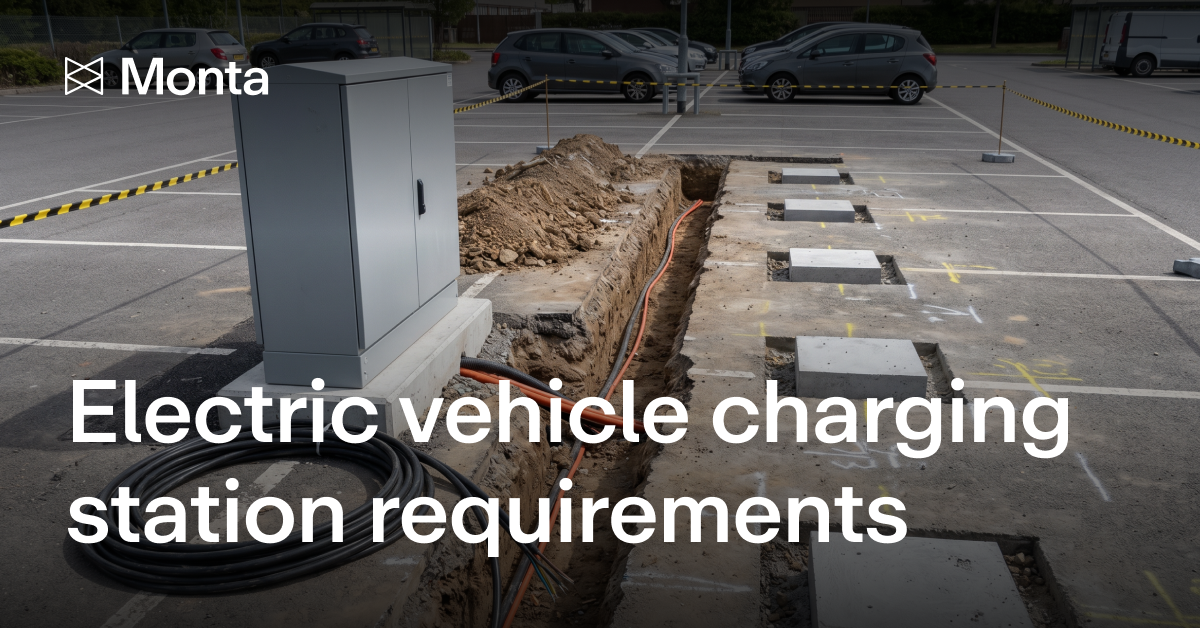
Electric vehicle charging station requirements refer to the technical, electrical, safety, and regulatory conditions necessary to install and operate charging equipment safely and reliably. Electric vehicle charging station requirements include adequate electrical capacity, certified equipment, proper grounding, protective devices, and code-compliant wiring methods to support continuous load operation. Electric car charging points installation regulations govern permits, accessibility provisions, signage, and inspection approval to ensure compliance with local authorities and safety standards. EV charging parking space requirements define accessible stall dimensions, clear access routes, and safe cable reach to support usability and traffic flow. Requirements vary based on charger type, site location, and local electrical and building codes, which determine infrastructure design, safety measures, and operational compliance.
What are the main EV charging station requirements?
The main EV charging station requirements are listed below.
- Adequate electrical capacity: Electrical service must support charger load demand, with load calculations confirming panel capacity, transformer sizing, and peak demand requirements.
- Certified charging equipment: Charging units must be safety-certified and rated for the intended voltage, environment, and usage conditions to ensure reliable EV charging performance.
- Dedicated circuits and proper wiring: Installations require dedicated circuits sized for continuous load, approved conductors, conduit protection, and code-compliant wiring methods.
- Grounding and protective devices: Proper grounding, overcurrent protection, and residual current protection are required to prevent electric shock, overloads, and fault conditions.
- Permits and regulatory approval: Electrical permits, planning approvals, and final inspections are required to verify compliance before operation.
- Accessibility and site compliance: Accessible parking dimensions, clear paths of travel, reach ranges, and compliant signage are required for public installations.
- Safety measures and equipment protection: Lighting, bollards, emergency shutoffs, equipment clearances, and protection from vehicle impact support safe operation.
- Network connectivity and payment systems: Network communication enables user authentication, payment processing, monitoring, and remote management, where applicable.
- Utility coordination: Utility approval and service upgrades are required for high-capacity installations or new electrical connections.
Which rules apply to EV charging station setup?
EV charging station setup must comply with electrical codes, building regulations, accessibility standards, utility requirements, and safety rules to ensure safe installation and public usability.
Electrical installation must follow national and local electrical codes (for example, NEC Article 625 in the United States or IET Wiring Regulations in the United Kingdom), which govern circuit sizing, grounding, overcurrent protection, disconnects, and equipment ratings. Building and planning regulations control structural mounting, trenching, zoning compliance, signage, and site layout modifications.
Accessibility standards require compliant parking dimensions, clear access routes, reach ranges, and operable controls to ensure usable access. Fire and safety regulations govern equipment clearances, emergency shutoff access, ventilation where required, and protection from vehicle impact. Utility interconnection rules apply when service upgrades, transformers, or high-capacity connections are required.
Environmental and workplace safety rules may apply to commercial and public installations, while final inspection and approval by the authority having jurisdiction is required before the charging station is placed into service.
What must be included in an EV charging station plan?
An EV charging station plan must include detailed electrical, site, safety, and operational specifications to ensure code compliance, safe operation, and long-term functionality. The plan must identify charger type, quantity, power ratings, connector standards, and network connectivity requirements. Electrical design must specify service capacity, load calculations, panel capacity, transformer requirements, grounding methods, overcurrent protection, disconnects, and conduit routing. Site layout drawings must show charger locations, parking configuration, accessible spaces, traffic flow, equipment clearances, cable reach, and protective barriers where required.
Accessibility provisions must include compliant parking dimensions, clear paths of travel, reach ranges, and signage. Safety measures must identify lighting, bollards, emergency shutoffs, fire clearance zones, and protection from vehicle impact. Communication and networking requirements must define connectivity for payment systems, monitoring, and remote management. The plan must include utility coordination details, permitting requirements, inspection checkpoints, and provisions for future expansion, such as EV-ready conduit capacity and load management integration.
What are the requirements to install an EV charger?
The requirements to install an EV charger are listed below.
- Certified charging equipment: Chargers must be safety-certified by recognised testing organisations (for example, UL, CE, or equivalent) and rated for the intended electrical supply and environment.
- Dedicated circuit and proper sizing: A dedicated branch circuit sized for continuous load operation is required, with conductor and breaker ratings matched to the charger’s amperage and output.
- Grounding and bonding: Proper grounding and bonding must be installed to protect against electric shock and ensure safe fault current paths.
- Overcurrent and residual current protection: Protective devices (circuit breakers, RCD/GFCI protection) are required to prevent overloads, short circuits, and ground faults.
- Code-compliant wiring methods: Wiring must follow local electrical codes using approved conduit, cable types, weatherproof enclosures, and protection against physical damage.
- Adequate electrical capacity: Electrical panels and service supply must support the charger’s load demand, with load calculations performed to confirm capacity.
- Licensed electrician installation: A qualified electrician must perform installation to ensure compliance with electrical codes, safety standards, and permitting requirements.
- Permits and inspection approval: Local permits and final inspection approval are required before the charger can be energised and placed into service.
Which permits are needed for EV charger installation?
The permits needed for EV charger installation are an electrical permit, a building permit, planning or zoning approval, and utility approval. An electrical permit is required to authorise connection to the electrical system and verify compliance with wiring, grounding, and protection requirements. A building permit is required when installation involves structural mounting, trenching, or concrete pads associated with EV charger installation. Planning or zoning approval is required for commercial or public sites to confirm land use compliance, parking layout changes, signage, and accessibility provisions. Utility approval is required when service upgrades, new transformers, or high-capacity connections are involved. Final inspection approval is required before the charger is placed into service.
What electrical inspections are required before EV charger installation?
Electrical inspections required before EV charger installation verify that the existing electrical system can safely support continuous charging loads and comply with applicable electrical codes. A qualified electrician or electrical inspector evaluates service capacity, panel rating, available breaker space, grounding and bonding integrity, and load calculations to confirm adequate capacity for the proposed charger. Inspectors review wiring condition, conductor sizing, overcurrent protection, and residual current protection to ensure compatibility with EV charging equipment requirements.
Site evaluation includes verifying voltage supply, phase configuration, and transformer capacity for higher-power installations. Outdoor or public installations require inspection of weatherproof enclosures, conduit protection, equipment clearances, and mounting surfaces. Accessibility, signage, and safety disconnects are reviewed where required by local codes and accessibility regulations. Final approval typically requires permit review and inspection by the local authority having jurisdiction to confirm code compliance before energising the charger.
How do installation requirements vary by charger type?
Installation requirements vary by charger type because power demand, electrical infrastructure, and site conditions differ significantly between AC and DC charging systems. Level 1 chargers require a standard household outlet on a dedicated circuit rated for continuous load and minimal site preparation. AC chargers require a dedicated 208–240 V circuit (North America) or 230 V single-phase or 400 V three-phase supply (Europe), appropriate breaker sizing, grounding, residual current protection, and wall-mounted or pedestal installation with suitable cable routing and weather protection. Public and commercial AC installations may require load management systems, network connectivity, and accessibility compliance.
DC fast chargers require substantially higher electrical capacity, utility coordination, and three-phase power service. Installation often includes service upgrades, pad-mounted transformers, switchgear, protective relays, and trenching for conduit and communication lines. Sites must accommodate equipment clearances, ventilation, cooling systems, and traffic flow management. High-power and fleet charging installations may require on-site substations, demand management systems, and energy storage to support peak loads and maintain grid stability.
How much power does an EV charger need?
EV charger power requirements range from low kilowatt levels for basic charging to hundreds of kilowatts or more for high-speed charging, depending on charger type and use case. Level 1 charging typically draws about 1.4 kW to 3 kW, while AC chargers commonly require 3.6 kW to 19.2 kW for residential and commercial installations. DC fast chargers operate at much higher power levels, typically 50 kW to 350 kW, and heavy-duty or megawatt charging systems can exceed 1 MW. Electrical infrastructure must match charger output to available panel capacity, service size, and utility supply to prevent overload and ensure safe operation. Load management systems and energy planning help align charger power demand with grid capacity and future expansion needs.
What outlet specifications are required for EV charging?
Outlet specifications for EV charging depend on the charging level, electrical supply, and national wiring standards rather than a single universal outlet type. Level 1 charging uses a standard household outlet rated for the local supply voltage (for example, 120 V in North America or 230 V in the UK and Europe) with a dedicated circuit capable of continuous load operation. AC charging requires a dedicated higher-capacity circuit and industrial or hardwired connection, typically delivering 208–240 V in North America or 230 V single-phase and up to 400 V three-phase in Europe, with current ratings commonly ranging from 16 A to 80 A depending on charger output.
Installations must include proper grounding, overcurrent protection, residual current protection (RCD/GFCI), and weather-rated enclosures for outdoor use. EV charging outlets and connections must be installed on dedicated circuits sized for continuous load (typically 125 per cent of rated current), with appropriate cable sizing, disconnecting means, and compliance with local electrical codes. High-power DC charging stations do not use plug outlets and instead connect directly to electrical service infrastructure through hardwired equipment and dedicated switchgear.
What grid capacity is needed for EV charging stations?
Grid capacity requirements for EV charging stations depend on charger power ratings, the number of charging units, and simultaneous usage demand rather than a single fixed value. Level 2 AC chargers typically require 7 kW to 22 kW per unit, making small installations suitable for existing commercial or residential electrical service. DC fast chargers require significantly higher capacity, commonly 50 kW to 350 kW per charger, which often requires upgraded service connections and utility coordination. High-power fleet depots and megawatt charging installations can demand 1 MW to 10+ MW of available capacity, frequently requiring dedicated feeders, on-site transformers, or substation upgrades.
Site planning evaluates peak demand, load diversity, and future expansion needs to determine total capacity requirements. Electrical engineers coordinate with utilities to assess service availability, transformer sizing, protection systems, demand charges, and grid balancing considerations to maintain system stability. Load management, energy storage, and smart charging controls reduce peak demand and defer costly grid upgrades while maintaining reliable charging performance.
How many parking spaces should include EV chargers?
There is no single universal requirement for how many parking spaces must include EV chargers, because the ratio is determined by local building codes, planning regulations, and green building standards rather than a national rule. Many jurisdictions require a percentage of parking spaces to be EV-capable or EV-ready, with a smaller portion equipped with active chargers at the time of construction. Typical frameworks call for about 2% to 10% of spaces to include operational chargers, about 10% to 20% to be EV-ready with conduit and electrical capacity, and, in some cases, full conduit capacity to support future electrification across the entire car park. Green building programmes and planning policies encourage phased deployment, where developers install a limited number of active chargers while preparing additional spaces for future demand growth, which reduces upfront costs, supports grid planning, and allows expansion as EV adoption increases.
What are the ADA requirements for EV charging infrastructure?
The ADA requirements for EV charging infrastructure are listed below.
- Accessible parking dimensions: Accessible EV charging spaces must meet ADA parking standards, which typically require wider stall widths and an adjacent access aisle to allow wheelchair transfer and mobility device use.
- Clear access aisles and routes: An unobstructed path must connect the accessible parking space to the charger and pedestrian walkways. The route must remain stable, slip-resistant, and free of barriers to support safe movement.
- Reach range requirements: Charger controls, screens, connectors, and payment interfaces must be positioned within ADA reach ranges so drivers using wheelchairs can operate equipment without assistance.
- Operable controls and interface accessibility: Buttons, touchscreens, and payment systems must be usable with one hand and without tight grasping, pinching, or twisting of the wrist.
- Cable management and connector handling: Charging cables must be manageable and positioned to avoid excessive weight, tripping hazards, or obstruction of the access aisle.
- Signage and space identification: Accessible EV charging infrastructure or spaces require clear signage that identifies accessibility features and ensures proper use and enforcement.
- Surface slope and ground conditions: Parking areas, access aisles, and routes must meet slope and surface requirements to support wheelchair stability and safe manoeuvring.
How does the NEC regulate EV chargers?
The National Electrical Code (NEC) regulates EV chargers by establishing safety and installation requirements for electric vehicle supply equipment (EVSE) to ensure safe connection to the electrical system and protection against electrical hazards. NEC Article 625 governs EV charging installations in the United States and specifies wiring methods, circuit sizing, grounding, overcurrent protection, disconnecting means, and equipment ratings. The code requires dedicated branch circuits for EV charging equipment, proper protection against electric shock, and installation practices that account for continuous load conditions. NEC provisions address indoor and outdoor installations, cable management, ventilation where required, and protection from physical damage, forming a core component of EV charging regulations. Compliance with NEC requirements ensures safe operation, fire prevention, and reliable integration of EV charging equipment into residential, commercial, and public electrical infrastructure.