
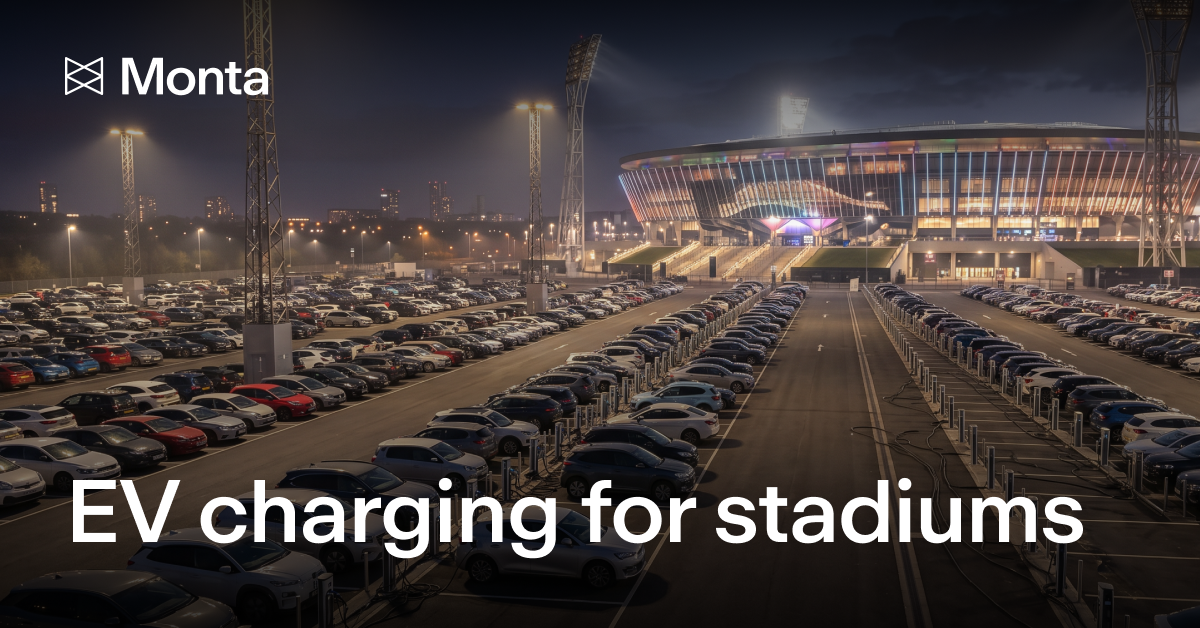
EV charging for stadiums involves deploying electric vehicle charging infrastructure in stadium parking and event facilities to support fans, staff, and fleet vehicles. EV charging systems manage high-volume event-based demand while improving sustainability and visitor experience. Integration of smart technology allows operators to coordinate energy loads during peak attendance periods. Advanced software facilitates automated billing and real-time monitoring of every session. Stadium owners prioritise reliable power delivery to meet the growing needs of eco-conscious attendees using Monta EV charging solutions.
What is EV charging for stadiums?
EV charging for stadiums involves installing dedicated charging stations in parking areas for electric vehicle users during events. EV charging supports short-term charging and long-duration parking scenarios. Infrastructure deployment focuses on providing accessible power to attendees arriving for matches or concerts. Facilities include a mix of slow and rapid units to cater to different dwell times. Stadium managers utilise the assets to demonstrate environmental commitment and provide modern amenities. Revenue generation occurs through per-use fees or membership subscriptions integrated into the digital platform.
How does EV charging for stadiums work?
EV charging for stadiums works by connecting individual dispensers to the venue’s centralised electrical distribution network. Users authenticate themselves through mobile applications or RFID cards to initiate the power transfer. Sensors within the hardware communicate with the vehicle battery management system to deliver the correct voltage safely. Backend software tracks energy consumption and automatically processes payments for the operator. Intelligent load balancing prevents the stadium grid from overloading during high-demand event windows. Data analytics provide insights into usage patterns to help with future capacity planning.
How does EV charging work in stadium parking facilities?
EV charging works in stadium parking facilities by operating through a network of pedestals or wall-mounted units strategically placed near entry points. Vehicles occupy designated bays equipped with electrical supply points for the duration of the event. Power flows from the main building substation through subterranean conduits to each charging port. Smart management systems prioritise energy distribution based on vehicle requirements and grid availability. Drivers monitor their session progress through smartphone notifications while attending the match. Proper signage and floor markings ensure that only electric cars are allowed in the zones.
Can stadiums install EV charge points for fans and event staff use?
Yes, stadiums install EV charge points for fans and event staff to use by designating specific sections of the car park for EV charging. Providing accessible power points encourages staff and visitors to transition to sustainable transport options. Separate access levels allow for different pricing structures or priority booking for employees. Integrated management software authenticates diverse user groups through a single dashboard. High utilisation rates during matches justify the initial capital expenditure for the facility. Reliable hardware ensures that employees and guests return to their vehicles with sufficient range to reach home.
What does EV charging infrastructure look like for stadiums?
EV charging infrastructure for stadiums looks like a station with charging units, power distribution systems, signage, and parking layout adjustments. Larger venues integrate multiple charge point types across different zones to serve operational needs. Subterranean cabling links the dispensers to upgraded transformers capable of handling sudden spikes in energy demand. Protective bollards and clear floor markings define the boundaries of the charging bays. Digital kiosks or mobile app integrations facilitate user interaction and payment processing. Modern EV charging infrastructure designs prioritise scalability to accommodate the increasing number of electric car owners attending events.
What is an EV charging station in a stadium setting?
An EV charging station in a stadium setting is a physical installation providing the hardware and electrical connection for vehicle batteries. EV charging stations consist of one or more charging ports housed in durable, weatherproof pedestals. Every unit connects to a centralised management platform for real-time status updates and diagnostic monitoring. Safety features include integrated circuit breakers and emergency shut-off switches to protect the public. Design considerations focus on making the equipment easy to locate and operate in high-traffic environments. Reliable hardware serves as a visible symbol of the stadium’s commitment to green technology.
Who uses EV charging at stadiums?
Users of EV charging at stadiums are listed below.
- Fans and Attendees: Spectators use the facilities to recharge their cars while attending matches or concerts. Power availability influences the choice of transport for long-distance visitors.
- Event Staff and Employees: Security personnel, catering staff, and administrative workers utilise the charge points during their shifts. Providing the benefit supports corporate sustainability targets and employee satisfaction.
- Vendors and Contractors: Logistics providers and food suppliers use the infrastructure to power delivery vans and service vehicles. Consistent access to energy ensures that event operations run smoothly without interruption.
- Fleet Operators: Stadium-owned maintenance vehicles and shuttle buses require dedicated ports for regular energy replenishment. Reliable power delivery is essential for EV charging users within the venue grounds.
- Venue Visitors: Non-event day visitors (tour groups or conference guests) use the amenities year-round. Usage patterns vary based on event size, duration, and regional adoption rates.
How are EV charging areas designed for stadium locations?
EV charging areas are designed for stadium locations by maximising vehicle throughput while ensuring pedestrian safety. Layouts place the charge points near car park exits or main entrances to improve visibility for arriving drivers. Civil engineering works include installing heavy-duty conduits and reinforced foundations for the pedestals. Signage and lighting improve the user experience by making bays easier to find in crowded facilities. Space planning accounts for different vehicle sizes and the necessary clearance for charging cables. Engineers integrate thermal management systems to prevent equipment overheating during intense usage periods.
What are the types of EV charging used in stadiums?
The types of EV charging used in stadiums are listed below.
- Level 1 Charging: Units provide slow charging via standard electrical outlets for long-duration stays. Typical usage occurs in staff areas where cars remain parked for an entire day.
- Level 2 Charging: Moderate-speed AC dispensers serve the majority of fans during three- to four-hour events. The systems provide sufficient energy for most commuter journeys.
- DC Fast Charging: Rapid dispensers provide a significant range boost for visitors needing a quick turnaround. Premium parking zones feature the high-output units.
- Networked and Smart Charging Systems: Integrated software manages energy distribution and prevents grid overloads across the entire site. Operators use these tools to monitor real-time usage and health.
1. Level 1 charging for stadiums
Level 1 charging for stadiums uses standard 230V AC outlets to provide a slow trickle of energy to vehicle batteries. Level 1 charging is uncommon in modern stadium developments due to the extremely low power output and long charging times required. Typical installation costs for the basic ports range from [£400 to £1,200 ($500 to $1,500, €470 to €1,400)] per unit. Venues prioritise faster alternatives to ensure fans receive a meaningful range boost during a match. Basic outlets lack the smart features and billing capabilities found in professional-level 1 charging systems.
2. Level 2 charging for stadiums
Level 2 charging for stadiums refers to the deployment of 7-22kW AC dispensers suitable for vehicles parked for several hours. Level 2 charging is the common infrastructure choice for stadiums because the typical event duration matches the charging time. Procurement and installation for a single commercial-grade pedestal costs [£2,000 to £5,000 ($2,500 to $6,300, €2,300 to €5,800)]. The units support smart load balancing and integrated payment processing through a centralised network. Reliability and ease of use make the technology the standard for professional-level 2 charging facilities.
3. DC fast charging for stadiums
DC fast charging for stadiums involves the installation of high-output dispensers that bypass the vehicle’s onboard charger to deliver energy directly to the battery. DC fast charging is less common than slower AC alternatives, but is increasingly found in premium parking zones or fleet areas. The total cost for a single rapid charging station ranges from [£25,000 to £80,000 ($31,000 to $100,000, €29,000 to €93,000)] including grid upgrades. Venues utilise the technology to serve travellers needing a quick top-up before or after a major event. High hardware and installation expenses dictate the selective deployment of DC fast charging units.
4. Networked and smart charging systems for stadiums
Networked and smart charging systems for stadiums consist of interconnected hardware managed by a central cloud-based software platform. The technology is becoming mandatory for large venues to prevent electrical grid overloads and to manage diverse user groups. Investment for the software integration and network hardware adds [£8,000 to £40,000 ($10,000 to $50,000, €9,000 to €46,000)] to the total site budget. Advanced algorithms distribute power based on real-time demand and site-wide energy limits. Stadium operators benefit from the automated billing and diagnostic features provided by networked and smart charging systems.
How much does EV charging infrastructure cost for stadiums?
EV charging infrastructure costs for stadiums range from £40,000 to £800,000, depending on the number of charging ports, the power levels of the charge points, and required grid upgrades. Small installations with a limited number of Level 2 units require an initial budget of [£40,000 to £80,000 ($50,000 to $100,000, €47,000 to €93,000)]. Large-scale projects involving DC fast-charging equipment and significant electrical infrastructure upgrades often exceed [£800,000 ($1,000,000, €930,000)], with complex deployments reaching several million pounds when extensive grid reinforcement and high-capacity systems are required. Expenses include hardware procurement, civil engineering, electrical permits, and ongoing software subscription fees. Significant capital is being invested in upgrading transformers and installing high-capacity subterranean cabling across the car park.
What charging power do stadium EV charging systems require?
Stadium EV charging systems require power levels ranging from 7kW for standard fans to over 150kW for rapid fleet support. Total site demand depends on the quantity of charge points operating simultaneously during peak event hours. Engineers calculate the required electrical capacity by evaluating the stadium’s baseline load and projected charging requirements. Dedicated substations are required to handle the massive energy transfer without affecting stadium lighting or hospitality services. Smart energy management software reduces the total power requirement by distributing loads across all active ports. Proper electrical design ensures the facility handles the intense energy demand during a sell-out match.
Is DC fast charging necessary for stadiums?
Yes, DC fast charging is necessary for stadiums to serve specific user groups (shuttle buses, emergency vehicles, and visitors) with very low battery levels. Rapid turnover in premium parking zones generates higher revenue and improves the convenience for time-pressed attendees. Slower AC units remain the primary choice for the general public due to lower installation costs and longer dwell times. Integrating a small number of high-power dispensers ensures the venue accommodates all types of electric vehicle charging requirements. Grid capacity and project budget influence the final decision to deploy direct current fast charging technology.
What are the benefits of EV charging for stadiums?
The benefits of EV charging for stadiums are listed below.
- Improved Visitor Experience: Fans enjoy the convenience of recharging their cars while watching the game or attending a concert. The amenity distinguishes the stadium as a modern and fan-centric destination.
- Increased Revenue Opportunities: Operators generate income through charging fees and premium parking memberships. Data from the sessions provides insights into attendee demographics and behaviour.
- Achievement of Sustainability Goals: Deploying green infrastructure supports corporate social responsibility targets and reduces the venue’s carbon footprint. Visible charge points signal a commitment to environmental stewardship to sponsors and the public.
- Environmental Branding: Stadiums improve their market position by highlighting eco-friendly facilities to potential partners. Sustainable infrastructure attracts environmentally conscious attendees to the location.
- Future Proofing: Installing charge points prevents expensive retrofits as electric vehicle ownership continues to rise. The venue stays ahead of national mandates regarding zero-emission transport.
Which manufacturers supply EV charge points suitable for stadiums?
Manufacturers supplying EV charge points for stadiums provide rugged, networked hardware designed for high-traffic public environments. Manufacturers specialise in creating weatherproof pedestals that withstand a range of outdoor conditions and heavy physical use. Preferred vendors offer units with integrated screens and payment terminals for ease of user interaction. Compatibility with open communication protocols ensures the hardware works with various management software platforms. Selection criteria focus on reliability, technical support availability, and the ability to scale the network. Quality equipment from leading EV charge point manufacturers ensures the long-term success of the stadium infrastructure project.
How do visitors benefit from EV charging at stadiums?
Visitors benefit from EV charging at stadiums by gaining the peace of mind that their vehicles are ready for the return journey. Recharging during the event eliminates the need to find a public station on the way home, saving time and effort. Drivers access the charge points through simple mobile applications that provide real-time updates on energy delivery. High-speed options in premium zones offer a luxury service for attendees with limited time. The presence of charging bays ensures that electric vehicle owners feel welcome and supported by the venue management.
How do stadium operators use EV charging systems?
Stadium operators use EV charging systems by managing their energy assets and generating additional income through flexible pricing models. Administrators monitor the health of the entire network from a single dashboard to ensure maximum uptime. Automated reporting provides the necessary data for sustainability audits and financial planning. Smart load management allows the venue to offer charging services without exceeding local grid limitations. Operators customise the user experience by offering different rates for season ticket holders, staff, and the general public. Integration with stadium apps enhances fan engagement and streamlines the payment process.
Will stadiums transition to EV-ready or fully electrified facilities in the future?
Yes, stadiums will transition to EV-ready or fully electrified facilities in the future to comply with evolving environmental regulations and consumer demands. National mandates to phase out internal combustion engines drive the requirement for massive infrastructure upgrades at major public venues. Future designs incorporate renewable energy sources (solar carports) to power the extensive charging networks. Smart grid technology allows stadiums to act as energy hubs that support the local community during off-peak periods. Continuous advancements in battery technology and energy management systems define the future of EV charging at large-scale entertainment facilities.