
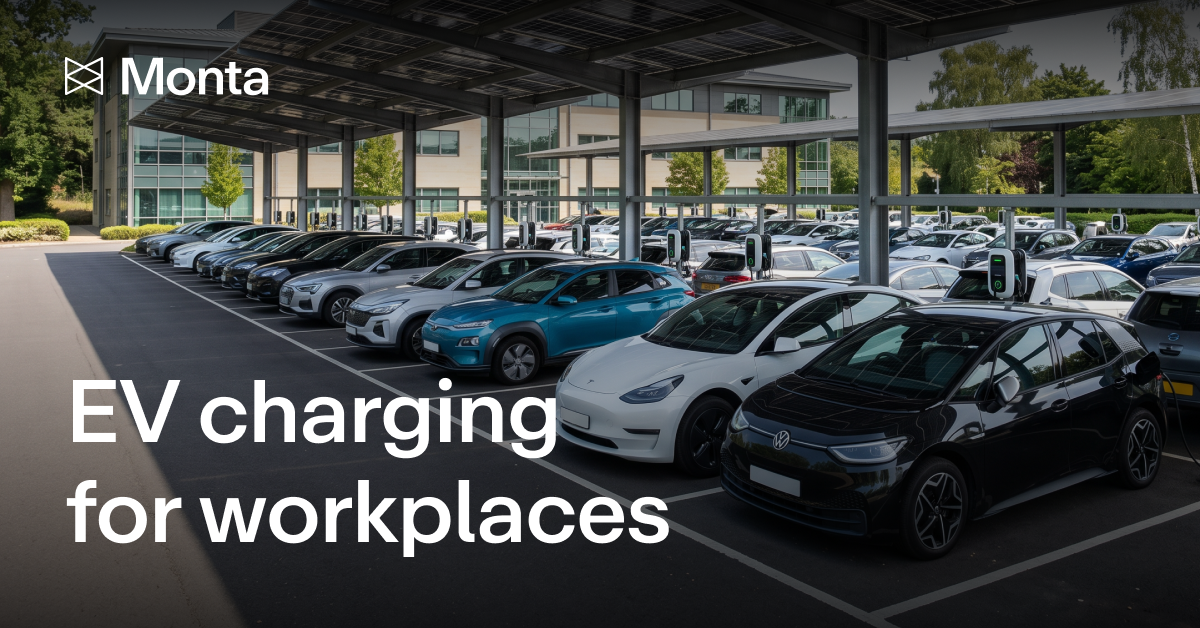
EV charging solutions for workplaces provide essential energy replenishment for employees at offices and corporate campuses. Providing dedicated workplace EV charging accelerates the transition to electric mobility. Corporations improve their sustainability profile by installing the systems. Reliable charging access during office hours reduces staff’s range anxiety. The EV charging at the workplace supports corporate environmental, social, and governance targets. Employee satisfaction increases with the convenience of powering vehicles during the workday. Integrated management platforms allow facility managers to monitor usage and energy consumption. Scalable installations accommodate the growing number of electric cars in the corporate fleet. Implementing workplace charging becomes a strategic asset for modern organisations. Dedicated charging infrastructure from Monta EV charging accelerates the transition to electric mobility across corporate environments.
What is EV charging for workplaces?
EV charging for workplaces is an electrical infrastructure system designed specifically for office environments and employee car parks. Hardware units handle the high-frequency usage associated with a daily workforce. Systems provide consistent alternating current power to vehicles that remain stationary for several hours. Corporate installations range from simple wall-mounted units to complex pedestal-style charge points. Professional designs ensure the equipment remains durable against environmental wear and frequent handling. Strong electrical components prevent overheating during simultaneous charging sessions. Employers provide a valuable benefit by ensuring employees have reliable EV charging at workplace access.
How does EV charging for workplaces work?
EV charging for workplaces works by supplying electricity to vehicle batteries while employees complete their daily responsibilities at the office or corporate campus. Workplace charging systems leverage long parking durations rather than relying on the rapid refuelling model used at traditional petrol stations. Electricity transfers through dedicated charging cables connected to a central building supply or a sub-metered electrical panel. Smart software systems control power distribution to maintain safe building load levels and optimise energy usage across multiple charging points. Traditional fuelling requires drivers to make separate trips to petrol stations. Workplace EV charging integrates directly into existing parking routines during the workday. Modern workplace charge points use intelligent communication technology to authenticate user access, monitor charging sessions, and accurately track energy consumption. Establishing workplace EV charging infrastructure simplifies vehicle charging for employees while supporting efficient, scalable workplace operations.
What does EV charging infrastructure look like for office buildings and corporate campuses?
EV charging infrastructure for workplace companies looks like a multi-layered system involving physical hardware and digital control layers. Installations involve trenching for heavy-duty cabling and installing protective bollards. Building managers integrate these systems into the existing facility’s power grid. Sophisticated layouts provide easy access for multiple parking stalls without obstructing traffic. The design focuses on long-term scalability to meet increasing demand for electric car power. Successful deployment relies on high-quality EV charging infrastructure.
The core layers of EV charging infrastructure in workplaces are listed below.
- Grid connection: The primary power source comes from the local utility substation or the building’s main electrical panel.
- Power distribution: Sub-panels and protective breakers manage the flow of electricity to individual parking zones.
- Charging stations: Physical pedestals or wall boxes serve as the interface for the vehicle connection.
- Communication network: Wi-Fi or cellular links allow the hardware to transmit data to a central management platform.
- Software management: Digital tools enable facility managers to oversee billing, maintenance, and user access.
What are the elements of an EV charging station for workplaces?
The elements of an EV charging station for workplaces are listed below.
- Energy management: Smart load balancing prevents the charging network from exceeding the building’s power capacity.
- Operational policy: Clear rules define who has access to the charge points and the duration allowed per session.
- Electrical resilience: High-quality components and surge protection ensure the system operates reliably under heavy loads.
- Software and control: Centralised platforms allow for remote monitoring and real-time adjustments to charging rates.
- Data and reporting: Detailed logs provide insights into energy usage, greenhouse gas savings, and individual user sessions.
How do workplace EV charge points differ from public charging stations?
Workplace EV charge points differ from public charging stations by prioritising private access and lower power outputs for longer charging durations. Public hubs prioritise high-speed DC charging to minimise travellers’ dwell times. Corporate charge points use Level 2 AC systems because vehicles are parked for 8 hours or more. Access to workplace units remains restricted to employees or authorised visitors via specific software credentials. Public networks require universal payment systems and are open to the general population. Employer-provided hardware avoids the high commercial tariffs found at public charging stations.
Who uses EV charging at workplaces?
Users of EV charging at workplaces are listed below.
- Full-time employees: Staff members utilise the charge points to replenish their vehicle batteries during the standard working day.
- Fleet drivers: Company car users rely on the infrastructure to ensure their work vehicles remain ready for business travel.
- Corporate visitors: Authorised guests receive temporary access to charging points as a courtesy during meetings.
- Facility contractors: Maintenance personnel with electric service vans use the charge points during on-site visits.
- Executive leadership: Senior managers with electric company cars occupy dedicated charging bays within executive car parks.
Can employers offer free EV charging at work to employees?
Yes, employers can offer free EV charging at work to employees as a non-monetary perk. Tax implications in certain jurisdictions require careful reporting as a benefit-in-kind. Companies provide free electricity to encourage the adoption of sustainable transportation. Providing free energy serves as an effective recruitment and retention tool for top talent. Businesses must monitor the total cost of electricity to ensure the benefit remains financially sustainable. Implementing clear usage policies prevents staff members from misusing free resources.
How are EV charging areas designed for workplaces and corporate parking facilities?
EV charging systems are designed for workplaces by optimising existing parking layouts and electrical circuit availability. Engineers assess the distance from the main power room to minimise trenching costs. Visual signage and floor markings designate charging zones clearly for all parkers. The design incorporates safety features like emergency stops and protective bollards around pedestals. Layouts prioritise ease of use while ensuring the hardware remains protected from vehicle impacts.
The key design considerations for EV charging in workplace operations are listed below.
- Accessibility: Placements ensure that charging cables reach vehicle ports without creating trip hazards in walkways.
- Electrical capacity: Design calculations verify that the building panel supports the maximum load of all charge points.
- Scalability: Empty conduits are installed to allow for the easy addition of more charge points in the future.
- User interface: Pedestals feature clear displays and contactless readers for simple session initiation.
- Network signal: Signal boosters ensure that the hardware maintains a constant link to the central control software.
What are the types of EV charging used in workplaces?
The types of EV charging used in workplaces are listed below.
- Level 1 charging: The basic system uses standard household outlets for extremely slow energy replenishment.
- Level 2 charging: Dedicated 240V stations provide the most common and efficient speed for office parking.
- Smart charging systems: Networked units manage power distribution dynamically across multiple parking stalls.
- Pedestal mounts: Freestanding units serve open-air car parks where wall mounting is impossible.
- Tethered stations: Charge points with attached cables offer maximum convenience for regular employee users.
1. Level 1 charging for workplaces
Level 1 charging for workplaces provides energy through a standard domestic-style socket. The method is extremely uncommon in modern corporate campuses due to insufficient speed. Installation costs remain low as it requires only basic electrical wiring without specialised hardware. Commuters gain only three to five miles of range per hour of connectivity. Employers avoid the setup because it lacks data tracking and safety features. High-power alternatives surpass the performance of level 1 charging for workplaces.
2. Level 2 charging for workplaces
Level 2 charging for workplaces utilises a dedicated 240V circuit to deliver power significantly faster than standard outlets. The system represents the industry standard for corporate and office environments. Hardware and installation costs range from £800 to £2,500 ($1,000 to $3,200, €1,000 to €3,200) per unit. Providing 25 to 30 miles of range per hour ensures most employees have a full battery by the end of the day. Sophisticated software integration allows for automated billing and energy monitoring. Businesses prioritise the deployment of level 2 charging for workplaces.
3. Shared and networked charging systems for workplaces
Shared and networked charging systems for workplaces connect multiple units to a central software platform for load management and access control. The configuration is common in large corporate headquarters and shared office buildings. Costs for sophisticated networked installations exceed £2,500 ($3,200, €3,200) per socket, depending on the load management features. Centralised control allows facility managers to allocate power based on vehicle priority or arrival time. Shared infrastructure reduces the total electrical load required for the building. Managing demand is simple with shared and networked charging systems for workplaces.
How much does EV charging infrastructure cost for workplaces?
Infrastructure costs for workplace charge points include hardware, electrical upgrades, grid connection fees, and professional installation. Businesses must budget for higher upfront costs than light-duty residential setups. Commercial projects require new sub-panels and extensive groundworks for cabling. Investing in fast-charging capabilities ensures the site remains relevant as battery technology improves. Total expenditures depend on the distance between the power source and the parking stalls. Managing EV charging station infrastructure costs requires careful site assessment and planning.
What charging power do workplace EV charging systems require?
Workplace EV charging systems require power levels ranging from 7 kW to 22 kW per unit. Office buildings install 7 kW charge points as they provide sufficient energy for an eight-hour shift. Higher-power 22 kW units require a three-phase electrical supply, which is common on industrial or large commercial sites. Total power requirements for the entire site depend on the number of vehicles expected to charge simultaneously. Smart software helps manage peak demand to prevent power limits from being reached in buildings. Planning the electrical load is a vital step in a successful workplace’s EV charging installation.
Is DC fast charging necessary for workplace charging?
No, DC fast charging is not necessary for most workplace charging scenarios where vehicles remain parked all day. Level 2 AC chargers provide a cost-effective and efficient solution for employees who are stationary for several hours. DC systems involve higher installation and equipment costs that rarely justify the speed benefit in an office setting. Fleet operations with high turnaround times are the primary candidates for rapid power delivery. Corporate campuses find that slower AC charging meets their workforce’s daily needs. Specific high-use areas are better served by DC fast charging.
How do EV charging points for business handle billing and reporting?
EV charging points for business handle billing and reporting through integrated software platforms that track every kilowatt-hour consumed. Employees authenticate their identity using mobile apps or RFID cards before the session begins. Managers receive detailed reports showing energy usage by individual, department, or location. Automated billing systems calculate electricity costs and either deduct them from payroll or charge them to a personal card. Reporting tools help businesses measure their reduction in carbon emissions for sustainability audits. Transparent data enables fair distribution of charging costs across the organisation.
What are the benefits of EV charging for workplaces and employers?
The benefits of EV charging for workplaces and employers are listed below.
- Employee attraction: Providing charging facilities helps attract and retain environmentally conscious staff members.
- Corporate sustainability: Reducing tailpipe emissions from employee commuting contributes to net-zero targets.
- Fleet efficiency: Maintaining a fully charged fleet on-site eliminates the downtime associated with external fuelling.
- Tax incentives: Government grants and tax breaks lower the total cost of installing the systems.
- Brand reputation: Visible charging infrastructure signals a forward-thinking corporate culture to clients and visitors.
Workplace operations benefit from overnight depot charging, ensuring that all fleet vehicles are fully charged before the start of the next shift. Reliable energy access at the site reduces the need for drivers to hunt for public charging stations during working hours. Consistent charging habits extend battery life and improve the efficiency of the corporate fleet. Employers demonstrate a commitment to innovation and environmental responsibility through the installations. Managing power distribution on-site provides greater control over energy expenses.
How do employers and facility managers manage workplace EV charging systems?
Employers and facility managers manage workplace EV charging systems using cloud-based dashboards that provide real-time visibility of the network. The platforms allow administrators to set charging schedules and prioritise power for certain vehicles. Managers monitor the health of every unit and receive alerts for any hardware faults or maintenance needs. Automated software handles the complexity of load balancing to protect the building’s electrical supply. Access levels are easily adjusted to accommodate visitors or temporary staff. Centralised control ensures the network remains efficient and cost-effective.
Will workplaces transition to EV-ready or EV-mandated parking in the future?
Yes, workplaces will transition to EV-ready or EV-mandated parking in the future as building regulations evolve. Jurisdictions already require a percentage of new commercial parking stalls to include pre-installed electrical conduits. Governments implement stricter mandates for corporate fleets to switch to zero-emission vehicles. Increasing employee demand for charging forces companies to upgrade their existing parking facilities. Integrated energy storage and solar power become common features of workplace charging hubs. Sustainability targets and legislative changes define the future of EV charging.