
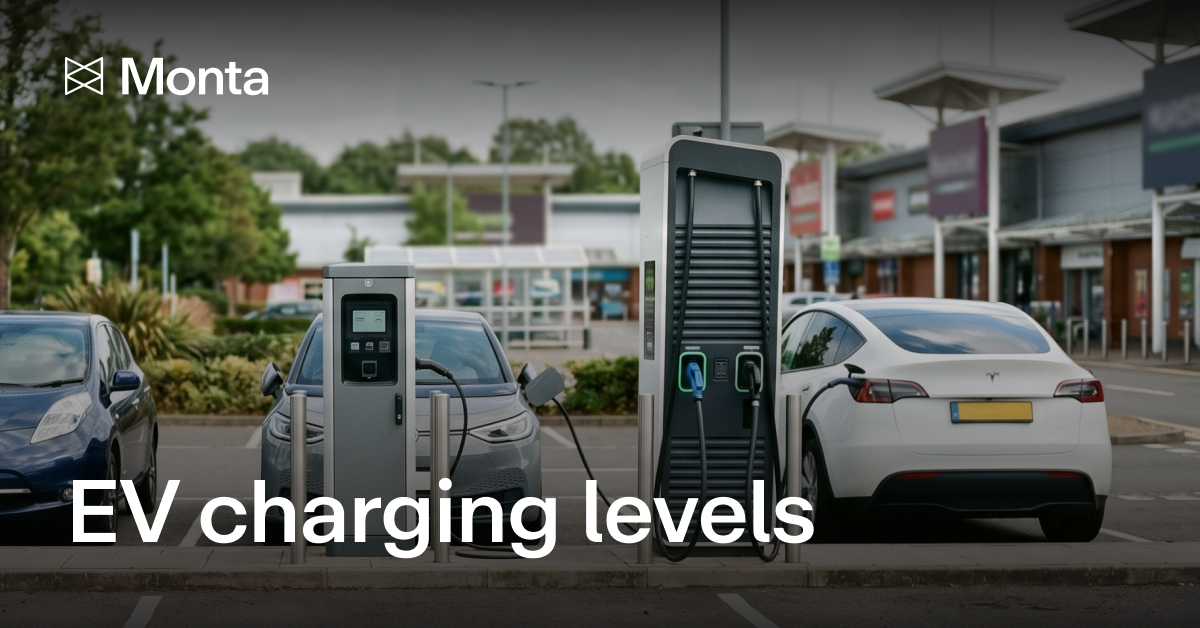
EV charging levels are standardised categories that classify charging speed, power output, and infrastructure requirements for electric vehicle charging. The structure of EV charging levels defines the levels of EV charging used across residential, commercial, and public environments, which helps operators match charging capability with operational needs. Classification of EV charge point types supports clear decision-making based on charging time, installation cost, and site requirements. Understanding each category allows drivers and businesses to select the most suitable electric car charge solution for daily use, fleet operations, or high-demand charging locations.
What are EV charging levels?
EV charging levels are classifications that define electric vehicle charging based on voltage, power output, and charging speed. The system categorises charging into structured tiers that range from low-power home charging to high-power commercial and public infrastructure designed for rapid energy delivery. Classification under EV charging levels establishes clear differences in electrical requirements, charging duration, and infrastructure complexity, which supports consistent deployment across residential, workplace, and high-traffic environments.
How many types of EV charge points are there?
The four types of EV charge points are listed below.
- Level 1 charging: Level 1 charging uses a standard household socket to deliver low-power AC electricity, which results in slow charging speeds suitable for light or occasional use.
- AC charging: AC charging uses dedicated charge points that supply moderate power levels, which allows electric vehicles to charge within several hours for daily use across common EV charge point types installed in homes and workplaces.
- DC fast charging: DC fast charging delivers high-power direct current directly to the battery, which enables rapid charging within minutes rather than hours.
- Level 4 charging: Level 4 charging provides ultra-high-power DC charging, which allows compatible vehicles to gain substantial driving range in a short time.
1. Level 1 charging
Level 1 Charging refers to low-power AC charging through a standard household socket that delivers a simple and accessible energy supply for electric vehicles. Charging speed for Level 1 Charging remains slow, typically around 2 kW to 3 kW, which results in full charge times of 8 to 24 hours, depending on battery size. Usage of Level 1 charging occurs mainly in residential settings where vehicles remain parked for long periods and daily driving distances remain limited. Cost for Level 1 Charging remains minimal because installation often requires no dedicated infrastructure, with setup costs ranging from £0 to £300 ($0–$375, €0–€350).
2. AC charging
AC Charging describes medium-power AC charging that uses a dedicated circuit and specialised charge point for faster and more reliable energy delivery. The charging speed for Level 2 Charging typically ranges from 7 kW to 22 kW, allowing most electric vehicles to reach a full charge in 4 to 8 hours. Usage of Level 2 charging appears across homes, workplaces, retail locations, and public parking areas where vehicles remain parked for moderate durations. Cost for AC charging involves equipment and installation expenses that typically range from £800 to £5,000 ($1,000–$6,250, €930–€5,800) depending on site conditions.
3. DC fast charging
DC Fast Charging refers to high-power direct current charging that bypasses the onboard chargepoint and delivers electricity directly to the battery. Charging speed for Level 3 Charging (DC Fast Charging) ranges from 50 kW to 150 kW, allowing vehicles to reach around 80 per cent charge in 20 to 60 minutes. Usage of Level 3 Charging (DC Fast Charging) occurs in commercial locations, motorway service areas, and fleet depots where rapid charging and high vehicle turnover are required. Cost for DC fast charging involves significant infrastructure investment, ranging from £50,000 to £150,000 ($62,000–$190,000, €58,000–€175,000).
4. Level 4 charging
Level 4 Charging describes ultra-fast DC charging that delivers very high power levels for rapid energy replenishment. Charging speed for Level 4 Charging typically ranges from 150 kW to 350 kW, which allows compatible vehicles to gain substantial driving range within 10 to 30 minutes. Usage of Level 4 Charging appears in high-traffic hubs, commercial charging networks, and long-distance travel corridors where speed is critical. Cost for Level 4 charging reflects high infrastructure complexity, with installation expenses typically ranging from £150,000 to £250,000 ($190,000–$310,000, €175,000–€290,000) depending on power capacity and grid upgrades.
Why are EV charge points categorised into levels?
EV charge points are categorised into levels to standardise charging speed, power output, and infrastructure requirements across different use cases. Classification into Level 1, Level 2, and DC fast charging defines how much electrical power is delivered, how quickly a vehicle charges, and what type of electrical system is required for installation. The structure allows manufacturers, operators, and regulators to align equipment specifications, safety standards, and grid planning with charging demand. Clear categorisation supports efficient deployment of charging infrastructure by matching charge point capability with residential, commercial, and high-traffic charging environments.
Which EV charging level is most common?
Level 2 AC charge points are the most common EV charging level because they provide a practical balance between charging speed, installation cost, and infrastructure requirements. Residential homes, workplaces, retail locations, and public parking areas widely use Level 2 systems due to compatibility with standard electrical supply and suitability for daily charging needs. Lower-power Level 1 charging appears less frequently due to slow charging times, while high-power DC fast charge points are deployed selectively in high-traffic or commercial locations because of higher installation costs.
How fast does each EV charging level work?
The charging speed of each EV charging level is listed below.
- Level 1 (slow charging): Charging speed at Level 1 remains slow because power output typically ranges from 2 kW to 3 kW through a standard socket. A full charge often takes 8 to 24 hours, which suits light daily use or occasional charging needs.
- Level 2 (moderate charging): Charging speed at Level 2 increases to moderate levels with power output between 7 kW and 22 kW. Most electric vehicles can reach a full charge within 4 to 8 hours, which supports overnight charging and regular daily use.
- Level 3 (fast charging – DC): Charging speed at Level 3 increases significantly because DC fast charge points deliver power between 50 kW and 150 kW. Vehicles can reach around 80 per cent charge within 30 to 60 minutes, depending on battery capacity and vehicle limits.
- Level 4 (ultra-fast charging – high power DC): Charging speed at Level 4 reaches ultra-fast levels with power output ranging from 150 kW to 350 kW. High-power systems enable rapid energy delivery, adding substantial driving range within 10 to 30 minutes for compatible vehicles.
- Power output scaling: Charging speed increases with each level as power output rises from low kilowatt ranges to high-capacity DC delivery. Higher power levels reduce charging time, although infrastructure complexity and cost increase with faster charging systems.
How long does it take to charge an EV at each level?
Charging time for an electric vehicle varies by charge point level and battery size, although clear ranges apply for typical use. Level 1 charging through a standard socket takes about 8 to 24 hours for a full charge due to low power delivery. Level 2 AC charge points reduce charging time to around 4 to 8 hours, which supports overnight charging for most vehicles. DC fast charge points deliver rapid charging in approximately 20 to 60 minutes to reach about 80 per cent battery capacity, depending on vehicle compatibility and power output.
Which charging level is the fastest?
DC fast charging is the fastest EV charge point level because it delivers high-power direct current directly to the vehicle battery without relying on the onboard chargepoint. High-power DC charging points typically operate between 50 kW and 350 kW, enabling electric vehicles to gain significant range in minutes rather than hours. Charging speed depends on vehicle capability and battery acceptance rate, although DC fast charging consistently provides the quickest energy delivery compared with Level 1 or Level 2 AC charge points.
Does Faster Charging Affect Battery Life?
Yes. Faster charging can affect battery life because high-power charging increases heat and electrical stress within the battery. Repeated use of high-power DC charge points accelerates EV battery degradation compared with moderate AC charging, particularly when charging to high state-of-charge levels. Battery management systems regulate temperature and charging rates to limit damage, although frequent reliance on rapid charging reduces long-term battery capacity more than regular use of lower-power charging methods.
How much does it cost to install level 1, level 2, or DCFC chargepoints?
The costs to install Level 1, Level 2, or DCFC chargepoints are listed below.
- Level 1 (standard socket charging): Installation cost for Level 1 charging remains minimal because the system uses an existing household electrical socket without requiring dedicated infrastructure. Basic setup costs range from £0 to £300 ($0–$375, €0–€350), which covers minor electrical checks or protective equipment where required.
- Level 2 (AC charge points): Installation cost for Level 2 AC charge points requires a dedicated circuit, professional installation, and potential electrical upgrades. Typical costs range from £800 to £5,000 ($1,000–$6,250, €930–€5,800) depending on site conditions, wiring distance, and electrical capacity.
- DC fast charging (DCFC): Installation cost for DC fast charge points involves significant infrastructure investment due to high power requirements, grid upgrades, transformers, and cooling systems. Total project costs typically range from £50,000 to £250,000 ($62,000–$310,000, €58,000–€290,000) per site, with higher costs for ultra-rapid systems or complex installations.
- Cost scaling by power and complexity: Installation costs increase as charging power and system complexity rise. Higher-power charge points require stronger grid connections, advanced equipment, and more extensive site preparation, which drives total project cost significantly above lower-level charging solutions.
Which EV charging level is the most cost-effective?
Level 2 AC charge points are the most cost-effective option for most use cases because they balance installation cost, charging speed, and electricity pricing. Level 1 charging has the lowest equipment cost, although slow charging times reduce practicality for regular use. DC fast charge points deliver rapid charging, although high installation costs and demand charges increase overall expense. Level 2 charge points provide efficient overnight charging at standard electricity tariffs, which keep energy costs within typical residential or workplace ranges (£0.20–£0.40 per kWh ($0.25–$0.50, €0.23–€0.46)) while avoiding the higher infrastructure and operational costs associated with high-power charging systems.
What are the electricity costs for each EV charging level?
The electricity costs for each EV charging level are listed below.
- Level 1 (standard socket charging): Electricity costs for Level 1 charging depend on total energy consumption rather than the charge point type. Residential tariffs typically range from £0.20 to £0.40 per kWh ($0.25–$0.50, €0.23–€0.46), which results in lower daily charging costs due to slower charging speeds and extended charging duration.
- Level 2 (AC charging): Level 2 AC charge points use more power than Level 1, although the electricity cost per kWh remains based on the tariff rather than the equipment. Residential and workplace rates generally fall between £0.20 and £0.40 per kWh ($0.25–$0.50, €0.23–€0.46), while commercial tariffs can vary based on demand and time-of-use pricing.
- DC fast charging: DC fast charge points deliver high power, which increases operational costs in commercial environments due to demand charges and infrastructure expenses. Public charging prices often range from £0.40 to £0.80 per kWh ($0.50–$1.00, €0.46–€0.93), reflecting higher installation, energy delivery, and peak demand costs.
- Cost drivers across all levels: Electricity cost is determined by energy consumption (kWh), local tariffs, and time-of-use pricing rather than the charge point level alone. Faster charging systems in commercial settings can incur higher demand charges due to peak power usage, which increases the overall cost per charging session despite similar base electricity rates.
Which EV charging level is best for home use?
Level 2 AC charge points are the best option for home use because they provide faster and more practical charging for daily driving needs. Level 1 charging uses a standard household socket and suits light use or occasional charging, although charging times remain slow. AC charge points connect to a dedicated circuit and deliver higher power, which allows most electric vehicles to charge overnight and remain ready for daily use, making them ideal for home EV charging setups. Installation improves convenience and reduces charging time, with typical costs ranging from £800 to £2,000 ($1,000–$2,500, €930–€2,300) depending on installation requirements and electrical setup.
What charge point level is ideal for businesses?
Level 2 AC charge points are ideal for workplaces, offices, retail locations, and hospitality sites where vehicles remain parked for extended periods, while DC fast charge points are ideal for high-traffic or commercial hubs that require rapid charging and quick vehicle turnover. Moderate-power AC charge points support consistent charging during longer dwell times, which aligns with typical workplace and retail usage patterns. Business requirements determine charge point selection based on customer dwell time, vehicle usage patterns, available electrical capacity, and return on investment considerations. Organisations match charging speed and infrastructure complexity with operational needs to deliver efficient and cost-effective charging services.
Can all EVs use all charging levels?
No. Not all electric vehicles can use all charge point levels because charging capability depends on the vehicle’s onboard chargepoint, battery design, and connector compatibility. AC charging levels rely on the onboard chargepoint within the vehicle, which limits maximum charging speed, while DC fast charging requires vehicle support for high-power direct current input. Connector types and charging standards vary across manufacturers, which restrict access to certain charge points without compatible EV charging connectors or adapters. Charging performance and compatibility differ by vehicle model, which determines whether a vehicle can use lower-power AC charge points, higher-power DC charge points, or both.
How do public charging stations differ from home charging?
Public charging stations differ from home charging in power capacity, accessibility, and usage patterns across EV charging environments. Home charging typically uses lower-power AC charge points connected to residential electrical systems, which supports overnight charging at lower electricity costs. Public charging stations operate at higher power levels, often using rapid or ultra-rapid charge points that deliver faster charging for drivers who require quick energy replenishment during travel. Infrastructure supporting public EV charging includes network connectivity, payment systems, and higher-capacity grid connections that enable shared access across multiple users. Public charging involves variable pricing based on location and demand, while home charging relies on residential electricity tariffs and private access.
Can all Homes support level 2 charging?
No. Not all homes can support AC charging because residential electrical capacity, wiring condition, and connection type determine whether a charge point can be installed safely. Older properties or homes with limited electrical supply often require panel upgrades, circuit installation, or service capacity increases before supporting a dedicated charge point. Installation costs vary depending on required upgrades for standard installations, with higher costs when electrical upgrades are needed. An electrical assessment by a qualified electrician determines whether a home can support safe and reliable AC charging.
What infrastructure is needed for DC fast charging?
DC fast charging requires high-capacity electrical infrastructure that supports large power loads and rapid energy delivery. Installation involves upgraded grid connections, dedicated transformers, power conversion equipment, and advanced cooling systems to manage heat generated during high-power operation. The system integrates compatible EV charging connectors that support high-current transfer and fast charging standards across different vehicle types. Deployment is more complex than lower-level charge points because site preparation, electrical upgrades, and safety systems require specialised engineering and higher capital investment (ranging from £50,000 to £250,000 ($62,000–$310,000, €58,000–€290,000) per installation, depending on power capacity and site conditions).
How do EV charging levels impact the electrical grid?
EV charge point levels impact the electrical grid by determining the amount of power drawn during charging sessions and the resulting load on local infrastructure. Lower-power AC charge points create steady demand that fits within existing grid capacity, while higher-power DC fast charge points draw large amounts of electricity over short periods, which increases peak demand and places greater strain on transformers and distribution networks. Charging networks require coordinated load management and grid balancing to distribute power efficiently and prevent overload conditions. Effective planning and smart charging controls regulate demand, maintain system stability, and reduce the need for costly grid upgrades.