
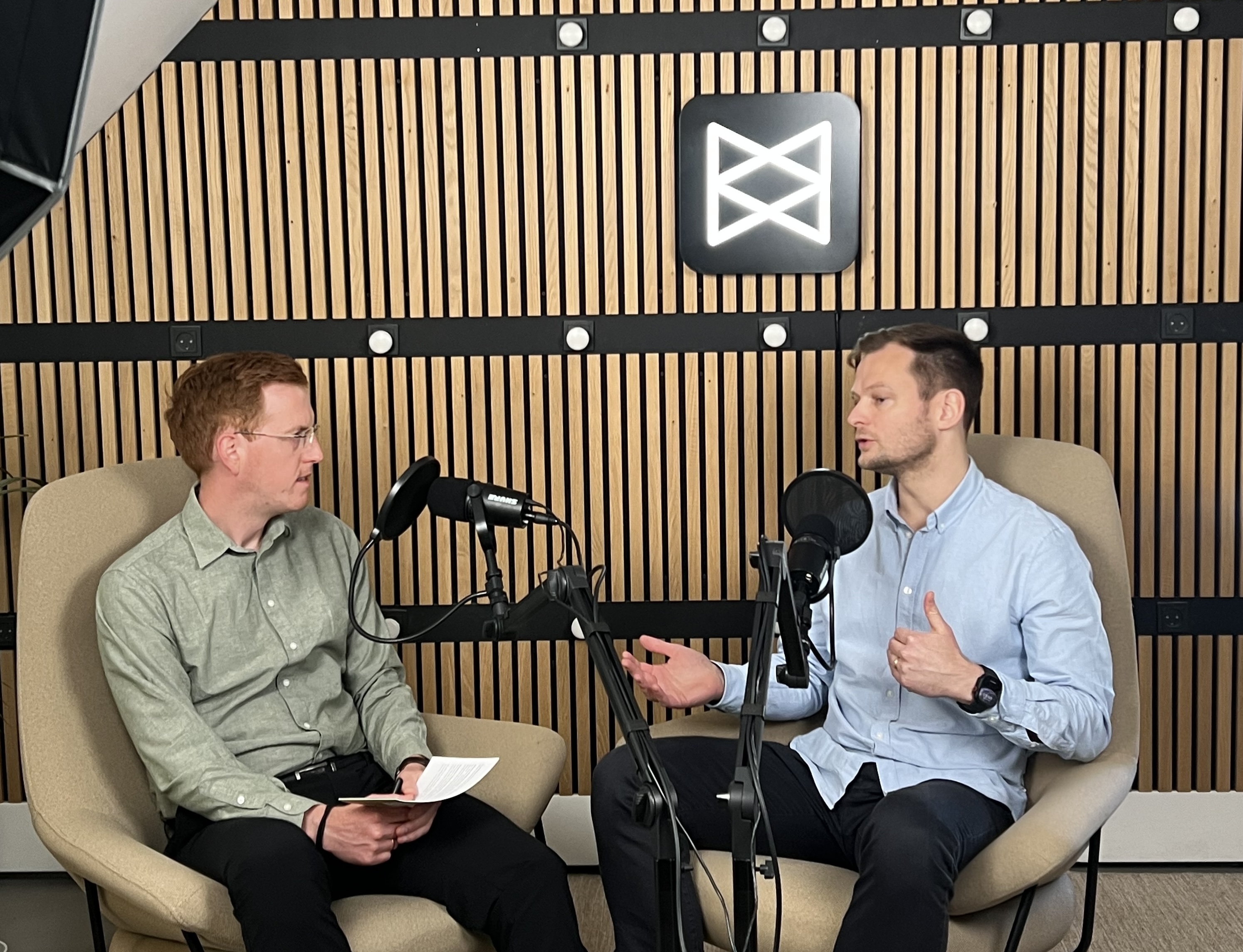
Monta COO Max Scherer on the next five years of EV charging – and what it’ll take to make it pay off.
When Sebastian Henßler – one of the most-read EV journalists in the DACH market came to Monta’s Copenhagen HQ recently, the hour-long conversation went where most podcasts about EV charging don’t.
Not roadmaps. Not feel-good market forecasts. Instead: The unit economics of running a charging business. The 20% of public charging sessions that still fail. The €25-per-session revenue line and the €2-€10-per-call support cost that quietly erases it. The reason most charging operators don’t differentiate on hardware or electricity price, even though that’s what most of the industry talks about.
Five things stood out.
1. Hardware isn’t where operators win or lose
Buy hardware well. Get your electricity cheap. Keep your supply chain tight. Most competent operators do all three. None of it decides whether the business is profitable.
What does, Max argues, is operating cost per charge point. How many drivers can one employee serve? How efficiently can a fleet manager move from handling ten drivers to handling ten thousand? Can the reimbursement flow plug into a payroll system without manual reconciliation?
“In public charging, software plays a role – but only one of many. In every other case, software plays a huge role, because that’s where you get economies of scale. And in EV charging, most charging doesn’t happen publicly. It happens at the office, at home, in front of the supermarket, wherever.” – Max Scherer, COO
That last point is worth sitting with. The headlines focus on public fast-charging hubs. The volume – and the operating-cost lever – sits everywhere else.
2. AI is already paying for itself
The unit economics of driver support are brutal. A single call to a support centre costs between €2 and €10. The average charging session is worth €25. Any session that creates a support event has already wiped out a meaningful share of its own margin.
Monta’s own AI Driver Support – now live across every market we operate in – picks up in under a second, answers roughly 80% of all incoming calls for operators who opt in, and resolves four in five of them in the conversation itself. It speaks thirteen languages out of the box, hands off to a human agent (in either party’s language) when it can’t, and is included in the base product to Monta operators at no extra cost.
“It’s a moment where technology actually delivers. People know they’re talking to an AI agent. They don’t care – they just want their problem solved.” – Max Scherer, COO
Behind the scenes, the NOC Agent does something less visible but arguably more important. It pulls millions of charging session records, OCPP (Open Charge Point Protocol) logs, hardware manuals, and prior support resolutions, and produces a root-cause analysis in seconds. The hardware-firmware combination that overheats on this charge point model? It surfaces. The firmware update that fixes it? It’s the proposed action. The next step toward predictive maintenance – fixing things before drivers ever know they were broken – is built on the same data.
3. Migration is the engine, not the exception
Most growth narratives in software talk about the new market. Max’s framing is the opposite: more than 70% of Monta’s growth comes from operators switching off other platforms. Around 100,000 charge points have migrated to Monta to date. One US operator cut their operating costs by 50% just by changing providers.
Migrations aren’t pretty – Max compared the decision to switching off SAP. The data has to be clean. The functional mapping has to be precise. There’s a single-day cutover, and a “Hypercare” 24/7 phase afterwards. Operators don’t make this decision lightly, which is precisely why being the destination platform matters so much commercially.
4. The next three to five years
The most interesting predictions in the conversation were about the things the industry hasn’t fully reckoned with yet.
The failure rate. One in five public charging sessions still fails. That number has to get below one in a hundred. “There is no alternative, honestly,” Max said. It’s a multi-stakeholder problem – operators, eMSPs (e-Mobility Service Providers), payment terminals, aggregators all have to align – and it’s the single biggest threshold between today’s market and a mass-market one.
Dynamic pricing. Early adopters are fleet drivers, who don’t shop on price. The mass market will. Dynamic electricity prices will prevail, and the operators who win will be the ones whose software lets them stay profitable while being transparent about it.
V2G and V2H. Vehicle-to-grid and vehicle-to-home aren’t a future feature. They’re a tick-box on a platform shortlist. They have to just work.
5. The one thing operators can’t afford to forget
Asked what an operator shouldn’t do to still be in market in five years, Max didn’t hesitate:
“Don’t forget the driver.”
It’s the simplest line in the conversation, and the easiest one to lose sight of when you’re scaling a network, a P&L, or a team. The whole rest of the conversation – the failure rate, the AI agents, the dynamic pricing, the migrations – comes back to that one principle.
Watch the full conversation
The full hour-long conversation with Sebastian Henßler is on YouTube now. Watch it here.