Annual Sustainability Report 2025
Our purpose
Monta exists to move the energy transition forward: charging infrastructure that gets people and businesses into electric vehicles, and keeps the grid in balance as renewables grow.
Monta builds and operates the infrastructure behind millions of charging sessions across Europe each year. Every one of those sessions replaces a journey that would otherwise have run on petrol or diesel. And because we aggregate charging demand, we help keep the grid in balance as more of Europe's electricity comes from renewables.
That purpose isn't adjacent to our business. It is the business model. We don't manufacture hardware, own charge points, or consume the energy that moves through them — what we build is the coordination layer beneath operator networks. Infrastructure that makes charging reliable enough for people and businesses to go electric and stay there, and that turns a network of charge points from a load on the grid into an asset that helps balance it. So every point of reliability we add, and every megawatt of flexibility we certify, moves the transition a little further along.
We hold our own operations to the same standard: reducing the footprint of how we work, and of the cloud infrastructure our product runs on. This report covers all three parts of that picture — the impact our software enables, what our own business costs, and the targets we've set ourselves.
Our approach
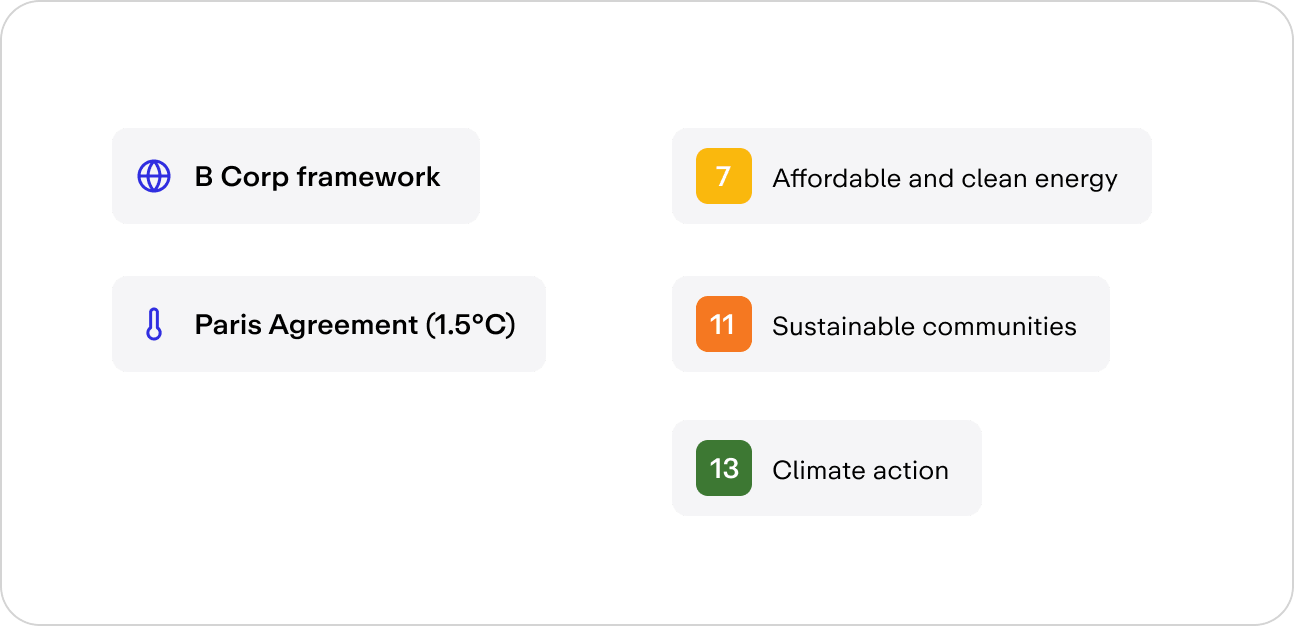
Electrification is the route to net-zero road transport, as long as two things hold: vehicle charging shifts to renewable electricity, and vehicle access scales fast enough to keep pace with 1.5°C-aligned adoption. That's where we come in. Our software makes charging accessible and reliable, and shifts demand toward the hours when renewable energy is abundant.
So growth and climate impact point in the same direction here: every new customer and charge point moves the transition forward. Growth carries an emissions cost of its own, which is why we make these choices deliberately — operating responsibly, choosing lower-impact options where we can, and measuring our footprint honestly as we scale.
Two types of targets

Enabled Impact
What our software enables across Europe's transport system. Every session replaces a petrol or diesel journey. And by pooling charge points into flexible capacity, we help the grid stabilize.

Operational footprint
The emissions our own business creates. Through 2026 we're putting the governance and measurement in place to track it, and then bring it down.
We track and publish four numbers: the avoided emissions our software enables, the energy delivered across our network, the certified flexible capacity we offer to support grid stability, and a comparable annual baseline for our own operational footprint.
Standards and frameworks
Governance
Our sustainability lead runs this work with the management team, and reports progress to the Board of Directors every quarter. The Board holds final accountability for the plan. Budget for measurement tooling or outside advice is approved by the CFO.
Stakeholder engagement
We keep the people affected by this work close to it. Monteers give input through regular surveys and feedback sessions. The Board reviews progress quarterly. Customers and suppliers get our emissions data, and we work alongside leading industry bodies, whose thinking shapes our own view of where regulation and best practice are heading.
Involvement with industry partners
Shaping the future of EV charging infrastructure across Europe.

Driving the green transition in transport and logistics.

Advancing smarter energy use across Europe.
What our software enables
Our biggest environmental contribution isn't what happens in our offices. It's what our software sets in motion across Europe's transport system, and it shows up in three ways: the CO2 avoided every time a driver charges instead of refuelling, the smart charging that moves demand to cleaner and cheaper hours, and the grid services our aggregated network provides.
CO2 emissions avoided
In 2025, charging through Monta avoided an estimated 408,499 tonnes of CO2e across 644 GWh of energy delivered and 25.3 million charging sessions. Every session replaces a journey that would otherwise have run on petrol or diesel. Decarbonisation, one charge at a time.
Growth trajectory
| Year | CO2e avoided | YoY growth * | Energy delivered | Successful charging sessions |
|---|---|---|---|---|
| 2022 | 18,413 tCO2e | — | 26 GWh | 1.3M |
| 2023 | 56,772 tCO2e | +208% | 83 GWh | 3.9M |
| 2024 | 225,041 tCO2e | +296% | 309 GWh | 13.1M |
| 2025 | 408,499 tCO2e | +82% | 644 GWh | 25.3M |
* Year-on-year growth in CO2e avoided.
Lifecycle context
Electric vehicles are cleaner than petrol cars over their lifetime, even counting what it takes to build them. Making an EV emits around 40% more CO2 up front, mostly from the battery. That's paid back after roughly 17,000 km of driving, typically inside the first one to two years. Across a full life cycle, an electric car in the EU emits about 73% less CO2 than an equivalent petrol car (63 vs 235 gCO2e/km), and that gap widens as electricity grids decarbonise. (ICCT, 2025)
We calculate avoided emissions per kWh delivered, session by session. For each charge, the CO2 avoided is the difference between what an equivalent petrol car would have emitted over the same distance and the carbon intensity of the electricity actually used. For 2022–2025, the petrol baseline is a fixed 890 gCO2 per kWh delivered, counting tailpipe emissions only, with no uplift for fuel production or transport.1 Neither side includes vehicle or battery manufacturing. Grid carbon intensity comes from Electricity Maps, at country level, at the time of each charge. Sessions without carbon intensity data are excluded entirely, so every total we report is a conservative lower bound. These figures sit separately from our operational Scope 1, 2 and 3 footprint. We never combine or net them against it.
- 1 179.8 gCO2/km, real-world on-board fuel consumption monitoring data for petrol cars registered in 2021 (European Commission, COM(2024) 122 final), × 4.95 km/kWh, real-world EV consumption metered at the charge point including charging losses (TNO 2022 R10409). Both are real-world rather than type-approval figures, and both are measured where we meter: at the charger.
Smart Charging
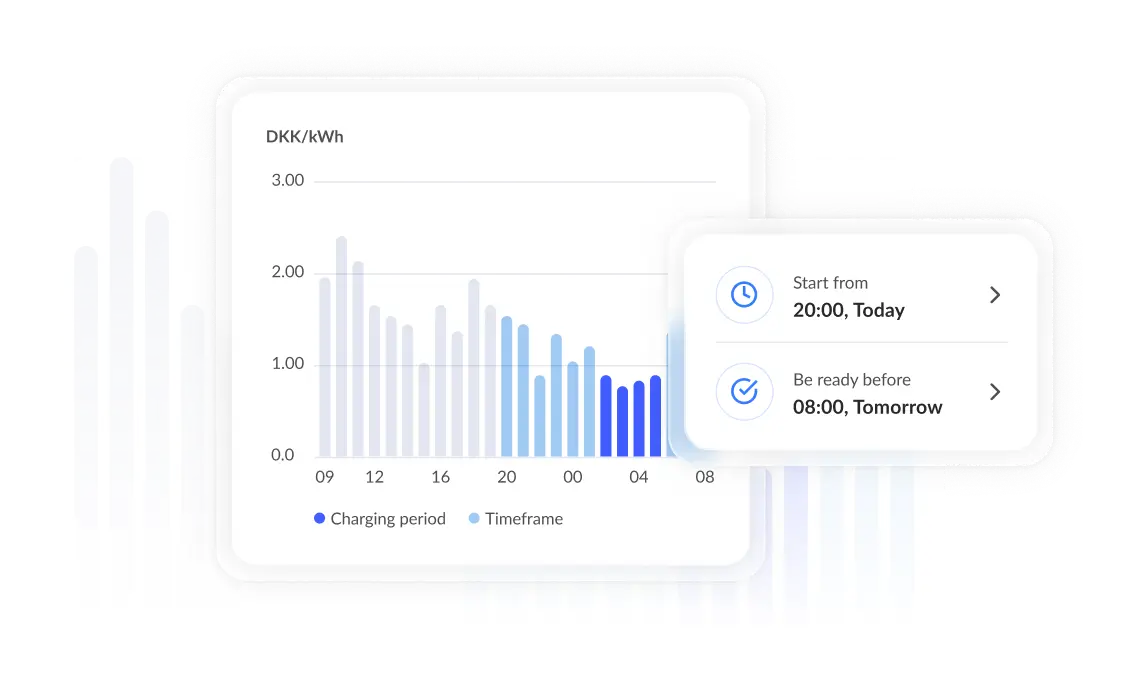
SmartCharge moves charging to the hours depending on a driver's priority: lower costs, lower CO2, or higher renewable energy. In 2025, around 2.9 million charges — roughly 12% of all successful sessions — were scheduled to better hours, and on about 434,000 of them the plan was weighted toward lower CO2 and more renewable energy. That's 14.8% of successful smart charges, holding roughly the same share as 2024.
Grid Services
This is where our infrastructure meets the energy system directly. By pooling charge points into flexible capacity, we take part in ancillary and flexibility markets across Denmark, Sweden and the United Kingdom, through three mechanisms: the FCR-D and aFRR frequency reserves in the Nordics, and the UK Capacity Market. When electricity supply and demand fall out of balance, connected charge points adjust how and when they draw power, so the network helps steady the grid and absorb variable renewable generation.
That capacity is scaling fast. We ended 2025 with 8.1 MW certified. By mid-2026 it's around 35 MW, with thousands of further charge points enrolled in UK smart-charging flexibility programmes on top. We're targeting at least 60 MW by the end of 2028, growing with new operators in the markets we already serve and potentially adding new ones.
For charge point operators, that's a new revenue stream from hardware they already own. For the grid, it's flexible capacity exactly when it's needed. We report certified capacity every year alongside the rest of our enabled impact.
Megawatts qualified to offer into ancillary and flexibility markets
Measuring and reducing our own footprint
We haven't completed a Scope 1 and 2 emissions estimate yet. Our first one covers 2026 and will be published in 2027. Once that baseline is in place, we'll prioritise at least five reduction initiatives. We expect Scope 1 and 2 to be relatively low, driven mainly by heating our Copenhagen office and our two leased electric company cars, and we'll add material Scope 3 categories as the data allows, starting with cloud services and business travel.
Existing climate policies
Lower emissions commuting
Keep 90%+ of commuting to our European offices car-free. Miami to establish a baseline from 2026.
Lower-impact business travel
Set a business travel baseline and an air travel reduction target in 2027.
Extend hardware lifecycle
Keep 100% of returned laptops in use, whether redeployed, lease-extended, or resold.
Efficient vendor and cloud costs
Review our software and cloud portfolio every year to cut waste and improve our cost per charging session.
Spotlight: sustainable commuting
Over 85% of our team commutes by bike, on foot, or by public transport.
Three programmes support that:

Electric company cars
Leased electric cars in Copenhagen and Berlin.

Company bikes
Company bikes available in Copenhagen.

Public transport benefit
A gross salary benefit for DSB public transport in Denmark.
How we work, and who we build for
Software is built by people. How we treat ours, and the drivers we build for, is part of our impact.
Who we are
Every year we run an anonymous Diversity Matrix survey, so our equity, diversity and inclusion work starts from facts rather than assumptions. The 2025 edition reached Monteers across seven countries and covers gender, age, ethnicity, religion, disability, neurodiversity, caring responsibilities, education and life experience.
The full picture, including the questions and the response breakdown, is in the report.
The 2025 survey went to 197 Monteers across seven countries: Denmark, Norway, Sweden, Spain, France, the UK and Germany. It covers full-time and part-time employees, but not external contractors. 141 of the 197 answered.
Figures are self-reported through our anonymous 2025 Diversity Matrix survey and are rounded. Every question is optional, including a “prefer not to answer” option, so response rates vary and these percentages describe survey respondents rather than the full workforce.
Fair work at Monta
Monta is an equal-opportunity employer, and our commitments on equity, diversity and inclusion, and on human rights, apply everywhere we employ people. In practice, that starts with the basics. Every Monteer has a written contract, a clear job level, and open salary bands set against objective criteria and applied consistently across locations. We hire through structured, bias-aware interviews, and we never ask candidates for their salary history. Parental, adoption, compassionate and sick leave are available in every location, reviewed for fairness across countries rather than defaulting to the local minimum. There's more on working here, including benefits and how we hire, on our careers page.
Belonging, led by our people
Our employee resource groups are started and run by Monteers, with resourcing and sponsorship from People & Culture rather than direction from above. Women@Monta and Parents@Monta are both active, and colleagues also organise as LGBTQ+ allies. Any Monteer can propose a new group through our ERG framework.
How we listen and act
Listening
- Annual anonymous Diversity Matrix survey.
- A dedicated equity, diversity and inclusion feedback route open to all Monteers.
- Our whistleblower system, open to employees, customers, suppliers, partners and the public.
Acting
- Survey findings and Monteer feedback set the priorities in our Equity, Diversity and Inclusion action plan.
- The plan is reviewed at least annually, shared with all Monteers, and available to them at any time.
- Accountability sits with the executive team, coordinated by People & Culture.
Raising a concern
Everyone, from an employee to a supplier, should be able to raise a concern with us anonymously and without fear of retaliation. Reports through our whistleblower channel are taken seriously, investigated, and resolved promptly. Raise a concern here.
Accessibility
Charging has to work for every driver, so we treat accessibility as a product requirement, not a retrofit. Monta Charge, our Whitelabel apps, Monta Hub and our websites are aligned with the European Accessibility Act and built to WCAG 2.2 Level AA: colour contrast, zoom, keyboard navigation, focus states, screen-reader labelling and touch-target sizing. A certified accessibility auditor validated that work. We publish a public accessibility statement, maintain VPAT/ACR documentation for our key products, run routine audits, and have completed compliance projects for both the European Accessibility Act and the Americans with Disabilities Act.
Inside Monta, we support colleagues with disabilities through reasonable accommodations and inclusive office design.