
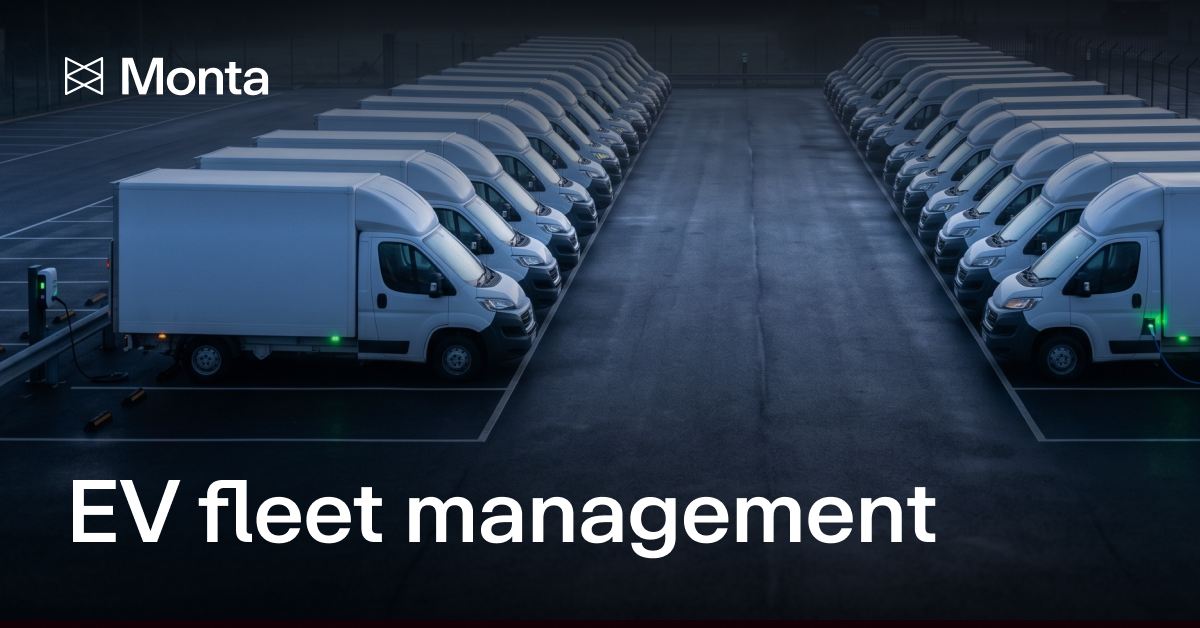
EV fleet management refers to the systems, tools, and operational strategies used to monitor, charge, maintain, and optimise a fleet of electric vehicles across commercial operations. Electric vehicle fleet management integrates telematics, charging coordination, energy scheduling, maintenance tracking, and performance analytics to ensure vehicles remain available and cost-efficient. EV fleet management software centralises vehicle data, charge point status, battery state of charge, route assignments, and energy usage into a unified dashboard for operational control. The primary purpose of EV fleet management is to lower operating costs through lower energy and maintenance expenses, improve vehicle utilisation and uptime, and support corporate sustainability targets by reducing emissions across transport operations. Data-driven decision-making enables fleet managers to align charging schedules, grid capacity, and duty cycles to maximise efficiency and long-term financial performance.
What is EV fleet management?
EV fleet management is the coordinated planning, monitoring, and optimisation of electric vehicle operations, charging infrastructure, energy use, and performance across a commercial or public fleet. The system integrates telematics, charging management platforms, route scheduling, and energy management tools to control vehicle deployment, battery state of charge, charging timing, and operational costs.
EV fleet management ensures vehicles meet daily duty cycles while minimising downtime, electricity expenses, and peak demand charges. The approach relies on data-driven decision-making to optimise range planning, charge point utilisation, maintenance scheduling, and grid interaction, which improves overall efficiency and total cost of ownership compared with unmanaged electric fleet operations.
Why are businesses electrifying their fleets?
Businesses are electrifying their fleets to reduce operating costs, meet regulatory emissions requirements, and improve long-term energy cost predictability. Fleet electrification lowers fuel expenses because electricity costs per kilometre are significantly cheaper than petrol or diesel, particularly when charging occurs during off-peak periods. Electric drivetrains reduce maintenance costs due to fewer moving parts, no oil changes, and less brake wear.
Corporate sustainability commitments, carbon reduction targets, and government mandates accelerate adoption across logistics, delivery, utilities, and public transport sectors, where fleet electrification supports measurable emissions reduction. Incentives, grants, and tax benefits further improve the total cost of ownership. Electrification strengthens brand positioning, supports compliance with low-emission zones, and prepares businesses for stricter future environmental regulations.
What are the core components of an EV fleet management system?
The core components of an EV fleet management system are listed below.
- Fleet management software dashboard: A centralised EV fleet charging management software dashboard provides real-time visibility into vehicle status, charging activity, energy use, route performance, and cost metrics. The platform consolidates operational data and enables scheduling, reporting, and performance optimisation across the fleet.
- Telematics and vehicle tracking: Telematics devices transmit vehicle location, battery state of charge, energy consumption, driving behaviour, and fault alerts to the management platform. Accurate telemetry supports route planning, range monitoring, predictive maintenance, and utilisation analysis.
- Charging infrastructure (AC and DC fast charge points): AC depot charge points support overnight energy replenishment, while DC fast charge points enable rapid turnaround for high-utilisation or multi-shift operations. charge point hardware connects to backend systems to provide authentication, load balancing, and session monitoring.
- Energy management systems: Energy management software controls power distribution across charge points, manages peak demand, integrates renewable generation, and schedules off-peak charging. Load balancing prevents grid overload and reduces electricity costs.
- Maintenance tracking and reporting tools: Maintenance modules monitor vehicle diagnostics, service intervals, charge point uptime, and fault notifications. Automated reporting supports regulatory compliance, warranty tracking, and cost control.
What software is used for EV fleet management?
EV fleet management uses integrated software platforms that combine telematics, charging management, energy optimisation, and fleet analytics into a unified system. Core software includes fleet telematics platforms that track vehicle location, battery state of charge, energy consumption, and route performance in real time. Charging management systems coordinate depot charge points, control load balancing, schedule off-peak charging, and monitor charge point uptime. Energy management software manages demand response, peak shaving, and integration with renewable generation or on-site storage.
Commercially used platforms include ChargePoint Fleet, Shell Recharge Fleet Solutions, BP Pulse Fleet, Siemens eMobility management systems, and dedicated telematics providers such as Geotab and Samsara. Advanced deployments integrate enterprise fleet management systems with charging backend software through API connections to support automated reporting, maintenance tracking, and total cost analysis. Choosing an EV charging management software depends on fleet size, charging complexity, multi-site coordination needs, and grid capacity constraints.
Does EV fleet management require telematics?
Yes. EV fleet management requires telematics to monitor vehicle location, battery state of charge, energy consumption, charging activity, and operational performance in real time. Telematics systems transmit vehicle data to a central platform, which enables route optimisation, charging coordination, maintenance tracking, and utilisation analysis. Accurate telemetry improves scheduling decisions, prevents range shortfalls, and supports cost control through data-driven energy management. Fleet operators that deploy EV telematics gain measurable improvements in uptime, operational efficiency, and total cost oversight compared with fleets that rely on manual tracking.
What is smart charging in EV fleet management?
Smart charging in EV fleet management is the automated control and scheduling of vehicle charging sessions using software-driven load balancing and energy optimisation systems. Smart charging platforms dynamically allocate power across multiple charge points based on vehicle state of charge, departure time, site capacity, and electricity tariff windows. Automated scheduling shifts charging to off-peak electricity periods, which lowers per-kilowatt-hour costs and reduces peak demand charges.
Load balancing prevents simultaneous high-power charging from exceeding site electrical limits, which protects transformers, switchgear, and distribution circuits from overload. Controlled power distribution stabilises grid interaction and eliminates the need for unnecessary infrastructure upgrades. Fleet operations reduce operational costs through smart charging by lowering energy expenses, avoiding demand penalties, and improving charge point utilisation efficiency across the fleet.
Can EV fleet management integrate renewable energy?
Yes. EV fleet management can integrate renewable energy by connecting charging infrastructure to on-site solar generation, wind systems, or renewable energy supply contracts. Depot charging systems prioritise energy drawn from rooftop solar arrays during daylight hours and store excess generation in battery energy storage systems for later use. Energy management software coordinates vehicle charging schedules with renewable production to reduce grid dependence and lower operating costs. Integration improves energy cost predictability, supports emissions reduction targets, and strengthens long-term sustainability strategies for fleet operators.
How many charge points are needed for EV fleet management?
The number of charge points required for EV fleet management depends on fleet size, average daily mileage, vehicle dwell time, shift structure, battery capacity, and charging power level. A fleet operating single daily shifts with long overnight parking may require one charge point for every one to three vehicles when using managed AC depot charging. Multi-shift or high-mileage fleets that require rapid turnaround often need a higher charge point-to-vehicle ratio, particularly when DC fast charging is used to minimise downtime.
Staggered charging schedules reduce the total number of charge points by rotating vehicles through available units during off-peak windows. Shared charging strategies allow multiple vehicles to use the same charge point at different times, provided dwell periods are sufficient. Load management systems further optimise utilisation by balancing power across charge points without overloading site capacity.
A detailed load and utilisation analysis should be conducted before infrastructure deployment to model energy demand, charging windows, peak load impact, and fleet availability requirements. Data-driven planning ensures the correct charge point quantity, power level, and electrical capacity are installed without oversizing infrastructure or constraining operations.
How much does an EV fleet management system cost?
An EV fleet management system typically costs between £60,000 and £600,000+ upfront ($75,000 to $750,000+, €65,000 to €650,000+) for a small to mid-sized depot deployment, with ongoing operating costs added monthly. Total pricing depends on fleet size, charge point power level, grid capacity, and system integration requirements.
Fleet management and charging management platforms generally cost £10 to £40 per vehicle per month ($12 to $50 / €11 to €45), depending on reporting depth, load management tools, and API integrations. Vehicle telematics devices typically cost £150 to £400 per vehicle ($180 to $480 / €165 to €440) upfront, with optional data plans of £5 to £20 per vehicle per month ($6 to $25 / €6 to €22). AC depot charge points range from £1,000 to £5,000 per unit ($1,200 to $6,000 / €1,100 to €5,500). DC fast charge points range from £25,000 to £120,000 per unit ($30,000 to $145,000 / €27,000 to €130,000). Megawatt-scale systems exceed these ranges significantly. Civil works, transformers, switchgear, cabling, and grid upgrades can cost £20,000 to £300,000+ ($25,000 to $360,000+ / €22,000 to €330,000+), depending on site readiness and power demand.
Ongoing maintenance contracts typically range from 5% to 10% of hardware value annually, covering inspections, software updates, and technical support. Pricing increases with larger fleets, higher power requirements, advanced load management systems, and complex multi-site deployments. Smaller fleets with overnight AC charging and minimal grid upgrades remain at the lower end of the cost range, while high-utilisation logistics or transit operations require significantly higher capital investment.
What is the upfront cost of an EV fleet management system?
The upfront cost of an EV fleet management system typically ranges from £50,000 to £500,000 ($60,000 to $600,000 / €55,000 to €550,000) for small to mid-sized depot deployments, depending on fleet size, charge point power level, grid upgrades, and software integration.
Hardware costs for depot charge points generally range from £1,000 to £5,000 ($1,200 to $6,000 / €1,100 to €5,500) per AC charge point and £25,000 to £120,000 ($30,000 to $145,000 / €27,000 to €130,000) per DC fast charge point. Electrical infrastructure upgrades, transformers, switchgear, trenching, and civil works can add £20,000 to £300,000+ ($25,000 to $360,000+ / €22,000 to €330,000+) depending on grid capacity requirements.
Software platform setup, system integration, telematics configuration, and commissioning services typically add £5,000 to £50,000 ($6,000 to $60,000 / €5,500 to €55,000). Total capital expenditure varies based on charge point quantity, power demand, site readiness, and fleet expansion planning.
What is the operating cost of an EV fleet management system?
The operating cost of an EV fleet management system typically ranges from £10 to £40 per vehicle per month ($12 to $50, €11 to €45) for software platforms, telematics integration, monitoring, and reporting tools. Charging network management platforms for commercial depots can add £200 to £1,000 per site per month ($250 to $1,250, €220 to €1,100), depending on charge point count, load management features, and support agreements.
Total operating cost includes software licensing, data connectivity, charge point maintenance, backend transaction fees, energy management systems, and periodic service inspections. High-power fleet depots with advanced load balancing and energy optimisation tools incur higher platform costs, while small fleets using basic monitoring systems remain at the lower end of the range. Overall system operating expenses typically represent a small percentage of total fleet operating cost compared with vehicle energy savings and reduced maintenance expenditure.
How do electricity costs compare to fuel in EV fleet management?
Electricity costs in EV fleet management are typically 40% to 70% lower per kilometre than petrol or diesel when vehicles charge under commercial or off-peak electricity rates. A typical electric van consumes about 18–22 kWh per 100 km, which at £0.10 ($0.12, €0.11) per kWh results in an energy cost of approximately £1.80–£2.20 ($2.16–$2.64, €1.98–€2.42) per 100 km. A comparable diesel van consuming 7–9 litres per 100 km at £1.50 ($1.80, €1.65) per litre costs roughly £10.50–£13.50 ($12.60–$16.20, €11.55–€14.85) per 100 km, which is substantially higher.
Off-peak charging rates as low as £0.07 ($0.08, €0.08) per kWh reduce electricity costs even further, strengthening total cost advantages. Regional electricity tariffs, fuel taxation, wholesale energy markets, and demand charges influence the final comparison, but electricity consistently delivers lower per-kilometre operating costs for high-utilisation fleet operations when charging is properly scheduled.
Is EV fleet management cost-effective?
Yes. EV fleet management is cost-effective for high-utilisation operations because electricity costs per mile are significantly lower than diesel or petrol, and electric drivetrains reduce maintenance expenses due to fewer moving parts and less brake wear. Fleets with predictable routes and high annual mileage recover upfront vehicle and charging infrastructure costs faster through fuel savings and operational efficiency. Total cost advantages depend on vehicle usage, electricity pricing, incentive availability, and effective load management, but well-planned deployments consistently demonstrate lower long-term operating costs compared with traditional internal combustion fleets.
What is the ROI of EV fleet management?
The return on investment (ROI) of EV fleet management typically ranges from 10% to 30% annually after infrastructure deployment, with full payback commonly achieved within 3 to 7 years for high-utilisation fleets. ROI is driven by lower fuel costs per mile, reduced maintenance expenses due to fewer moving parts, lower brake wear, and available government incentives. Delivery, logistics, transit, and utility fleets with high annual mileage generate the strongest returns because energy savings compound quickly. Total ROI depends on vehicle purchase price, charging infrastructure cost, electricity rates, demand charges, utilisation levels, and operational efficiency. Data-driven fleet analysis determines the precise financial outcome for each deployment.
How long does it take to break even with an EV fleet?
Break-even for an EV fleet typically occurs within 3 to 7 years, depending on vehicle utilisation, fuel displacement savings, electricity pricing, incentive availability, and infrastructure costs. High-mileage fleets, such as delivery, logistics, and transit operations, reach break-even faster because fuel and maintenance savings accumulate more quickly than in diesel or petrol vehicles. Lower annual mileage, high upfront infrastructure investment, or limited incentives can extend the break-even period beyond seven years. Total cost of ownership analysis, including vehicle purchase price, charge point installation, grid upgrades, maintenance reduction, and energy cost savings, determines the exact timeline for each fleet deployment.
How do companies transition to EV fleet management?
Companies transition to EV fleet management through a structured rollout that aligns vehicle capability, charging infrastructure, and operational planning with real duty cycles. Fleet leadership starts by assessing fleet suitability through route analysis, payload requirements, dwell-time patterns, and depot return behaviour to determine which vehicles can electrify first. Cost analysis then compares the total cost of ownership across electricity, maintenance, incentives, charge point installation, and grid upgrade requirements to establish a financial baseline.
A pilot programme follows to validate range performance, charging time, uptime, and driver workflow under live operating conditions, supported by telematics and charging data. Charging infrastructure deployment then focuses on site electrical capacity, charge point selection, load management, and utility coordination to support reliable depot operations. Driver and technician training standardises charging procedures, safe handling, and energy-efficient driving practices to protect uptime and range predictability. Gradual scaling expands the EV fleet in phases based on measured performance, cost outcomes, and infrastructure readiness, using ongoing data tracking to refine routes, charging schedules, and procurement decisions.
What industries benefit most from EV fleet management?
The industries that benefit most from EV fleet management are listed below.
- Last-mile delivery services: Short, repeatable urban routes define last-mile delivery services, where fleets operate with predictable daily mileage that makes battery range planning reliable and depot charging practical. High stop frequency and dense delivery zones increase fuel consumption in conventional vehicles, so electric fleets reduce operating costs and maintenance intensity in city environments.
- Logistics and distribution operators: Fixed regional routes characterise logistics and distribution operators, where fleets move between depots, warehouses, and retail locations under structured schedules that support overnight charging and controlled energy management. High annual mileage improves the total cost of ownership economics when electricity replaces diesel in consistent duty cycles.
- Public transportation authorities: Scheduled service patterns shape public transportation authorities, where bus and transit agencies operate defined routes with planned dwell times at depots or terminals that enable structured charging windows. Predictable operations and high daily mileage improve cost recovery and emissions reduction performance.
- Utilities and field service fleets: Planned maintenance routes and regular depot returns support utilities and field service fleets, where vehicles follow controlled dispatch cycles that simplify charging coordination and energy planning. Fleet electrification aligns with corporate sustainability objectives while reducing fuel and maintenance costs across high-utilisation service vehicles.
- Municipal and government services: Defined service territories distinguish municipal and government services, where refuse collection, street maintenance, and inspection fleets operate repetitive routes within controlled geographic zones. Stable mileage profiles and return-to-base operations make electric fleet management practical and cost-effective compared with traditional fuel fleets.
What are the challenges in managing an EV fleet?
The challenges in managing an EV fleet are listed below.
- High infrastructure investment: EV fleet deployment requires capital for charge points, electrical upgrades, transformers, and site works. Traditional fleets primarily invest in fuel storage or depot tanks, which usually involve lower electrical integration costs.
- Grid capacity limitations: Fleet depots often require service upgrades, new feeders, or demand management systems to support high charging loads. Diesel fleets rely on fuel delivery logistics rather than electrical capacity constraints.
- Charging downtime and scheduling complexity: Vehicles must be scheduled around charging windows, dwell time, and power availability. Internal combustion fleets refuel quickly, which reduces operational planning complexity.
- Range planning and operational certainty: Route assignments must align with battery capacity, terrain, payload weight, and climate conditions. Conventional fleets depend on widely available fuel stations and predictable refuelling time.
- Demand charges and energy cost volatility: Peak electricity demand can significantly increase operating costs if charging is not managed properly. Traditional fleets face fuel price volatility, but do not encounter electrical demand penalties.
- Charge point reliability and uptime: Fleet performance depends on charge point availability and maintenance response times. Internal combustion vehicles rely on established fuel infrastructure with minimal operational downtime risk.
- Driver training and behavioural adaptation: Drivers must understand energy-efficient driving, charging procedures, and state-of-charge management. Traditional fleet drivers typically require less technical training related to refuelling.
- Technology integration and data management: EV fleets depend on telematics, charging software, load management systems, and energy reporting tools. Conventional fleets rely more heavily on fuel tracking and maintenance scheduling systems without electrical coordination requirements.
What are the best practices for EV fleet optimisation?
The best practices for EV optimisation are listed below.
- Route and duty cycle analysis: Fleet managers must analyse route length, dwell time, payload demand, and daily energy consumption before vehicle deployment. Accurate duty cycle modelling ensures vehicles match operational requirements and prevent range shortfalls.
- Right-sizing battery capacity: Battery capacity should align with real operational needs rather than maximum theoretical range. Proper sizing reduces upfront capital cost and avoids unnecessary vehicle weight.
- Strategic charging infrastructure planning: Charging locations must be positioned based on depot return patterns, opportunity stops, and corridor requirements. Infrastructure design should balance AC depot charging with higher-power DC where turnaround speed is critical.
- Load management and grid coordination: Smart load management systems should distribute power across charge points to prevent peak demand spikes. Coordinated charging schedules reduce demand charges and improve grid stability.
- Data-driven energy monitoring: Telematics and charging software should track energy use, charging duration, state of charge, and vehicle availability. Performance analytics support predictive maintenance and cost control.
- Driver training and operational alignment: Drivers must follow structured charging procedures and energy-efficient driving practices. Consistent operational discipline improves range predictability and reduces charging disruption.
- Preventive maintenance and uptime management: Routine inspection of charge points, connectors, and electrical systems ensures reliability. High charge point uptime directly improves fleet utilisation and schedule adherence.
- Scalability and future-proofing: Infrastructure should allow power upgrades, additional charge points, and software integration as fleet size expands. Flexible system design protects long-term investment and operational continuity.